Showing posts with label Kostova. Show all posts

Thursday, July 12, 2012

The Swan Thieves

Title: The Swan Thieves
Author: Elizabeth Kostova
Year: 2009
Genre: Thriller/Mystery
Rating: 1


Passion faded, love lost. The question rises, is there anything more real than this moment? Has everything reported before this second disappeared into fiction, and if not, how can something that you've never seen be as real as the hands you hold out before you, the color of your skin, the moisture of your lips? All the hundreds of millions of lives that began and ended before you were a single cell don't make sense to you, with all their myriads of emotions swirling, pulsing, and disappearing without any more trace than a wind that ripples your hair.
With the quiet grace of Kazuo Ishiguro and the dark strength of Philip Pullman, Elizabeth Kostova's second novel The Swan Thieves ponders the impact of history on the present. Subtle and sweeping, the novel of painters and their lives quivers with the life that Kostova says painters strive to evoke in their works. Kostova has vastly outdone herself from The Historian, although her style remains her own, vague and moving.
The book is largely told from the perspective of a middle-aged psychologist, Dr. Andrew Marlow, who receives a patient by the name of Robert Oliver who attempted to attack a painting in the National Gallery. Marlow is stymied in his treatment of Robert by the patient's refusal to speak at all, and is mystified as to why Robert will only paint portraits of a dark-eyed woman. Marlow's quest to cure this one patient leads him from DC to North Carolina, New York City, and Paris, all the while wondering if this man is insane or simply misunderstood.
Along the way, we slowly discover the seemingly disconnected story of Beatrice de Clerval and Olivier Vignot, two rather unknown painters from nineteenth-century France, linked by invisible ties to the present and the madness of the man who paints endless portraits.
Kostova is one of the finest novelists of our time. Although we are aware vaguely that Robert Oliver is one of the main characters of the book, we are introduced to him only through the memoirs of those who knew him, as if we are discovering him for ourselves after the fact. Robert Oliver is like an event in the lives of those he has touched; they remember him vividly, all of his actions, his mannerisms, his faults and wonders. By the end of the novel, although we only hear him actually say about a paragraph's worth of words, Robert Oliver is as familiar as Marlow, the man we've known from the first.
A master of the first person, Kostova has clearly thought out each character to the ends of their souls. The clear shifts in voice from person to person display an understanding of her own work rarely shown, and a strong reason for each word. Nothing that occurs in The Swan Thieves is arbitrary or by accident; a clear sense of purpose permeates the air of the story. Even the minor characters have a defined role to play, and once this is complete, they gracefully turn away to their own lives. That is perhaps the most beautiful thing about this novel: each character is a person, full of a life beyond the pages written.
That is certainly not the only beautiful thing, though. Some of the words that would apply best to this novel are marvelous, spectacular, and aesthetic. With the knowledge of an experienced author, Kostova describes dozens of masterworks of the painting world to us, but the most exhilarating aspect is the pure pleasure of the writing. Some of the passages, especially those of Beatrice, are moving enough to take the reader's breath away; others are so deep and thoughtful that the reader is compelled to stop and think about the questions raised for a moment before continuing.
To say this novel is intricate would be an understatement. From specifying the year and artist of vague paintings to the dates of birth of the fictional Beatrice de Clerval (she is a synthesis of Berthe Morisot and some of the other Impressionists), Kostova has provided us a net of facts, times, and little details that make the novel into an impressive reality for the readers as well as the characters. Her presumptions on the museums of Paris impress the thought that is really is okay for novelists to add their own facts to real places and events-- it is only fiction, after all.
The Swan Thieves is not only a better novel but is a step forward for the author from The Historian. More complete and rife with emotion, the dark elements so characteristic to the story of Dracula take on a softer, more human edge in the tale of Robert Oliver. The whole story itself feels more complete, with matching segments on both ends, and the connected elements of foreshadowing and prediction that her previous novel lacked. But perhaps most importantly, she has understood her readers as well as her fictions: we are all just people, seeking to understand ourselves in relation to history and the world around us.
This novel is fairly recent and well known, so it will probably be hard to find at a library. I managed to snag my hardback copy for $6.95 at a Barnes and Noble clearance, but according to Amazon you can get it for $9.99 on the Kindle or $10.33 for a hardback copy of your own. Do purchase it, and follow Elizabeth Kostova. I expect that her next novel will be even more enchanting.

Thursday, April 19, 2012

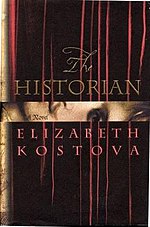
The Historian

Title: The Historian
Author: Elizabeth Kostova
Year: 2005
Genre: Fiction/Mystery/Thriller
Rating: 2

If we're sick of vampires, that's only because we've got a reason to be, after Twilight and "True Blood" and the absolute cultural obsession with the occult. But every once in awhile, there's an intellectual who focuses on the subject, because underneath all the pop culture, it is an interesting one.
Elizabeth Kostova's debut novel The Historian preceded the undead craze by a few years, and took a very intellectual, analytical approach to the legend of Dracula. Bram Stoker originally handled the 15th century Romanian myth in his 19th century novel, but Kostova reimagines the story with a gracious amount of research and historical context. The novel is wide-spanning, painting a picture of two different worlds-- tense Cold War Europe and the tenser 15th century Ottoman takeover.
Although it takes awhile to fall into the structure of this novel, it soon flows easily between your fingers, like intertwined threads. The story follows a young woman (who remains unnamed throughout the book) as she gradually discovers her father's deep research on Vlad Tepes, better known as Vlad the Impaler, better known as Dracula. Her father, Paul, haltingly tells her the flashbacks to 1954 of his unfortunate adviser at a New York university, Bartolomeo Rossi, who started him on this road before disappearing without a trace. From there, Paul meets a young Romanian woman named Helen who accompanies him in his search for the undead, legendarily cruel Dracula. Their road takes them across Eastern Europe, from Istanbul to Budapest and and back, and the truth becomes darker and more bloody with the more they discover.
The chapters of Paul's tale are interspersed with the tale of his daughter, who becomes caught up in his research on the Transylvanian vampire, and the occasional document or letter from Paul or Rossi. The novel is broken up into three parts, but there are no real cliffhangers or time jumps separating the parts, which is reminiscent more of a term paper than a novel.
Mrs. Kostova, an American, has certainly done her research. The novel is the work of ten years of her life, and her meticulous writing and composition shows in the style and gravity. Each of the places mentioned is real enough to touch; one can almost feel the sun in Istanbul, hear the voices of the singers in Bulgaria, and feel the wind off of the ominous Lake Snagov. She mentions dozens of scholarly papers and works on Dracula in as many languages, some of which are lost or fragmented. The dedication of the novel relates that Mrs. Kostova first gained interest in the character from the tales that her father told her of the Eastern European legends of the undead.
The novel could easily have been a hundred more pages. There is a lot of material here, and despite the 642-page length, it feels condensed. At the beginning, we're eased into the background, like lowering oneself slowly into hot bathwater, but toward the end, all of the important plot points happen in the space of about twenty pages. It's actually fairly disappointing. The whole novel is a great story, with so much to interest, and whole cultures that have been shut off to us by the Iron Curtain for years. Kostova does not sidle around the issue of language-- she includes snippets of Hungarian, Turkish, Bulgarian, German, French, and Romanian, making an almost cheeky point about the state of American linguistics (as the old joke goes, what do you call someone who speaks one language?). Fortunately, she smoothly provides translation that makes sense for us, and the novel never comes unglued with unexplained mysteries.
Oh, wait. The only mystery she doesn't touch is how Dracula became undead in the first place.
To a degree, it's the novelist's job to delve into mysteries and secrets that have been close-guarded, but in this case, it seems more respectful than anything. She's created a whole tale around a foggy legend, and it only seems fair that she leave one mystery to keep the original tale interesting and gripping to future generations.
The book largely sticks to its story without too much philosophizing, but she can't help but stray into the realm of deep thought at the end, when a character poses the question of good versus evil. Good is not perfectible, but evil is, so why not strive for the thing that you can make perfect? Temptation, darkness, reason, and inner conflict... it all concatenates in this one line, a tear in the neat fabric of the mystery before returning to the plotline. It shows an admirable amount of restraint-- this book alone could merit a term paper on the essence of life, death, evil, cruelty, et cetera, but Mrs. Kostova's primary goal is to tell the story. Like the great novelists, she leaves it to us to draw our own conclusions from what she's written.
After all, she is only the historian.
This fabulously dark work is available on the Kindle for $9.99, or from barnesandnoble.com for $6.28. I had to wait a long time to get it from my library because a lot of people want to read it, so I would advise buying it, because it's worth a couple of reads.