Showing posts with label science. Show all posts

Saturday, June 8, 2013

The Left Hand of Darkness

Title: The Left Hand of Darkness
Author: Ursula K. Le Guin
Year: 1969
Genre: Science fiction
Rating: 2

The concept of negative space is confusing. Who ever heard of calling nothing something? And yet, in art, the first thing you learn is how to use negative space to define the positive space. In sociology, this often translates in a negative way: we define ourselves by what we're not, creating an "us" and an amorphous "them." But, reflecting back, don't we need "them" to be "us?"
In her 1969 novel The Left Hand of Darkness, Ursula K. Le Guin presents us with a conundrum of a people so foreign that they can't possible be us, but still strikingly human. 44 years later, the theme of cultural understanding in the novel still rings eerily true, with the marriage equality battle and more and more international contact every day.
Tucked neatly between several of her other science fiction Hainish novels, the story takes place on a frozen planet called Gethen, or colloquially Winter. The people of Winter are human in every way except one: they are physiologically bisexual, meaning that they are essentially androgynous but hermaphroditic and can change gender during a sexual phase of each month. While this is initially shocking to any reader– our lives are so dictated by our genders, it's nigh impossible to imagine not having one– this is essentially the point. The main protagonist of the novel, Genly Ai, is a human envoy sent to prepare the planet to join a coalition called the Ekumen. He is, however, the only human with a fixed gender on the planet, isolating him so completely that he is forced to reevaluate how he sees other life forms. In his negotiations to prepare the planet to join, he meets with insane kings, curious exiles, double-crossing diplomats and prisoners on the brink of the world.
One thing to note is Le Guin's brilliant use of the first person. Much of the time, when novelists revert to first person to tell a story, it becomes borderline autobiography, or the character at least becomes a direct reflection of the author. Not so here; Genly is a clear, strong voice, distinct from Le Guin's protagonists in her other works (such as the fabulous A Wizard of Earthsea cycle and Rocannon's World). She also departs from Genly to tell the story through the other main protagonist, Estraven, a resident of Winter, and to use "documents" to illustrate the fullness and history of Winter and its people. A full chapter about halfway through the book describes in detail the sexual functions of the people, which is incredibly helpful and interesting to readers.
Duality is the main theme of the story. Besides the obvious (switching between storytellers) we also feel the sharp rift between Genly and the rest of the world he lives in each time he interacts with a Gethenian. Surprisingly enough, Le Guin does not focus overmuch on the sexual frustration Genly feels, but instead on his feeling of isolation amid a society that does not have any definition of male or female. He makes some astute observations about human nature, now stripped of gender expectations, and it gives us a surprisingly raw view of what our nature really is.
The friendship between Genly and Estraven is another buried gem of the book. We meet Estraven in the first few pages of the story, but the relationship between the two develops in a non-linear way that keeps readers guessing up until the end. After all, Estraven could become a woman at any time, but is undeniably a man in others. In some ways, that subverts all elements of friendship that we are familiar with (especially between the sexes) but also solidifies it as a friendship between two souls.
It should be noted that Le Guin was and is one of the few women authors in science fiction. Especially in the 1960s and 70s, that field was particularly domineered by men, and her strong presence there is remarkable in and of itself. Her writing is a little more long-winded than many sci-fi readers might be used to and drags in some places, but it definitely stands on its own as a beautiful work of literature with all the complexity of a space novel.
All in all, Le Guin has created a pithy novel that still cuts to the core of multicultural understanding today, particularly between the gay and straight communities. However, it's larger than that; Genly's struggle to understand a culture both so far and so near is our own, even from block to block. We don't have to travel to other planets to find a dissimilar, misunderstood people.
The Left Hand of Darkness is not available on Kindle, but is available in mass paperback from Amazon for $8.99, or on the Barnes and Noble nook for $9.99. Even if you're not into science fiction, this is a great book to read for your own personal gain, and Le Guin is a great author to get into; she has written a host of books on a variety of subjects, and all possess her deep thought and broad ideas.

Saturday, January 26, 2013

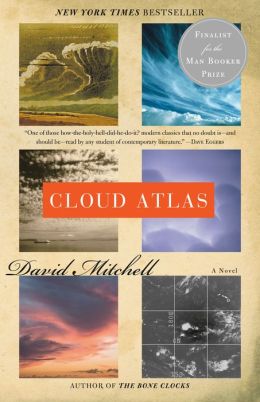
Cloud Atlas

Original image at barnesandnoble.com
Title: Cloud Atlas
Author: David Mitchell
Year: 2004
Genre: Science fiction/short stories
Rating: 1

Articles of life that we barely understand are sometimes the most beautiful. Those great mysteries that we realize can never be solved attract us over and over throughout our lives, preying on the backs of our minds, nagging, wondering. How is it that we cannot put them out of our minds? We know they have no answers, and never did, but some little part of human nature says that we cannot help ourselves. It’s better to wonder and never know than to be forever incurious.
Cloud Atlas is that balance of curiosity and answer, like echoes down a long canyon, leaving us to wonder if there really is a source at the other end. Woven artfully through difficulty and oppression, all of the characters of the book are victims of some heinous thing, but all heroes by their own spirit. Even if their stories end ingloriously, the meaning still stands, and that fact is the whole point.
            Summarizing David Mitchell’s abstract work is a bit like trying to make a Da Vinci out of cat’s cradle. So many different pieces pull against one another and seem separate, but are still knots on the same rope. We follow, more or less, a stream of consciousness on its path through six different lives, watching and guessing how they impact and change one another through the upheavals of time. From earthy, grounded Adam Ewing on the Pacific in the late 19th century to an unspecified, post-Apocalyptic Hawaii, Mitchell leads us along his twisted storyline of broken lives, and we wonder what anything means for the first 300 pages. And then, like a ball that’s made its weary way to the top of the hill, we slowly unwind to the bottom in a rush of emotions and revelations that both end our wondering and launch it into a new stratosphere.
            Mitchell is not only a literary master, but also clearly an outright genius. The organization and ingenuity it took to engineer the crisscrossing, complex, interlocked lives chronicled in Cloud Atlas would make the average novelist dizzy, let alone the invention of the unique structure. Formatted like a series of short stories, we are cut off at crucial moments and left to wonder for unnervingly long page numbers. For instance, we part ways with Adam Ewing after 39 pages and don’t meet him again until 475. If Mitchell were an average writer, we would hardly care for any of his characters by the time we see them again, but thankfully, he is not.
            Mitchell is renowned on both sides of the pond for his vivid imagery and evocative characterization, much stemming from this novel. With remarkably few lines, he attaches us so firmly to a person that never existed and never could (e.g. clone Sonmi-451, an artificially grown human that becomes sentient).
            Another feat of writing is the center segment, “Sloosha’s Crossin’ and Everythin’ After.” Written in a pidgin English style that evokes Brer Rabbit, Mitchell flexes his imaginative and technical muscles, detailing a world completely foreign to us in language difficult for us to understand. Somehow, it comes out clear and endearing, and that alone earns him a star.
            Another star comes for the sheer beauty of the ending. Many modern authors have lost the ability to move their readers by the sheer beauty of their prose, but Mitchell clearly feels deeply about the written word and the power it can bestow. He uses the last, poignant moment to reflect on what it is we are, summarizing the novel in one way and in another dispersing it.
            In essence, Cloud Atlas tells the story of what we mean to one another. Just as there is no way to accurately summarize a life, there is no way to summarize them all. We study, we learn, we pull meaning out of the past and apply it to the present, but each second creating a past that will only be changed in the future. The truth of history is what we make of it; the truth of the human experience is what we are.
            Mitchell delivers us this observation in an airy package full of printed sounds, black and white colors, and souls wrapped in words.  Something undefined fills the karma that he implies—that no matter if we live alone, feel alone, and die alone, as long as we are alive, we are never truly alone.
            Cloud Atlas is available on the Kindle for $11.99, or in paperback from Amazon for $12.98. This is not your average light weekend reading, nor is it pure entertainment—no, this book requires your attention and consideration as the pages turn. It was recently made into a film starring Tom Hanks and Halle Berry, and I have not seen it yet, but I cannot fathom how the screenplay runs. I’ll have to watch it just for pure curiosity as to how it flows.

Sunday, October 7, 2012

The World Without Us

Title: The World Without Us
Author: Alan Weisman
Year: 2007
Genre: Science, environmental
Rating: 3

Ever feel guilty about being a human?
Sometimes I have spurts of self-consciousness, and I start recycling for a week, or I make an honest attempt to use as little electricity as possible. I even pick up other people's trash off the street and apologize to seagulls about polluting their lake and taking their swamp to build a huge city on. But then, life gets back to me, and I'm busy being a person again, and by the time I remember my environmentally friendly aspirations, it's many months later.
In his hypothetical experiment The World Without Us, American journalist Alan Weisman poses the question of what would happen to the Earth if we all instantly vanished. If every human either kicked the bucket or was abducted to some extraterrestrial zoo in the space of an instant, what would happen to the great cities and monuments we've built? What would become of the blue planet that we call home?
Weisman begins with our cities and suburbs. With exquisite detachment, Weisman chats about falling roofs, dirt-filled swimming pools, cracked pavement, and crumpling houses as if he is discussing the weather over a cup of coffee. Nothing in our drywall-and-plexiglass neighborhoods will last more than a decade (except for the ceramic bathroom tiles, but those will be buried by sediment before long). The step-by-step breakdown of the towns and houses we feel so safe in today is a little bit unnerving, if methodically and casually told.
Next he addresses our cities. Nature will make short work of those, Weisman says-- cracked pavement, invading trees, crumbling stone facades, collapsing subways, and so on-- and before long, islands like Manhattan will be close to the natural woodlands that they were before the Dutch ever set foot there. Of course, some things will be different, but these are just projections from one of the humans that will be long gone by the time the Empire State Building is rubble.
However, once Weisman shifts into the next part of the book (the one about the environment) the feeling of wonder ceases. The tone of casual detachment vanishes for one vaguely tinged with accusation and derision, and the guilt sets in. One must wonder if Weisman is a self-hater, for all the negative voice that he directs at mankind, even if the facts are straight.
The guilt keeps pouring on throughout the rest of the book, and by the time you reach the chapter about polymers, you're begging for good news about yourself. Maybe there's one thing that humans have done to benefit this planet, you hope desperately. And sure enough, there is a chapter about creatures that would miss us. Bad news: they're cockroaches, lice, and bacteria. The cute creatures might or might have a party when we disappear.
On top of being an enormous guilt trip, the book is really strangely organized. The beginning flows neatly, the pieces lining up into a fluid narrative of a world after humanity, the story growing like the trees that it describes. After that, however, it falls apart into a chapter-by-chapter non-cohesive blurb of information, all of which is indelibly researched and sound, but poorly set up. Disappointing for such a good beginning, the readers sigh in relief by the time they reach the end.
Altogether, though, Weisman poses an interesting question. What are we doing to protect the earth that we love? The resources may be there for our benefit, but are we being good stewards of what we have? Management is just as important as productivity. Maybe if we all think a little harder about what we use, what we buy, and especially what we throw away, the Earth would miss us a little more on the day we disappear.
The History Channel is running  an interesting series about the same topic, titled "Life After People." It's not affiliated with the book, but it just goes to show that now that the question has been raised, that nasty human attribute called curiosity has to explore it to its bitter end.
The World Without Us is available on the Kindle for $10.00, or in paperback for $10.20. After spending 26 straight weeks on the New York Times Bestseller list, this book is available in most libraries, but if not, see if a friend has it. It's not one of those books you read for fun on the weekends, but it's definitely worth it for the thought that it provokes.

Thursday, April 12, 2012

The Court of the Air

Title: The Court of the Air
Author: Stephen Hunt
Year: 2007
Genre: Science Fiction/Thriller
Rating: 4

Let's face it: imaginary worlds are the best if they're, well, outlandish. There's a reason that Middle Earth is so much better loved than any of Isaac Asimov's worlds, and that Hitchhiker's Guide to the Galaxy boasts millions of fans while other alien books fall flat. In the world of science fiction, anything goes, and the crazier the better. The true magic of fiction is that anything unbelievable can indeed be believed.
Stephen Hunt has created a spectacular, detailed steampunk-style world in The Court of the Air, complete with unique races (I've never heard of crustacean people before) and a full, tragic history just as imaginative and convoluted as any in the real world. Jackals, Quatershift, and the Steammen Free State are gritty and vital enough to just be beyond the fingertips. Regrettably (bitterly so) this book is clumsy in every sense of the word.
The novel follows two orphans, the street-smart Molly Templar and reclusive Oliver Brooks, who are both special outcasts in the world. Oliver was abandoned to a dangerous substance called the feymist from the ages of one to five, and as a result is a registered feybreed, targeted by the government to be dragged into service. Molly, on the other hand, has no idea why she is special, and when all of her friends are mysteriously murdered or kidnapped, she runs for her life.
The book is fast-paced, with little time taken aside for thoughts and recollections, which is almost nice for a change. We meet a colorful host of characters-- Harry Stave, the rogue wolftaker (an agent of the Court of the Air); Silas Nickleby, a war criminal who is investigating a series of brutal murders for a newspaper; Commodore Black, who doesn't explain much of his history but is irrepressibly cheerful; Aliquot Coppertracks, a steamman (a sort of living machine) with an incredibly powerful mind; and the Whisperer, a dark presence with incredible power imprisoned in dreams. There are dozens of characters, each with interesting, individual features, and 582 pages don't feel like enough to get to know them very well.
I can't explain how unbelievably creative the world of Jackals is. Imagine crossing the raw creativity of Lewis Carroll with the grit and ingenuity of Philip Pullman, and then shading in more and more details until you have a maddeningly fascinating reality. The history of Jackals is filled with words lifted straight out of Aztec history (Duitzilopochtli Deeps, Chimeca, etc.) and the idea of severing the monarchs' arms to prove their lack of power to Parliament is gory and riveting. I've seen a lot of inventive government systems in fantasy, but never one with the complexity of The Court of the Air.
I might have claimed this book as one of my favorites if it hadn't been so poorly executed.
From the first page, we are absolutely bombarded with terms, jargon, slang, places, names, whatchamacallits, and anything you can imagine. Hunt may have been trying to immerse the readers in his world, but he successfully drowned us with far too many unexplained details. For instance, the very titular Court is never fully explained. Chapter after chapter goes by with allusions to it, and the only details that come out are more complexities. It's absolutely maddening.
Hunt also made a habit throughout the book of latching onto phrases and reusing them again and again. At one point, he refers to Harry as "the disreputable Stave" three or four times on a single page. By that time, we've gotten the message-- Harry is bad news. Hunt may have been trying to be humorous and give him a nickname in Oliver's mind, but there are certainly better ways to do it than that. The intriguing Whisperer is also left annoyingly vague, as are all the characters. According to Stephen Hunt's website, The Court of the Air is only the first in a series of books based in Jackals, so maybe he brings more light on the subjects in the future.
But even if he does, he needs to rectify his organizational skills first. The chapters are really poorly sorted out, mashing together the viewpoints of multiple characters with no markers for place and time at all. We jump from Molly to Oliver to Commodore Black to a random citizen to King Steam to Molly to whatever just make it stop. Some authors can do this gracefully (i.e. Ken Follett), but it's irritating and confusing in this book. Having seventy chapters is not a bad thing-- if it really bothers you, split the book into acts or sections.
To top it all off, the book ends in a fashion similar to dropping an anvil on a bird in flight. The plot has just begun to settle in and all fit together in a big map, and thwack! the end comes and makes no sense. We're given no hint as to what has happened to the rest of the characters, and there's not even a cliffhanger to imply that there will be another book. An extremely minor character who appears maybe two or three times in the entire course of the novel has the last line, and not even in a meaningful way.
The Court of the Air had so much potential. It's the most imaginative book to come into the science fiction/fantasy genre in absolute ages, but because it's so poorly written, the idea is shot down before it has a chance to really prove itself. It's a shame, because the steampunk world needs a real example of quality to set itself a standard.
Five years later, the book is available in libraries (on a side note, I picked it up purely for the cover-- the art is great). You can't buy it from the Kindle store, but you can get it at Barnes and Noble in paperback for $8.99. Amazon has several listings for cheap, but don't buy it if you can just rent it. One read is good enough for this novel.