Showing posts with label slavery. Show all posts

Wednesday, October 3, 2012

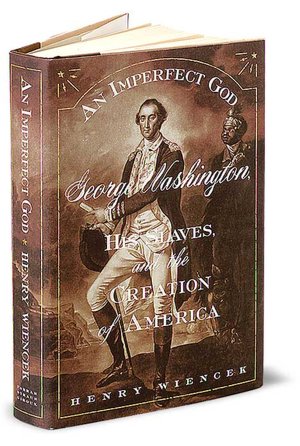
An Imperfect God

Title: An Imperfect God: George Washington, His Slaves, and the Creation of America
Author: Henry Wiencek
Year: 2003
Genre: History
Rating: 3

Think back on your elementary school history lessons. Other than the colorful (and notably bloodless) pictures of Gettysburg and the clean, proper descriptions of the Continental Congress, what do you know about our Founding Fathers as people? Most of the things we think about them are fiction, or glorified attributes. The truth of the matter is that they were tradesmen, farmers, philanderers, rebels, subversives, and, most notably, slave owners.
Most elementary school teachers somehow skip that one.
In An Imperfect God, historian Henry Wiencek stops to look closer at the life and occupation of perhaps the most mythologized man in American history: George Washington. With no royalty to idolize, Americans have generation upon generation lifted up the stories of the man with the wooden teeth (they were actually ivory and extracted teeth) who chopped down the cherry tree and had to tell the truth (a composite tale that's only partially true). In fact, the man that George Washington was has been somewhat buried in time and a whirlwind of events, and Wiencek seeks to bring it starkly to light.
The main point of the book is the irony of America: a state based on the purported ideals of freedom while maintaining slavery with a fist of iron. The Constitution "solidified the institution," Wiencek writes. Although the title and face of the book focus on Washington, the real heart of it is to convey the depth of slavery in young America and the double standard that the Founding Fathers lived by.
The book begins in the year of Washington's death, where he decides to make an addendum to his will where all of his own slaves would receive their emancipation upon his death, a shocking breach of protocol for a Virginian plantation owner at the time. By following Washington's meticulous diaries, Wiencek shows us firsthand the struggle that our first president went through within his own rigid moral barriers, trying to reconcile the ideas of the Enlightenment with a creaky, superstitious, inhuman institution like slavery. And yet, his life, his world was centered around it, and one could not pull the rafters from a building and not expect it to collapse. This was the dilemma that Washington faced, and this is the conflict that the book presents us with.
Unfortunately, it's not extremely well organized. The author is in such a rush to present us with his painstakingly researched data that he begins to gush in the very first chapter, bursting at the seams with stories and histories and connections and context. The whole book follows in this theme, sort of like a scatter plot. Washington's life is the median trend of the plot, following him from beginning to end, with bits and pieces of history, culture, and new anecdotes on slavery scattered about. The effect is somewhat confusing, but in the end it conglomerates into a big picture: division.
For the pure purpose of education, An Imperfect God is enlightening, clearing away the cobwebs of myth and idolizing with a proliferation of primary source documents. Washington kept detailed journals and books of finances, down to what he spent on gambling on nights in Williamsburg. He also kept yearly diaries with the markedly unromantic title "Where and How My Time is Spent." No one could accuse him of being flowery. However, Wiencek doesn't just leave it there, with his subject; he has scoured the annals at Mount Vernon and other depositories for letters, records, journals, and exchanges on a host of other subjects, some of which include barely literate slaves who worked at Mount Vernon. Scarcely a paragraph passes without a reference to some obscure historical character, backed up by extensive documentation.
Wiencek is a fine historian, and his work is sure to last, if only for the motivated. An Imperfect God is not written for the passive reader, only cursorily interested-- no, the dense writing and blob-like organization don't make this a golden work of the literature world. But as a historical document, it stands. Raw facts are hard to memorize; people like stories.
Maybe we ought to tell our elementary school kids the truth sometimes, even if it's hard to hear.
This book isn't available on Kindle, which is alright-- I snagged my copy from a dusty corner of the library. You can purchase it from Amazon for as low as $10.50 in the hardback, which is a lovely edition with a group of paintings in the center (including one remarkable one of Washington's cook, Hercules) that I had never seen before. Worth a read if you've got the time, worth a summary if you haven't.

Wednesday, August 8, 2012

The Help

Title: The Help
Author: Kathryn Stockett
Year: 2009
Genre: Historical fiction, social issues
Rating: 2

Self-examining fiction is always an interesting endeavor: a song about writing a song, a film about making a film, a book about writing a book. Obviously, as the author is a professional book-writer, the idea of writing is something dear to their heart and familiar, which makes the description of the process very real and accurate. What The Help attempts, in contrast, is to show the power of reaching people with your voice without them seeing your face.
All the evidence of today, despite America's creed of acceptance and tolerance, leads one to believe that racism is not dead, but buried under a thin sheet. We are so acutely aware of one another's color in our attempts to ignore it that any violation of this throws us into a tizzy of denials of racism and passing anti-hate crime laws and all sorts of nonsense. Kathryn Stockett takes on the heart of the most oppressive environment for African-Americans-- Jackson, Mississippi in 1962-- to show the true subtlety of the separations in "one nation under God."
Told from three perspectives, The Help follows the lives of Aibileen Clark and Minny Jackson, two black maids and best friends, and Eugenia "Skeeter" Phelan, a white college graduate and aspiring journalist. Aibileen's job is to look after two-year-old Mae Mobley Leefolt, whose mother doesn't want to be near her child. Minny, who "has a mouth on her," is fired at the beginning of the book from working for Mrs. Walters, the mother of the malicious Hilly Holbrook. Both of them think darkly of their white mistresses, but stuff down their opinions in order to keep their jobs-- one misstep could cost them their livelihoods and safety.
Skeeter Phelan, on the other hand, is a wealthy white girl whose parents own a cotton farm on the edge of Jackson-- and has been best friends with Hilly Holbrook and Elizabeth Leefolt since college. She gets a job writing a cleaning column for the local paper and enlists Aibileen's help, as she has never cleaned a day in her life and her own maid, Constantine, disappeared without explanation from Skeeter's very controlling mother. After coming to know Aibileen a little better, Skeeter is compelled to write about a book about what it's really like to work for a white woman as a maid in Jackson.
Stockett's first novel, The Help is a creative, enveloping read about a topic that was not well-known outside of the South. She draws from her own experiences of a maid close to her family when she was young to create the characters of the maids around Jackson, and is keenly aware of the social climate of a city like Jackson. The struggles of housewives to raise their children in the 1960s pales in comparison to the struggles of the black families to raise their children on dirt-low wages and poor working conditions-- little better than slavery in practicality, despite being a hundred years after the Emancipation Proclamation.
And yet, for all the activist intentions, Stockett does not make the African-American people into a heroic race. There is doubt, cruelty, spite, bitterness, and pettiness juxtaposed with the courage, longsuffering, and beauty. Minny's husband is abusive and alcoholic, and Aibileen's husband left her for another black woman with no warning. With all their achievements and failures thrown together into the facts, Stockett does what many novels fighting racism fail to do: make their heroes human.
Skeeter and her mother are a classical dichotomy: a rebellious child of the 1960s, questioning the standing laws, with a mother who treats the African-Americans who work for them as little better than mentally handicapped animals. Her mother, Charlotte, is prim and proper and constantly hounding Skeeter about how to dress and do her hair and act in public, while Skeeter would let her frizzy hair go and her clothes be mismatched. By the end of the novel, their love-hate relationship is also extremely, pulsingly human, making one wonder whether Stockett has drawn from her relationship with her own mother.
Aibileen, too, is a wonderfully deep and conflicted character. She clearly loves the white children she raises as her own, while nursing a bitterness that her own son was killed three years before the story takes place because of the negligence of a white man. Every time she holds Mae Mobley, it is clear how much more she loves this little girl than her prim and proper white mother, but we realize with heartbreak that Mae Mobley will grow up to be exactly the same as the other white housewives. Aibileen's voice is carefully hardened to protect herself, but we see the pain that she knows daily as she watches this little girl grow up in a world that tells her that the woman who raised her is dirty, diseased, stupid.
Many interesting insights regarding racism come forward in this novel, but nothing that we haven't seen or thought of before. Although the actual physical topic of the book is rather novel, the underlying themes of racism have all been dealt with in books that are, frankly, better-- like To Kill a Mockingbird. Understanding racism in the 1960s is important for our culture, but perhaps what we need more is a novel to help us understand the racism so prevalent today-- the more dangerous idea of pretending that racism is dead.
Altogether, The Help is an educating, entertaining, and fascinating read. Stockett masters the voices and accents of Minny and Aibileen, but still slips in literary turns of phrase that captivate. The organization and pace of the novel leave something to be desired, but overall the story sticks and is memorable.
And Hilly is a hilarious, ridiculous, malignant character that seems overdramatic and fictional but is unfortunately all too real.
Available for $10.00 in both Kindle and paperback, this book is very accessible and affordable, and should be available in most libraries. The movie, starring Viola Davis and Emma Stone, is an excellent reproduction, but the book holds more of the voice and power that the author intended. Somehow, reading always does.

Friday, February 4, 2011

Someone Knows My Name

Title: Someone Knows My Name
Author: Lawrence Hill
Year: 2007
Genre: Historical Fiction
Rating: 1

Oh, 2007. What a good year for the literary world.
Told in stunning and heartbreaking detail, Someone Knows My Name is a beautiful story of a young African woman ripped from her homeland and forced into slavery. Although this topic is a common enough one, Lawrence Hill takes a different angle: Aminata, or Meena, is a Black Loyalist. Hill portrays a beautiful story in an impeccably written format, giving us a treasure to enjoy no matter how many times we read it.
The story begins in the tiny African village of Bayo, where Aminata lived with her parents happily. She is the daughter of two different tribes, and because her parents learned different languages, Aminata is able to speak both Fula and Bamanankan. She often accompanies her mother to different villages in her profession of midwifery, and on one such occasion, tragedy struck. Aminata is kidnapped and taken to the coast in a long, horror-filled march.
She boards a boat for the terrible crossing to America, the description of which is covered in mud, darkness, blood, and despair. During this time, we see Aminata's gentle innocence slowly disappear, and she speaks with a clear, mature voice throughout the entire book. Aminata is greatly wronged throughout the story; her first child is stolen and sold after only a few months of nursing, and her husband is perpetually lost to her, always working on a different plantation. Her second child is stolen by a white couple and is lost to her. She is beaten, nearly raped, and always being abused. But she keeps her mind and her intelligence.
The story follows Aminata from Bayo to Canada, her story always resonating in beautiful descriptions. Her character changes throughout the book, but as her father says in the beginning of the book, "Strength stays forever." The strength that her parents passed to her remains, and even if she weeps in despair, she always stands back up. She is a heroine truly worth knowing. Even when she escapes to the north, she knows that she is not safe, and must always fight for her freedom. And we weep in grief or cheer in triumph as her story unfolds.
The boo runs a little lengthy at 470 pages, but the entire story relates a true world. With many books, there are too many emotional descriptions and not enough about the setting, but Someone Knows My Name does not fall into that category. The world of the Americas in the 18th century becomes clear and real to us, and we see enough of it to feel as if we are actually there alongside Aminata. Hill creates a beautiful cast of characters, from Chekura's determined nature to Georgia's mothering knowledge to Solomon Lindo's mercurial disposition. They feel real, as if one can really reach out and touch them.
All the while, I longed for Aminata to return to Bayo and her innocent childhood, just as she did. However, my mind tracked with hers; when she discovered that even by returning to her homeland, she could never regain the world with her parents she had known, I felt a dull aching in my heart. A longing unfulfilled. For when we want something, we want it the way we picture it, not the way it will actually be.
Because it's the winner of the Commonwealth Writer's Prize, Someone Knows My Name should be available in most places. It is on eBooks, and I don't know how much it costs on the Kindle, but on the nook, it's very affordable. In paper copy, which is what I am fortunate enough to possess (:D), it is about $15.00, but I got it for $10.00 because it was on sale. But you should get your hands on this book as soon as you can; it's really amazing to read and experience.
That's it for today, ladies and gentlemen. Happy reading, my pageturners!
So geographers, in Afric-maps,
With savage-pictures fill their gaps;
And o'er uninhabitable downs
Place elephants for want of towns.
--Jonathan Swift