Showing posts with label scifi. Show all posts

Monday, January 7, 2013

Mockingjay

Original image at suzannecollinsbooks.com/
Title: Mockingjay
Author: Suzanne Collins
Year: 2010
Genre: Teen/thriller/sci-fi
Rating: 2

The end of a series is supposed to settle the readers' minds, even if it's not a happy ending. We want to see our heroes reach a resting place to nurse their wounds and work their way toward happiness after the battle is over.
But for a hyperactive, ADD plot like Mockingjay's, concluding is synonymous with death. Had Suzanne Collins not committed to a trilogy, she would have probably drawn out Katniss's story for another two books or so, and if it would have helped to pace this novel better, she would have been right to do so. As it stands, Mockingjay reads like twenty climaxes smashed together to make a jarring, heaving, ponderous plot laced with gratuitous gore and little meaning. The only thing that keeps us going is an attachment to the central characters.
At the beginning, we find Hunger Games victor Katniss Everdeen broken, bruised, and confused after her dramatic rescue from the arena and removal to the mythical District Thirteen, which resembles some kind of industrial distopia. Katniss chafes at the rigorous rules of her new home and at the expectations placed upon her to become the Mockingjay, the symbol of the rebellion now seizing Panem. For the past two years, Katniss's presence on national TV has been sparking these seeds of discontent, and now the rebels see her as an icon of hope, of defiance. All she wants to do is go back to District Twelve with Gale Hawthorne and her family, but her home has burned to the ground, her friends either dead or refugees, and Peeta Mellark in captivity in the Capitol.
Katniss, besides being faced with the decision to be the face of the revolution or not, is also faced with that omnipresent question of romance: her best friend Gale, or her fellow victor Peeta. As the violence spins more and more out of her control and she begins to question her own dedication to the cause, the world exerts more pressure on her and on her fellow soldiers, driving their war to the bitter end.
The most interesting thing that Collins does with the idea of revolution is the PR face. Katniss is by no means the great general that the rebels need to command them; she is merely the symbol that they all recognize to keep fighting, and the hard-hearted president of District Thirteen is set on using her as propaganda to propagate her war. The executives of the movement tape clip after clip of Katniss and her team to indoctrinate the people, constantly considering her behavior and how it will affect mass opinion of the war. Katniss knows this and feels ill-used, which is the most complicated emotion in all the books that Collins puts forth: are the deaths of all the people she encourages Katniss's fault?
When it comes to sheer surface entertainment, the Hunger Games series is unrivaled. Loaded with suspense and danger, Mockingjay keeps readers on the edges of their seats and guessing until the end, the plot careening down a wildly twisting path until the conclusion. And it is twisting: any sense of restraint that Collins felt about her violence is suddenly stripped away in her third installment. The first two books were graphic, but there was always a subtle hint of reluctance to kill characters that we had grown attached to. Not so here. Just like her characters, Collins seems to have driven herself to the edge and held her ground strongly enough to kill off rebels that she had written extensively about. This lends the story a feeling of reality-- revolutions are horrifyingly bloody, and many beloved people die every time. It would have been laughable had all of Katniss's allies made it through unharmed.
Oh, do the parallels of the evils of socialism continue. District Thirteen is an eerie shell of Soviet Russia, with toe-trampling rules and over-the-top punishments for tiny crimes. Freedoms are restricted to the bare minimum, and the people don't seem to mind. Only Katniss and Gale, the brave champions of freedoms, are willing to defy the rules of the overbearing society, braving the anger of the ruling powers for the general good.
However, that's the only real parallel. The surface entertainment is about all the value available in Mockingjay; Collins awkwardly skirts around any pithy topics, even if she has set up a perfect situation for them to be explored. One theme that appears over and over again is the question of what it truly means to kill another person. She repeatedly mentions this struggle in Katniss's thoughts throughout all three books, and yet after roughly 1100 pages, we still don't know what it really means. Death after death goes by, and the only one that really comes close to touching that question is Rue's death in the arena in the first book.
(On a side note, does Collins really think she's being clever with her Latin? Maybe for a monolingual society she is, but seriously, I saw the Rome parallel before I even read the book. She didn't need her whole Panem et Circenses bit. Plus, Avox is a really pathetic attempt. When the characters think 'hijack' is an archaic word, how on Earth do they know enough Latin to name various things?)
The most disappointing part of Mockingjay is the ending. With all this colorful, thrilling writing under her belt, one would think that Collins could piece together a conclusion worthy of the characters that she has spent so much time developing, but we're left with a twenty-five page slop that is like staring at grey wallpaper with grey patterns on it. Sure, she's trying to portray a fog of grief, but the writing should induce tears of sympathy, not boredom. Even the epilogue is arbitrary and pointless. The bare facts of how the story ends are sort of bittersweet and touching, but change in pace drops us like a stone into the cold water of the book being over. Something tells me that her publisher was pushing her toward a deadline and she had to crank out an ending.
Altogether, the Hunger Games tells a beautiful, terrible story, filled with characters we can believe in images we won't forget. Perhaps the meaning is meant to come from us as we read. Collins has provided us with a beautiful wilderness of story; it's up to us to make it mean something.
 Mockingjay is available on the Kindle for $5.99, or in hardback from Amazon for $9.86. Because the Hunger Games is such a book of our times, it's worth a read, but don't go in expecting deep thoughts. Consider the series a light weekend thing, but definitely don't read it to your kids. It's a little graphic even for adults.

Tuesday, December 25, 2012

The Hunger Games

Image credit to suzannecollinsbooks.com/
Title: The Hunger Games
Author: Suzanne Collins
Year: 2008
Genre: Sci-fi/thriller/teen
Rating: 2

Action! Danger! Tragedy! Oppression! Romance!
You couldn't ask for more on a movie poster. Perhaps, in fact, if any book could have skipped the written phase and gone straight to film, it would be The Hunger Games. Rapid-paced action and visceral imagery make this book a top-notch story, and even if the language leaves something to be desired, it hits its target crowd exceptionally well. After all, sometimes all we need is a good story, right?
Suzanne Collins is an experienced children's writer; she has written multiple episodes for 1990s TV shows like Little Bear, Oswald, and Clarissa Explains It All. She has also written a five-book series for children known as The Underland Chronicles, which are an interpretation of the classic Alice in Wonderland.
However, with The Hunger Games, she takes a step into the gritter world of teen fiction, leaving behind squeaky-clean genres for a heftier tale. The novel tells the story of 16 year-old Katniss Everdeen, a poor girl living in the 12th District of a post-apocalyptic North American country called Panem. She is content to lead a quiet, meager existence by illegally poaching off of government land to feed her family until her younger sister, Primrose, is called out to be a participant in the bloody gladitorial contest known as the Hunger Games. In desperation to save her sister's life, Katniss volunteers to take her place, sealing her fate to kill or be killed.
To make matters more complicated, a boy that Katniss owes her life to, Peeta Mellark, is named as the other participant, obliging her to kill someone that she feels indebted to. Thus, she explains, is the horror of the Games: in order to survive, you must give up all your dignity, which is the government's aim. As the book progresses, the relationship between Katniss and Peeta becomes much muddier and more complicated, and even she is not sure how she feels about the boy who saved her life, the boy she is obliged to kill.
Told in the first person, the book places the readers firmly inside Katniss's mind. We hear her thoughts, her gut reactions to things, and see the grossly unfair world of Panem as she sees it. Grammar fanatics will squirm and squawk as they read turns of phrase (think high school language, written down) and the truncated fragments of thoughts are jarring, but the argument stands that they do place you into the mind of a coarse teenager.
Collins has created a marvelously dark, creative world replete with extensive details and logical, ordinary, yet beautiful characters. Although some of the people we meet are rather two-dimensional (Prim and Effie are exceptionally flat, and Cato runs a close third) Katniss and Peeta are fully fleshed out, and blend together beautifully. As time progresses, we understand more of the darkness and complete victory that the Games are to the Capitol, dehumanizing their victims and their audience in one blow.
The story is a thinly veiled allegory for the evils of socialism, what with the rigid rule controls on each district's product and the omnipotence and omniscience of the government. Katniss and Peeta represent the young capitalists defying the shackles of governmental regulation, shaking off the social expectations of submission and fear. Collins has essentially created a effective propaganda piece for republicanism with a action-packed, fast-paced, driven plot filled with believable people and graphic imagery.
The target audience is most definitely teenagers and young adults. The language is easy and flows much like an average American talks, and there are few moments without some sort of action or plot-centric exchange. Collins draws in a female audience with the sweet, innocent romance between Peeta and Katniss and the male audience with the sheer horror of the Games that she describes. (Cato's death is particularly horrifying, and will shock anyone with a visual imagination.) Intuitively weaving all of her different articles together to create one enormous, lumpy tapestry, Collins introduces us to a plot that we can love and remember, cheer and grieve for, and step easily into with the tightly-woven words she has written.
Because it is told in first person, the book stays with Katniss nearly every waking moment for a few weeks, but at just over 300 pages is surprisingly short. While that style necessitates some dull moments, some of the scenes are exceptionally poignant, such as the reaping (where the participants, known as "tributes," are named) when Katniss throws herself forward to save her sister. Rife with passionate language and the impulsive nature of the action, we are gripped throughout the telling and tied tightly to the brave girl as she sacrifices herself for love of family. Because it is told in the present tense, the readers experience the events in hypothetical "real time," which places us even more inside the mind of Katniss, lending us her emotions and distractions. Perhaps it is because we nearly become her, but our heroine is one of the most complete characters in popular literature.
The film, starring Jennifer Lawrence as Katniss and Josh Hutcherson as Peeta, came out in March 2012 and drew an enormous audience for its extended run. Catching Fire, the next film, is expected in September 2013.
The Hunger Games is available for a meager $5.00 on the Kindle (it's free if you join Amazon Prime), or $10.89 in hardback. The entire trilogy, which includes Catching Fire and Mockingjay, is available for $18.99 on the Kindle or $29.50 in hardback. Because of the popularity and timeliness of these books, they are probably taken out of most libraries most of the time; if you can't borrow them, they're worth the purchase. Mine were given to me by some wonderful people as a Christmas gift, and I profusely thank them. It's taken me a really long time to jump on the bandwagon.
Merry Christmas, everyone! Hope you got or gave at least one book today. Enjoy your break and keep reading!

Tuesday, March 20, 2012

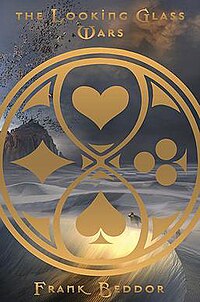
The Looking Glass Wars

Title: The Looking Glass Wars
Author: Frank Beddor
Year: 2006
Genre: Fiction
Rating:  2


Playful, charming, mischievous, and endearing, Frank Beddor's takeoff on the classic Alice in Wonderland has taken the world of fairytale adaptation to another stratospheric level. Over the past few years, we've seen an increasing fascination with Lewis Carroll's magical world of caterpillars, card soldiers, singing flowers and the Red Queen-- Johnny Depp as the Mad Hatter, SyFy's miniseries, and the disturbing video games, among numerous others-- with each instance growing a little more dark and twisted. The Looking Glass Wars is a step above the others, with Beddor imagining Wonderland as something else entirely.
We first get the idea that something is wrong in the introduction, with a tempestuous Alice-- or Alyss, as Beddor spells her name-- throwing the draft for Alice in Wonderland back into the face of Charles Dodgson, the real name of Lewis Carroll. From there, we learn that Alyss is the last of the Hearts, the rightful rulers of Wonderland with extremely powerful imaginations, and that her foul aunt Redd has gruesomely murdered her father and mother and exiled her to Victorian England. Alyss's story is populated by familiar characters, twisted into far more fallible, unrecognizable people (the Mad Hatter becomes Hatter Madigan, the White Rabbit becomes the tutor Bibwit Harte, and the caterpillar becomes six distant oracles) who form the Alyssian Resistance, fighting against Redd for the future of Wonderland.
And yet, Beddor has kept the intrinsic playful nature of the original book. In a dry, acidic humor, he makes jokes out of Redd's cruelty, and the grimy streets of Wondertropolis are filled with whimsy. He has created all sorts of interesting details, even down to the favorite foods of the Wonderlandians. Wonderland also becomes one nation in a world full of ones just as outlandish and interesting; Boarderland lies across the vast desert, and suddenly, we're confronted with a whole world.
Alyss herself is an interesting conundrum. At first, she spends much of her time on Earth trying to preserve her royalty and memories of her home, but after dozens of people have told her that she is making all this up, she begins to wonder if she indeed has. Her imagination fades away, and she becomes an embarrassingly normal young woman on the brink of marriage when she is suddenly dragged back to Wonderland. All of a sudden, instead of the dreamy little girl in a white frock, she is a full-grown woman with real danger all around her.
The redesigning of Redd and her servant the Cat (a particularly unsavory creature twisted from the Cheshire Cat) is clearly the one that took the most work for the author. He has changed every aspect of the nearly impotent Red Queen of the book and movies, retaining only her affinity for scarlet and her catchphrase, "Off with his head!" Instead of having cronies do all of her executions for her, she has a delightfully grisly dress made of carnivorous vines that eats people that cross her. She also has a wicked pleasure in patenting products designed to cause misery with tacky names, which only adds to the charm of the book.
Beddor has created a spectacular world that is impossible to be uninterested in. Even from the first few pages, the story draws us in and grips us tightly until the end. Fortunately for us, this is not the only book-- there are two more in the series (Seeing Redd and Arch Enemy) to complete the full tale of Alyss.
On a side note, one of the more interesting choices that Beddor made was to include illustrations. I wouldn't term this novel as for children-- maybe for teens, but no one under 14 or so-- but there are four pages of full-color illustrations, even in the paperback. They're notably Burton-esque, with sketchy lines and dark looking characters, not at all definitive of the whimsy of Alice in the past. I prefer to imagine the characters in my own mind, so I skipped them until the end, but they're a bemusing addition.
The Looking Glass Wars is definitely worth your time. You can pick up an eBook copy for $8.99, or a paperback for as low as $3.22 on Amazon. Although I only gave it a 2-- just because it's not the sweeping, meaningful tale that other novels are-- I usually read once a year or so, so I'd recommend buying it if you can. I actually own all three, as I got started when they were first coming out.