Showing posts with label history. Show all posts

Sunday, February 17, 2013

The Devil in Massachusetts

Title: The Devil in Massachusetts: A Modern Enquiry into the Salem Witch Trials
Author: Marion L. Starkey
Year: 1949
Genre: Non-fiction/history
Rating: 2

Today, we put the utmost faith in justice. We hope that the men responsible for any crime will be brought to justice; we decide before a trial is over who is guilty, and are borderline angry if the accused is acquitted. We watch thousands of hours of police shows, we are obsessed with stories of the CIA and FBI hunts, and who can help but admire Sherlock Holmes' deep dedication to finding the source of wrong in the world.
Yet, justice can sometimes be this dark, terrifying thing. In the case of the Salem Witch Trials, justice took on the face of a superstitious population hunting for something which did not truly exist, and found it in innocent people to salve its own conscience. That is the deep power of justice-- when imperfect people are the ones implementing it, can it truly be considered pure justice?
With cold logic and three centuries of insight, Marion L. Starkey's The Devil in Massachusetts sets this blemish in American history against a starkly (pun, anyone?) white background, forcing us to look it in the eye for the first time and consider the humanity of the situation beyond just the facts. Told in a narrative format, she puts us inside the community which inverted on itself in 1692.
The books begins by introducing us to those infamous little girls, Abigail and Betty, who began the panic in little Salem Village. We all know the story, but seeing it firsthand (more or less) brings a greater understanding or impact to what happened all those years ago. As the girls play with the dark arts in the minister's kitchen, readers can almost hear the clock ticking to the day of reckoning.
We watch the girls accuse soul after soul, and the general confusion and moral arm race unfold across the community. For the first time, Starkey points out to us the social and legal connotations of these events, and we wonder more and more how an emerging world could allow something like this to happen eight years before the 18th century began. Not quite a hundred years later, this same state would be in the grip of the American Revolution, full of the ideas of human rights and freedom.
Strange to know that the Salem Witch Trials were a rather small event compared to the enormous witch trials and hangings in Europe at the time. Only twenty witches in total were executed, but we remember the event today like it was the greatest tragedy of that part of history; the more studious can even recite the names of those killed, while the hundreds killed in Europe lie in anonymity. Starkey explores this question: why is this event then so significant?
Obviously, as this book was written 64 years ago, the language is a bit dated. Some of the spellings and turns of phrase can evoke letters that your grandparents wrote, but taking the age into account, Starkey has written a response to history remarkably clearly and concisely. At a mere 270 pages, this is not a long read, and the crunch of information we receive makes it flow much faster than expected.
One of the most notable things about this book is its meticulous research. Obviously, documents from an obscure village in Massachusetts in 1692 are not a dime a dozen, nor are they a light weekend read. Many of the spellings vary greatly (thank budding Germanic English for that one) and others were destroyed to cover up the affair. Starkey has winnowed to the bottom of all the paperwork and brushed together the scrapings of what was real, and applied it to the world as it lived and breathed at the time. Down to the description of John Procter's face and Sarah Good's tobacco habit, she has provided us with enough information to lead us down the factual road, but fill our hands with the feelings of humanity along the way.
The Devil in Massachusetts makes history tangible. It may not take the most comprehensive look at what the trials mean, nor does it add anything exceptional to what happened, but it gives us a more complete picture of what we know.
Because this book is so old and it is more commonly a textbook than recreational reading (you know you're a nerd when you read books like this in your spare time), it's not available on the Kindle, but you can get it in paperback from Amazon for $10.66. I bet a decent library might have a copy as well, so I'd try there first. If it's not there, look in your library network, because this is definitely worth a read for any budding student of history.

Sunday, November 25, 2012

To the End of the Earth

Title: To the End of the Earth: Our Epic Journey to the North Pole and the Legend of Peary and Henson
Author: Tom Avery
Year: 2009
Genre: Non-fiction/memoir/history
Rating: 2

Foolhardiness often overlaps with bravery. Oftentimes, it's not until after the success that we dub it as brave; the most famous accomplishments were often accused of being ludicrous when they were first proposed. From the top of Everest to the bottom of the ocean's trenches, we are constantly encroaching on that legendary phrase-- "to boldly go where no man has gone before."
Tom Avery has dedicated his life to doing just that. In his young life, Avery has made expeditions to both poles, in the Andes, to a remote mountain range in Kyrgystan (don't ask me to find that one on a map) and various other places on earth. What's most interesting about these trips is not that he has done so many, but that he survived them at all. Some people might call him an adrenaline junkie for his numerous, at times reckless, brushes with death. In his 2009 memoir To The Ends of the Earth, Avery recounts dozens of moments where he thought he might have just missed the mark and sentenced his team to death on his daring expedition to the North Pole.
The adventure wasn't a passing fancy. After returning from his 2002 pursuit to the South Pole, Avery was surprised by an offer of sponsorship for his next trek, which he decided on the spot would be to the North Pole. Over the next two years before the actual trip took place, he would discover how monumental that idea actually was. The simple reason is that the North Pole is in the middle of an enormous, malevolent, frozen ocean, and Avery wanted to sled there. On foot.
The subtitle of the book alludes to a 100 year old mystery, the voyage of Robert Peary, who claimed to have reached the North Pole by dogsled in 37 days. Upon his return, his claim was decried by the arctic exploration community as ridiculous, impossible, and false. For a man who had forever held aspirations of reaching the Pole, this was a crushing blow, and to this day Peary's assertion is doubted.
 With his 2005 expedition, Avery's goal was to prove once and for all that Peary was telling the truth. The most difficult part of organizing the mission was to recreate Peary's exploration team, composed of the nearly-extinct Eskimo dog (no, not a husky, an Eskimo dog) and two turn-of-the-century sleds. Not only did he want to do this whole 413-mile trek with 5 people and 16 dogs, he wanted to make the entire run in 37 days. To any onlooker, Avery was asking for death.
His memoir of the trip is gripping, with an expert's wry sense of humor. Readers come to know each of the dogs' names as well as the explorers do, to laugh at the little anecdotes of their antics, and to feel their pain as they struggle for life on the hostile plains of the Arctic. The explorers themselves keep a friendly, co-dependent dynamic, companions in this strange world where no man has ever lived.
We also come to know the landscape as well as Avery did, with his ardent descriptions of what could only be described as an icy wasteland. To him, it is a wonderland, and that love is communicated in his writing. As the book progresses and the conditions grow more desperate, we see that love grow briefer and more passing, but never entirely fades: here is a man obsessed, and come face to face with his deepest passion. No matter the hardships, Tom Avery pursues the poles, and that in itself is admirable, albeit the daredevil nature of his exploits.
Structurally, To the End of the Earth flows very easily, the history intermittent with the narrative, creating one cohesive story, in the purest sense of the word. Avery has even reconstructed dialogue between himself and his companions, which lends the book a feeling of personality rather than a dry historical memoir to be logged away at the Royal Geographical Society.
Taking another step back, the sheer topic of the book is incredible. So few men make the trip to the North Pole and live to tell the tale, let alone on foot, that the idea of it is incredible. Avery deserves applause for his incredible bravery and ambition for taking on a task that so many have failed to do, and for increasing our true knowledge of the planet that, day by day, it becomes apparent that we know very little about.
Because it's such a specific book and not of wide interest, To the End of the Earth is available in paperback for as little as $6.36 from Amazon, and $7.99 on the Kindle. However, even if you are not familiar with the story of the Arctic, take a look at this one. Avery's website gives a little more information on the background of the book if you are interested, and gives a list of his expeditions as well.

Sunday, November 11, 2012

River of Darkness

Title: River of Darkness: Francisco Orellana's Legendary Voyage of Death and Discovery Down the Amazon
Author: Buddy Levy
Year: 2011
Genre: History
Rating: 4

Few people know that the name of the Amazon is actually Greek in origin. Most of the time, the Amazon is automatically associated with the enormous river commanding the northern part of South America, with a possible secondary association with the mythical all-female colony hidden deep in the thick jungles. If the person is really well versed in Greek literature, they might come up with Hippolyta, Euripides's fictional queen of the Greek Amazons. But isn't it odd how disparate the two are? The faraway women sequestered in ancient Greece and the indomitable tropical river.
That's the air of Buddy Levy's new book on the conquest of the Amazon, River of Darkness. Though he pours thick, vivid details in, constructing a true story of an incredible event, it seems marginalized by the structure of the book and the writing style. In fact, the topic of the book feels like it just doesn't belong.
 Despite the scale of Francisco Orellana's fame in the 16th century, he seems to have slipped away from conquistador canon in favor of characters like Francisco Pizarro and Hernan Cortes, who toppled empires and killed thousands. Levy brings his journey back to us, though the telling leaves something to be desired.
The book opens with a gritty, visual narrative of the moment Francisco Orellana embarked on his fateful journey down the Amazon, destined to make him the first man to cross the entire continent of South America. Orellana originally came with the youngest Pizarro (fun fact: there were five Pizarro brothers, all notoriously cruel and effective conquerors) to the new Spanish land of Peru and began an expedition to find El Dorado and the Cinnamon Valley, two myths common throughout conquistador lore. Unfortunately for Pizarro, the intended conquest goes as wrong as possible, and he is forced to split from his trusted captain, Francisco Orellana.
Orellana takes the group's boat and goes in search of food for a great distance down the river, and rather than return, he continues down the river to explore and reach the sea on the other end. For a poorly outfitted, uninformed, and unprepared group of men, the journey has often been greeted with incredulity and accolade, for the dangers of the Amazon are legendary. Orellana managed to avoid poisonous fish and plants, enormous snakes, hostile natives, and tricky rivers to guide his men back to civilization on two islands north of modern-day Venezuela.
Levy relates the tale with remarkable amounts of research and commendable detail. He has unearthed the narrative of a priest who accompanied Orellana and made notes along the way, relating the man's remarkably diplomatic approach to the natives of the area. Most conquistadors would rather slash and burn their way into kingdoms, but Orellana had a gift for linguistics and managed to learn the rudimentary parts of the local language and even secured a month's room and board for his men with a local tribe.
Levy relates all these details with the cool, academic air of a historian, which turns the book into a dry pile of incongruous dust. It's horribly unfortunate, because such a remarkable piece of obscure history could be told in such a gripping way. The Amazon captures all our imaginations with the vivid beauty of a nearly untouched world, and Orellana was seeing it for the first time. Levy, however, take the clinical approach of not stepping into the captain's shoes and relies solely on documents. His purist attitude is admirable, but boring.
What's more, the book claims to be the story of Francisco Orellana, but spends much of its time telling the general history of the conquest of Peru. At 250 pages, Levy is short on space for this huge topic, and chooses to spend much of it talking about Gonzalo Pizarro and what happened after Orellana succeeded rather than the actual journey. In fact, only a little more than half the book is actually spent on its topic, which is bitterly disappointing. There is so much to discuss and so much to research, and Levy chooses only to scratch the surface. Perhaps he should have instead written a book about the Spanish conquest of South America-- he would have had more to talk about.
Altogether, the story is interesting, but very superficial. After reading Levy's book, readers who are interested will have to go out and pick up another book on the same subject for more detail.
Because it's only about a year old, River of Darkness is $13.99 on the Kindle and $17.82 for the hardback from Amazon. My library had a copy, so if you live in a city, yours might too; if not, skip this one. It's tantalizing, but there have got to be better books out there on this same subject that delve more deeply into Orellana's fascinating, groundbreaking journey.

Wednesday, October 24, 2012

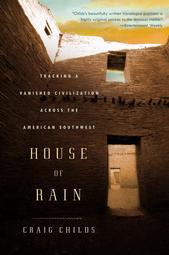
House of Rain

Title: House of Rain: Tracking a Vanished Civilization Across the American Southwest
Author: Craig Childs
Year: 2006
Genre: Non-fiction/history/archaeology
Rating: 2

Rain and the desert: polar opposites, at least to most people. Say the word desert in a crowd of people from a temperate climate, and immediately images of saguaro catci, bleached cow skulls, rattlesnakes, sand dunes, and sombreros come to mind. Dig a little deeper, and some people might think of the distant Native Americans, guiltily mumbling about how white people forced them onto godforsaken spits of land that nobody else wanted. What might surprise the average observer is that those people (the Apache, the Navajo, the Hopi, the Zuni, and many others) have lived in those lands for thousands of years and love it like their own blood. It may be harsh land, but it's their heritage.
Craig Childs's expose on the world of the Anasazi (or, more properly, the ancestral Puebloans) dispels many of the cliche tourist assumptions that Americans may have about the previous owners of our land. With a slow, respectful voice in deference to the secrets of the world around him, Childs quietly follows in the footsteps of a people who left their worlds behind them as a manner of living, tracing their history through only broken pots and tumbled walls.
House of Rain is a bifurcated novel: the main "story" follows Childs's physical pilgrimage across the migratory trails of the pre-Columbian Anasazi, and as he uncovers ruins and artifacts, he divulges his wealth of accumulated archaeological research. He begins in the New Mexican Chaco Canyon, where a great religious and commercial civilization flourished over a thousand years ago. He introduces us slowly to the terminology and basic architecture that these people used, then moves on to the next site at Fajada Butte, taking us along a journey that has long been misread, dusted over and ignored in favor of a more mysterious, though ultimately incorrect, theory.
According to popular mythology, the Anasazi were a people that lived in the Four Corners area of southwest Colorado and northeastern Arizona, constructing the impressive sites of Mesa Verde and Kayenta. On a visit to Mesa Verde, an ordinary tourist will be taken down into some of the breathtakingly complete and preserved cliff dwellings, leaning down into kivas and beholding intact wooden ladders from the 13th century. A tour guide will tell them that these people took refuge in the cliffs from an unknown enemy, possibly the Apache or the Navajo, and only occupied these dwellings for 80 to 100 years before suddenly vanishing without a trace. The guides cite the presence of full baskets of food, personal effects, and ceremonial artifacts as evidence that the people had no chance to collect themselves before disappearing.
This is not the truth, according to Childs. His research and experience have shown him time and time again that the Anasazi were a migratory people, who regularly used a pattern of abandoning structures and following the rain and drought cycle to preserve their way of life.
With extensive research and remarkable personal physical effort, the author takes us on a visceral, sensitive walk along a road that people traveled long ago, tracing the footsteps of a people not entirely gone. Along the way, he makes the point that there still are descendents of the ancestral Puebloans along this road: the Hopi still occupy their ancestral lands, the Navajo are linked to the mountains of their reservation, and people in the Paqime region of northern Mexico are familiar with the migrants' history. They are not gone, Childs concludes; they are simply dusted over with the passage of time.
His own journey drives this point home. Childs is no droll scientist sashaying into writing: his voice is clear, piercing, and in some places moving, bringing to life the dusty places that he stands. His passion for archaeology and the American Southwest pervades the novel, imbuing the words with a meaning other than simple information. That is the true beauty of this book: it is not just a dry recitation of facts. By throwing himself completely into his work, Childs has brought a possibly boring topic to life, enabling his findings to draw in even casually interested readers into a long-lost tale of a people long forgotten.
Although he does stray into sometimes long and dull passages rife with tangential information, the author never loses track of where he stands. One interesting and possibly unintentional beauty of the book is the fact that he brings his wife Regan and toddler son Jasper with him on parts of the adventure. Perhaps it was practical and coincidental, but by bringing such vivid pictures of life into these places long dead, he illustrates a point: the cycle goes on. Even if a civilization vanishes, life has not ended, and there will always be people chasing the rain, adjusting their lives to what is given.
Fascinating, comprehensive, and understandable even for a stranger to archaeology, House of Rain's 445 pages are a fantastic trip through a land that few modern Americans see: the bare deserts of the central Southwest. This book is available for $9.99 on the Kindle or $10.87 in paperback from Amazon, but because it's about five years old, it might be available in your local library. Go and take a look, because dispelling rumors is one of the most valuable things that an author can do. Sharing the truth is a great facet of history.

Wednesday, October 3, 2012

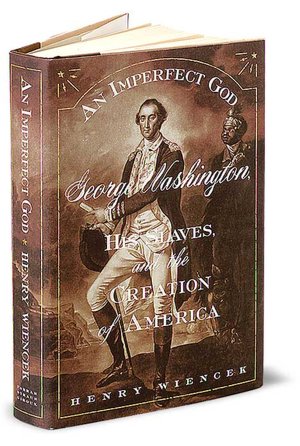
An Imperfect God

Title: An Imperfect God: George Washington, His Slaves, and the Creation of America
Author: Henry Wiencek
Year: 2003
Genre: History
Rating: 3

Think back on your elementary school history lessons. Other than the colorful (and notably bloodless) pictures of Gettysburg and the clean, proper descriptions of the Continental Congress, what do you know about our Founding Fathers as people? Most of the things we think about them are fiction, or glorified attributes. The truth of the matter is that they were tradesmen, farmers, philanderers, rebels, subversives, and, most notably, slave owners.
Most elementary school teachers somehow skip that one.
In An Imperfect God, historian Henry Wiencek stops to look closer at the life and occupation of perhaps the most mythologized man in American history: George Washington. With no royalty to idolize, Americans have generation upon generation lifted up the stories of the man with the wooden teeth (they were actually ivory and extracted teeth) who chopped down the cherry tree and had to tell the truth (a composite tale that's only partially true). In fact, the man that George Washington was has been somewhat buried in time and a whirlwind of events, and Wiencek seeks to bring it starkly to light.
The main point of the book is the irony of America: a state based on the purported ideals of freedom while maintaining slavery with a fist of iron. The Constitution "solidified the institution," Wiencek writes. Although the title and face of the book focus on Washington, the real heart of it is to convey the depth of slavery in young America and the double standard that the Founding Fathers lived by.
The book begins in the year of Washington's death, where he decides to make an addendum to his will where all of his own slaves would receive their emancipation upon his death, a shocking breach of protocol for a Virginian plantation owner at the time. By following Washington's meticulous diaries, Wiencek shows us firsthand the struggle that our first president went through within his own rigid moral barriers, trying to reconcile the ideas of the Enlightenment with a creaky, superstitious, inhuman institution like slavery. And yet, his life, his world was centered around it, and one could not pull the rafters from a building and not expect it to collapse. This was the dilemma that Washington faced, and this is the conflict that the book presents us with.
Unfortunately, it's not extremely well organized. The author is in such a rush to present us with his painstakingly researched data that he begins to gush in the very first chapter, bursting at the seams with stories and histories and connections and context. The whole book follows in this theme, sort of like a scatter plot. Washington's life is the median trend of the plot, following him from beginning to end, with bits and pieces of history, culture, and new anecdotes on slavery scattered about. The effect is somewhat confusing, but in the end it conglomerates into a big picture: division.
For the pure purpose of education, An Imperfect God is enlightening, clearing away the cobwebs of myth and idolizing with a proliferation of primary source documents. Washington kept detailed journals and books of finances, down to what he spent on gambling on nights in Williamsburg. He also kept yearly diaries with the markedly unromantic title "Where and How My Time is Spent." No one could accuse him of being flowery. However, Wiencek doesn't just leave it there, with his subject; he has scoured the annals at Mount Vernon and other depositories for letters, records, journals, and exchanges on a host of other subjects, some of which include barely literate slaves who worked at Mount Vernon. Scarcely a paragraph passes without a reference to some obscure historical character, backed up by extensive documentation.
Wiencek is a fine historian, and his work is sure to last, if only for the motivated. An Imperfect God is not written for the passive reader, only cursorily interested-- no, the dense writing and blob-like organization don't make this a golden work of the literature world. But as a historical document, it stands. Raw facts are hard to memorize; people like stories.
Maybe we ought to tell our elementary school kids the truth sometimes, even if it's hard to hear.
This book isn't available on Kindle, which is alright-- I snagged my copy from a dusty corner of the library. You can purchase it from Amazon for as low as $10.50 in the hardback, which is a lovely edition with a group of paintings in the center (including one remarkable one of Washington's cook, Hercules) that I had never seen before. Worth a read if you've got the time, worth a summary if you haven't.

Thursday, September 13, 2012

The Last Prince of Ireland

Title: The Last Prince of Ireland
Author: Morgan Llywelyn
Year: 1992
Genre: Historical fiction
Rating: 3

Anyone who's been reading this blog for awhile knows that I've got a penchant for history. My grandfather was a professor of history, my sister is a history teacher, my father was a history buff, and my favorite classes in school were always history. In the American school system, we usually focus on the "usual" docket of historical events, meaning European history and American history, with a sprinkling of ancient history thrown in. But what about those parts of the world that we've completely passed over? Those are my passion, my curiosity, my real love of history-- there are so many stories out there, each more fraught with passion and fear than the last. It is our privilege and our duty to learn and share them, to gain a fuller understanding of this wonderful world we live in.
But enough of my ranting, and on to the book of the day-- The Last Prince of Ireland, by Morgan Llywelyn (pronounced a bit like hly-WE-lin).
Based in Ireland during the end of the Elizabethan era, this book follows the journey of Donal Cam O'Sullivan and his thousand followers on their long, hungry, cold march out of the district of Munster, fleeing the wrath of his former friends and kinsmen. Although it takes place over just fifteen days (each chapter covers one day), the story seems much longer than that-- more like a slow fall into ruin and decay. Each day, the ragged survivors lose more friends, more animals, more dignity and more hope, and we can't help but wonder if it would be more of a mercy to let them just give in somewhere along the way. Donal Cam, the commander of his bedraggled and wretched army, wonders the same while struggling to lead them to life.
And yet, we see hope growing between the cracks of despair. From the earliest pages we see a lovestruck Niall spy Maire Ni Driscoll and attempt to win her heart with kindness rather than bravado, even in the depths of starvation and fear. Joan Ni Sweney and her husband, Dermod O'Sullivan, provide a wry sense of humor and determination, struggling onward and depending on one another more and more as their provisions and strength run out. And Orla Ni Donoghue, a strong woman married to Rory O'Sullivan, struggles with the past and her faith as she fights for life and fierce loyalty to her leader.
Although the novel is protracted and somewhat basic in its choice of words, the burning passion of the writer is obvious. He sees Ireland itself in these pathetic survivors, relics of a noble and strong past being exterminated by the betrayal of the modern world. This is the time when Ireland finally succumbs to the rule of the expanding British, whose influence will change and shape Irish culture for the next four hundred years. Llywelyn, while recognizing this force, clearly believes that there is a deep individuality and strength within the Irish people that cannot be extinguished by oppression.
This, too, can be extended to the human soul in general. The factual march of Donal Cam and his survivors is a tribute to that, but Llywelyn's narrative of the horrific suffering and losses of those people in their struggle for that most basic of human rights-- freedom-- is heart wrenching. As the readers, we find ourselves growing more and more attached to characters we know are considered traitors and are sentenced to death, as if that bright glimmer of light just before it goes out is the most beautiful thing that a person can ever be. And despite the fact that they are bony, dirty, and desperate, these people are beautiful, if only for the sheer strength of will that carries them forward.
The whole novel feels like a slow decline into ruin, which may be intentional, but definitely detracts from the book's readability. There is no clear climax, only a long, drawn-out journey to the end. While the story is character-based, this can only carry on to a certain extent before it become dry and-- dare I say it?-- boring. Every tale needs some sort of arc, some sort of rising action, and while this one doesn't lack for battle scenes, it just seems like disaster after disaster before long.
But in the end, The Last Prince of Ireland is still a tale that needs to be told and understood in its fullest, for the true tragedy it is-- a betrayal of trust, and a shift in patriotism. Most of the princes of the island gave up in order to save their houses, which seems pathetic and selfish, but the motives are understandable. While practically foolish, Donal Cam's protest and subsequent rebellion are noble and contain a spirit of pride; we treasure that kind of national pride and look for it in our leaders, which makes Donal Cam a truly full, admirable, nearly tangible character.
Not exactly a best seller or common, I pulled this book off the shelf by pure happenstance and enjoyed it-- it's not a long read at 364 pages. It's actually fairly difficult to find on Amazon, but if you live in a city with a good library, they should have it. You can get a copy from Amazon for $15.00, but the next lowest price was nearly $40. Go figure on obscure books.
History is vital to understanding the present, even if it is obscure history. Every story weaves together to make the present, which makes it vital to appreciate the past before we move toward the future.