Showing posts with label Non-fiction. Show all posts

Sunday, February 17, 2013

The Devil in Massachusetts

Title: The Devil in Massachusetts: A Modern Enquiry into the Salem Witch Trials
Author: Marion L. Starkey
Year: 1949
Genre: Non-fiction/history
Rating: 2

Today, we put the utmost faith in justice. We hope that the men responsible for any crime will be brought to justice; we decide before a trial is over who is guilty, and are borderline angry if the accused is acquitted. We watch thousands of hours of police shows, we are obsessed with stories of the CIA and FBI hunts, and who can help but admire Sherlock Holmes' deep dedication to finding the source of wrong in the world.
Yet, justice can sometimes be this dark, terrifying thing. In the case of the Salem Witch Trials, justice took on the face of a superstitious population hunting for something which did not truly exist, and found it in innocent people to salve its own conscience. That is the deep power of justice-- when imperfect people are the ones implementing it, can it truly be considered pure justice?
With cold logic and three centuries of insight, Marion L. Starkey's The Devil in Massachusetts sets this blemish in American history against a starkly (pun, anyone?) white background, forcing us to look it in the eye for the first time and consider the humanity of the situation beyond just the facts. Told in a narrative format, she puts us inside the community which inverted on itself in 1692.
The books begins by introducing us to those infamous little girls, Abigail and Betty, who began the panic in little Salem Village. We all know the story, but seeing it firsthand (more or less) brings a greater understanding or impact to what happened all those years ago. As the girls play with the dark arts in the minister's kitchen, readers can almost hear the clock ticking to the day of reckoning.
We watch the girls accuse soul after soul, and the general confusion and moral arm race unfold across the community. For the first time, Starkey points out to us the social and legal connotations of these events, and we wonder more and more how an emerging world could allow something like this to happen eight years before the 18th century began. Not quite a hundred years later, this same state would be in the grip of the American Revolution, full of the ideas of human rights and freedom.
Strange to know that the Salem Witch Trials were a rather small event compared to the enormous witch trials and hangings in Europe at the time. Only twenty witches in total were executed, but we remember the event today like it was the greatest tragedy of that part of history; the more studious can even recite the names of those killed, while the hundreds killed in Europe lie in anonymity. Starkey explores this question: why is this event then so significant?
Obviously, as this book was written 64 years ago, the language is a bit dated. Some of the spellings and turns of phrase can evoke letters that your grandparents wrote, but taking the age into account, Starkey has written a response to history remarkably clearly and concisely. At a mere 270 pages, this is not a long read, and the crunch of information we receive makes it flow much faster than expected.
One of the most notable things about this book is its meticulous research. Obviously, documents from an obscure village in Massachusetts in 1692 are not a dime a dozen, nor are they a light weekend read. Many of the spellings vary greatly (thank budding Germanic English for that one) and others were destroyed to cover up the affair. Starkey has winnowed to the bottom of all the paperwork and brushed together the scrapings of what was real, and applied it to the world as it lived and breathed at the time. Down to the description of John Procter's face and Sarah Good's tobacco habit, she has provided us with enough information to lead us down the factual road, but fill our hands with the feelings of humanity along the way.
The Devil in Massachusetts makes history tangible. It may not take the most comprehensive look at what the trials mean, nor does it add anything exceptional to what happened, but it gives us a more complete picture of what we know.
Because this book is so old and it is more commonly a textbook than recreational reading (you know you're a nerd when you read books like this in your spare time), it's not available on the Kindle, but you can get it in paperback from Amazon for $10.66. I bet a decent library might have a copy as well, so I'd try there first. If it's not there, look in your library network, because this is definitely worth a read for any budding student of history.

Friday, December 14, 2012

A Reenchanted World

Original image at jameswilliamgibson.com
Title: A Reenchanted World: The Quest for a New Kinship With Nature
Author: James William Gibson
Year: 2009
Genre: Non-fiction/environmental/sociology
Rating: 3

Tree-huggers have a negative connotation in today's culture. Somehow, they've acquired this stereotype of long-haired, smelly, poor, bleeding-heart liberals, and we look down on them as a handicap to progress. They strap themselves to bulldozers for the sake of a few trees, and that's ridiculous, right? Why defend a few trees?
It's more than the trees. It's a kinship with nature itself, according to James William Gibson's book A Reenchanted World. With detailed journalism and observations on sociology, Gibson explores the modern yearning for a connection with nature amidst the expanding suburban world of chain-link fences and asphalt. While he does address the whole world, he mostly focuses on America, which deserves all the discussion it gets.
The book begins with the story of John Quigley, who received national attention for his two-month-long tree-sit in California in 2002. The local developers wanted to tear down the tree in order to expand a road into a subdivision, and the local environmentalists howled in protest. Quigley climbed into the tree and refused to move, much to the chagrin of the developers, and was supported by other environmentalists in the LA area. "Old Glory," as he named the tree, remained standing.
This fierce love for nature is not new to the world, but it's new to us, according to Gibson. For nearly 200 years, Americans have been recklessly and aggressively taking hold of the New World, blazing fields and drilling oil rigs in the name of progress, and the victims have been endangered species, our natural environment, and the climate. Odd, considering that the Native Americans are some of the most naturally-connected people on the planet, and it is from this that Gibson draws his beginning.
Native Americans believe in the spirituality of nature, and the environmental movement in the 1960s and 70s stemmed mostly from a revival in tribal traditions amongst Native American chieftains. As we know, it spread quickly through the youth because of the anti-war sentiments at the time, taking the world in great strides with movements like "flower power" and Greenpeace. Yet, despite all the positive effects that a more natural environment has been proven to have, these hippies have been blacklisted by modern society as radical, liberal, and dangerous.
Gibson takes this movement in hand and explains the desire for a connection with nature in both scientific and spiritual terms. The very title refers to attaching a holiness to the natural world, which seems ridiculous to us. But if you look at it, we do anyway. Gibson's primary example is our reverence for whales. People come from around the world to the great oceans to take a cruise liner out into the middle of the sea just to see whales surface for a moment, and it changes them. This doesn't just apply to biologists or whale experts; ordinary people have been reduced to tears by simply watching a whale surface out of the water for a moment, blow water at them, and disappear majestically once more. Any whale stranded on a beach makes national news as hundreds of people rush to its rescue, and there was recently a film entitled Big Miracle based on the true story of the drastic attempts to rescue a whale family marooned in the ice. Shamoo, the performing whale at SeaWorld, is more famous than many humans.
Gibson's point is not that we are coming back to nature worship, or that people will soon revert to worshiping ants or grass. No, instead, he outlines the reasons that we are still attached deeply to our world, and that environmentalism is merely an expression of the love and responsibility that we must bear for our planet.
This book was remarkably similar in topic to The World Without Us, which I reviewed earlier this year. However, Gibson doesn't have Weisman's writing charisma, and A Reenchanted World reads like a scientific article. The facts and points are well laid-out, the theme is relevant, and the ideas that he shares are true and thought-provoking, but it still feels dry. Scattered with words like "dispensationalism" and "counterculture," Gibson might have reached a wider audience by simplifying his ideas into layman's terms.
Addressing environmentalism's place in politics is necessary for any ecology book, but because of the stiff relations between the two, the discussion can become awkward. Gibson devotes two chapters for politics and religion, and while they make excellent points, they both feel a bit like rants against the right wing and conservatism. Although the men he refers to are radicals and usually known as such, he does not address the moderate right wing, nor the average American view of environmentalism, which leaves a big gap in our ideology. It is easy to pick out the red threads in the weave, but all the ones that blend together make the big picture and are equally important.
Altogether, this book makes an important contribution to the picture of today's environmentalism: it's not just a sense of misplaced duty, but a pure connection to the world that motivates us to save it. Rife with excellent examples and pithy quotes, Gibson has provided us with a guidebook for why we love nature and how to responsibly go about conserving it as long as we can. There are more details about the book on his website.
The book is only two years old, so it's available for $9.99 from the Kindle store or $10.80 in hardback from Amazon. The library might have a copy, so check there first, but do read this. Even if you're not an environmentalist, it can't hurt to understand what drives them, and it might help to make you understand our world and its people a little better.

Sunday, November 25, 2012

To the End of the Earth

Title: To the End of the Earth: Our Epic Journey to the North Pole and the Legend of Peary and Henson
Author: Tom Avery
Year: 2009
Genre: Non-fiction/memoir/history
Rating: 2

Foolhardiness often overlaps with bravery. Oftentimes, it's not until after the success that we dub it as brave; the most famous accomplishments were often accused of being ludicrous when they were first proposed. From the top of Everest to the bottom of the ocean's trenches, we are constantly encroaching on that legendary phrase-- "to boldly go where no man has gone before."
Tom Avery has dedicated his life to doing just that. In his young life, Avery has made expeditions to both poles, in the Andes, to a remote mountain range in Kyrgystan (don't ask me to find that one on a map) and various other places on earth. What's most interesting about these trips is not that he has done so many, but that he survived them at all. Some people might call him an adrenaline junkie for his numerous, at times reckless, brushes with death. In his 2009 memoir To The Ends of the Earth, Avery recounts dozens of moments where he thought he might have just missed the mark and sentenced his team to death on his daring expedition to the North Pole.
The adventure wasn't a passing fancy. After returning from his 2002 pursuit to the South Pole, Avery was surprised by an offer of sponsorship for his next trek, which he decided on the spot would be to the North Pole. Over the next two years before the actual trip took place, he would discover how monumental that idea actually was. The simple reason is that the North Pole is in the middle of an enormous, malevolent, frozen ocean, and Avery wanted to sled there. On foot.
The subtitle of the book alludes to a 100 year old mystery, the voyage of Robert Peary, who claimed to have reached the North Pole by dogsled in 37 days. Upon his return, his claim was decried by the arctic exploration community as ridiculous, impossible, and false. For a man who had forever held aspirations of reaching the Pole, this was a crushing blow, and to this day Peary's assertion is doubted.
 With his 2005 expedition, Avery's goal was to prove once and for all that Peary was telling the truth. The most difficult part of organizing the mission was to recreate Peary's exploration team, composed of the nearly-extinct Eskimo dog (no, not a husky, an Eskimo dog) and two turn-of-the-century sleds. Not only did he want to do this whole 413-mile trek with 5 people and 16 dogs, he wanted to make the entire run in 37 days. To any onlooker, Avery was asking for death.
His memoir of the trip is gripping, with an expert's wry sense of humor. Readers come to know each of the dogs' names as well as the explorers do, to laugh at the little anecdotes of their antics, and to feel their pain as they struggle for life on the hostile plains of the Arctic. The explorers themselves keep a friendly, co-dependent dynamic, companions in this strange world where no man has ever lived.
We also come to know the landscape as well as Avery did, with his ardent descriptions of what could only be described as an icy wasteland. To him, it is a wonderland, and that love is communicated in his writing. As the book progresses and the conditions grow more desperate, we see that love grow briefer and more passing, but never entirely fades: here is a man obsessed, and come face to face with his deepest passion. No matter the hardships, Tom Avery pursues the poles, and that in itself is admirable, albeit the daredevil nature of his exploits.
Structurally, To the End of the Earth flows very easily, the history intermittent with the narrative, creating one cohesive story, in the purest sense of the word. Avery has even reconstructed dialogue between himself and his companions, which lends the book a feeling of personality rather than a dry historical memoir to be logged away at the Royal Geographical Society.
Taking another step back, the sheer topic of the book is incredible. So few men make the trip to the North Pole and live to tell the tale, let alone on foot, that the idea of it is incredible. Avery deserves applause for his incredible bravery and ambition for taking on a task that so many have failed to do, and for increasing our true knowledge of the planet that, day by day, it becomes apparent that we know very little about.
Because it's such a specific book and not of wide interest, To the End of the Earth is available in paperback for as little as $6.36 from Amazon, and $7.99 on the Kindle. However, even if you are not familiar with the story of the Arctic, take a look at this one. Avery's website gives a little more information on the background of the book if you are interested, and gives a list of his expeditions as well.

Sunday, November 11, 2012

River of Darkness

Title: River of Darkness: Francisco Orellana's Legendary Voyage of Death and Discovery Down the Amazon
Author: Buddy Levy
Year: 2011
Genre: History
Rating: 4

Few people know that the name of the Amazon is actually Greek in origin. Most of the time, the Amazon is automatically associated with the enormous river commanding the northern part of South America, with a possible secondary association with the mythical all-female colony hidden deep in the thick jungles. If the person is really well versed in Greek literature, they might come up with Hippolyta, Euripides's fictional queen of the Greek Amazons. But isn't it odd how disparate the two are? The faraway women sequestered in ancient Greece and the indomitable tropical river.
That's the air of Buddy Levy's new book on the conquest of the Amazon, River of Darkness. Though he pours thick, vivid details in, constructing a true story of an incredible event, it seems marginalized by the structure of the book and the writing style. In fact, the topic of the book feels like it just doesn't belong.
 Despite the scale of Francisco Orellana's fame in the 16th century, he seems to have slipped away from conquistador canon in favor of characters like Francisco Pizarro and Hernan Cortes, who toppled empires and killed thousands. Levy brings his journey back to us, though the telling leaves something to be desired.
The book opens with a gritty, visual narrative of the moment Francisco Orellana embarked on his fateful journey down the Amazon, destined to make him the first man to cross the entire continent of South America. Orellana originally came with the youngest Pizarro (fun fact: there were five Pizarro brothers, all notoriously cruel and effective conquerors) to the new Spanish land of Peru and began an expedition to find El Dorado and the Cinnamon Valley, two myths common throughout conquistador lore. Unfortunately for Pizarro, the intended conquest goes as wrong as possible, and he is forced to split from his trusted captain, Francisco Orellana.
Orellana takes the group's boat and goes in search of food for a great distance down the river, and rather than return, he continues down the river to explore and reach the sea on the other end. For a poorly outfitted, uninformed, and unprepared group of men, the journey has often been greeted with incredulity and accolade, for the dangers of the Amazon are legendary. Orellana managed to avoid poisonous fish and plants, enormous snakes, hostile natives, and tricky rivers to guide his men back to civilization on two islands north of modern-day Venezuela.
Levy relates the tale with remarkable amounts of research and commendable detail. He has unearthed the narrative of a priest who accompanied Orellana and made notes along the way, relating the man's remarkably diplomatic approach to the natives of the area. Most conquistadors would rather slash and burn their way into kingdoms, but Orellana had a gift for linguistics and managed to learn the rudimentary parts of the local language and even secured a month's room and board for his men with a local tribe.
Levy relates all these details with the cool, academic air of a historian, which turns the book into a dry pile of incongruous dust. It's horribly unfortunate, because such a remarkable piece of obscure history could be told in such a gripping way. The Amazon captures all our imaginations with the vivid beauty of a nearly untouched world, and Orellana was seeing it for the first time. Levy, however, take the clinical approach of not stepping into the captain's shoes and relies solely on documents. His purist attitude is admirable, but boring.
What's more, the book claims to be the story of Francisco Orellana, but spends much of its time telling the general history of the conquest of Peru. At 250 pages, Levy is short on space for this huge topic, and chooses to spend much of it talking about Gonzalo Pizarro and what happened after Orellana succeeded rather than the actual journey. In fact, only a little more than half the book is actually spent on its topic, which is bitterly disappointing. There is so much to discuss and so much to research, and Levy chooses only to scratch the surface. Perhaps he should have instead written a book about the Spanish conquest of South America-- he would have had more to talk about.
Altogether, the story is interesting, but very superficial. After reading Levy's book, readers who are interested will have to go out and pick up another book on the same subject for more detail.
Because it's only about a year old, River of Darkness is $13.99 on the Kindle and $17.82 for the hardback from Amazon. My library had a copy, so if you live in a city, yours might too; if not, skip this one. It's tantalizing, but there have got to be better books out there on this same subject that delve more deeply into Orellana's fascinating, groundbreaking journey.

Wednesday, October 24, 2012

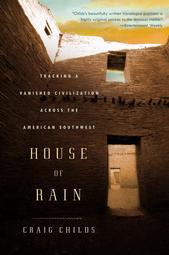
House of Rain

Title: House of Rain: Tracking a Vanished Civilization Across the American Southwest
Author: Craig Childs
Year: 2006
Genre: Non-fiction/history/archaeology
Rating: 2

Rain and the desert: polar opposites, at least to most people. Say the word desert in a crowd of people from a temperate climate, and immediately images of saguaro catci, bleached cow skulls, rattlesnakes, sand dunes, and sombreros come to mind. Dig a little deeper, and some people might think of the distant Native Americans, guiltily mumbling about how white people forced them onto godforsaken spits of land that nobody else wanted. What might surprise the average observer is that those people (the Apache, the Navajo, the Hopi, the Zuni, and many others) have lived in those lands for thousands of years and love it like their own blood. It may be harsh land, but it's their heritage.
Craig Childs's expose on the world of the Anasazi (or, more properly, the ancestral Puebloans) dispels many of the cliche tourist assumptions that Americans may have about the previous owners of our land. With a slow, respectful voice in deference to the secrets of the world around him, Childs quietly follows in the footsteps of a people who left their worlds behind them as a manner of living, tracing their history through only broken pots and tumbled walls.
House of Rain is a bifurcated novel: the main "story" follows Childs's physical pilgrimage across the migratory trails of the pre-Columbian Anasazi, and as he uncovers ruins and artifacts, he divulges his wealth of accumulated archaeological research. He begins in the New Mexican Chaco Canyon, where a great religious and commercial civilization flourished over a thousand years ago. He introduces us slowly to the terminology and basic architecture that these people used, then moves on to the next site at Fajada Butte, taking us along a journey that has long been misread, dusted over and ignored in favor of a more mysterious, though ultimately incorrect, theory.
According to popular mythology, the Anasazi were a people that lived in the Four Corners area of southwest Colorado and northeastern Arizona, constructing the impressive sites of Mesa Verde and Kayenta. On a visit to Mesa Verde, an ordinary tourist will be taken down into some of the breathtakingly complete and preserved cliff dwellings, leaning down into kivas and beholding intact wooden ladders from the 13th century. A tour guide will tell them that these people took refuge in the cliffs from an unknown enemy, possibly the Apache or the Navajo, and only occupied these dwellings for 80 to 100 years before suddenly vanishing without a trace. The guides cite the presence of full baskets of food, personal effects, and ceremonial artifacts as evidence that the people had no chance to collect themselves before disappearing.
This is not the truth, according to Childs. His research and experience have shown him time and time again that the Anasazi were a migratory people, who regularly used a pattern of abandoning structures and following the rain and drought cycle to preserve their way of life.
With extensive research and remarkable personal physical effort, the author takes us on a visceral, sensitive walk along a road that people traveled long ago, tracing the footsteps of a people not entirely gone. Along the way, he makes the point that there still are descendents of the ancestral Puebloans along this road: the Hopi still occupy their ancestral lands, the Navajo are linked to the mountains of their reservation, and people in the Paqime region of northern Mexico are familiar with the migrants' history. They are not gone, Childs concludes; they are simply dusted over with the passage of time.
His own journey drives this point home. Childs is no droll scientist sashaying into writing: his voice is clear, piercing, and in some places moving, bringing to life the dusty places that he stands. His passion for archaeology and the American Southwest pervades the novel, imbuing the words with a meaning other than simple information. That is the true beauty of this book: it is not just a dry recitation of facts. By throwing himself completely into his work, Childs has brought a possibly boring topic to life, enabling his findings to draw in even casually interested readers into a long-lost tale of a people long forgotten.
Although he does stray into sometimes long and dull passages rife with tangential information, the author never loses track of where he stands. One interesting and possibly unintentional beauty of the book is the fact that he brings his wife Regan and toddler son Jasper with him on parts of the adventure. Perhaps it was practical and coincidental, but by bringing such vivid pictures of life into these places long dead, he illustrates a point: the cycle goes on. Even if a civilization vanishes, life has not ended, and there will always be people chasing the rain, adjusting their lives to what is given.
Fascinating, comprehensive, and understandable even for a stranger to archaeology, House of Rain's 445 pages are a fantastic trip through a land that few modern Americans see: the bare deserts of the central Southwest. This book is available for $9.99 on the Kindle or $10.87 in paperback from Amazon, but because it's about five years old, it might be available in your local library. Go and take a look, because dispelling rumors is one of the most valuable things that an author can do. Sharing the truth is a great facet of history.

Sunday, October 7, 2012

The World Without Us

Title: The World Without Us
Author: Alan Weisman
Year: 2007
Genre: Science, environmental
Rating: 3

Ever feel guilty about being a human?
Sometimes I have spurts of self-consciousness, and I start recycling for a week, or I make an honest attempt to use as little electricity as possible. I even pick up other people's trash off the street and apologize to seagulls about polluting their lake and taking their swamp to build a huge city on. But then, life gets back to me, and I'm busy being a person again, and by the time I remember my environmentally friendly aspirations, it's many months later.
In his hypothetical experiment The World Without Us, American journalist Alan Weisman poses the question of what would happen to the Earth if we all instantly vanished. If every human either kicked the bucket or was abducted to some extraterrestrial zoo in the space of an instant, what would happen to the great cities and monuments we've built? What would become of the blue planet that we call home?
Weisman begins with our cities and suburbs. With exquisite detachment, Weisman chats about falling roofs, dirt-filled swimming pools, cracked pavement, and crumpling houses as if he is discussing the weather over a cup of coffee. Nothing in our drywall-and-plexiglass neighborhoods will last more than a decade (except for the ceramic bathroom tiles, but those will be buried by sediment before long). The step-by-step breakdown of the towns and houses we feel so safe in today is a little bit unnerving, if methodically and casually told.
Next he addresses our cities. Nature will make short work of those, Weisman says-- cracked pavement, invading trees, crumbling stone facades, collapsing subways, and so on-- and before long, islands like Manhattan will be close to the natural woodlands that they were before the Dutch ever set foot there. Of course, some things will be different, but these are just projections from one of the humans that will be long gone by the time the Empire State Building is rubble.
However, once Weisman shifts into the next part of the book (the one about the environment) the feeling of wonder ceases. The tone of casual detachment vanishes for one vaguely tinged with accusation and derision, and the guilt sets in. One must wonder if Weisman is a self-hater, for all the negative voice that he directs at mankind, even if the facts are straight.
The guilt keeps pouring on throughout the rest of the book, and by the time you reach the chapter about polymers, you're begging for good news about yourself. Maybe there's one thing that humans have done to benefit this planet, you hope desperately. And sure enough, there is a chapter about creatures that would miss us. Bad news: they're cockroaches, lice, and bacteria. The cute creatures might or might have a party when we disappear.
On top of being an enormous guilt trip, the book is really strangely organized. The beginning flows neatly, the pieces lining up into a fluid narrative of a world after humanity, the story growing like the trees that it describes. After that, however, it falls apart into a chapter-by-chapter non-cohesive blurb of information, all of which is indelibly researched and sound, but poorly set up. Disappointing for such a good beginning, the readers sigh in relief by the time they reach the end.
Altogether, though, Weisman poses an interesting question. What are we doing to protect the earth that we love? The resources may be there for our benefit, but are we being good stewards of what we have? Management is just as important as productivity. Maybe if we all think a little harder about what we use, what we buy, and especially what we throw away, the Earth would miss us a little more on the day we disappear.
The History Channel is running  an interesting series about the same topic, titled "Life After People." It's not affiliated with the book, but it just goes to show that now that the question has been raised, that nasty human attribute called curiosity has to explore it to its bitter end.
The World Without Us is available on the Kindle for $10.00, or in paperback for $10.20. After spending 26 straight weeks on the New York Times Bestseller list, this book is available in most libraries, but if not, see if a friend has it. It's not one of those books you read for fun on the weekends, but it's definitely worth it for the thought that it provokes.

Wednesday, August 22, 2012

The Emperor of All Maladies

Title: The Emperor of All Maladies: A Biography of Cancer
Author: Siddhartha Mukherjee
Year: 2010
Genre: Non-fiction/Medicine
Rating: 1

When you believe that you know someone well, you can look into their eyes and understand what it is they're going to think, say, and do. You know what buttons to push to make them mad, and what stirs their passions and makes them angry. You understand them, and even if they confuse you, you know who and what they are.
 Siddhartha Mukherjee describes his Pulitzer Prize-winning work in the foreword as a biography rather than a documentary because of the way that cancer behaves: more like a malicious, unpredictable person than a disease. The more we get to know it, the more it becomes an enigma, a presence, a personality. The Emperor of All Maladies (quite possibly the most fascinating and useful title I've ever heard for a book) reads like a morose biography, chronicling the 4000 year life of something that kills.
Cancer itself is a dark word in our culture, and doctors are the Spanish Inquisition in white coats. We intrinsically fear them because being in the presence of one means illness. Mukherjee, an oncologist from Boston, is acutely aware of the patient side of the medical process-- before the first chapter, he gives the projected mortality rate for cancer in 2010. At regular intervals in the book, he reminds us how unpredictable, volatile, and fragile our health is; at the slightest provocation, we can erupt into broken chains that lead us to death.
Mukherjee reminds us over and over of his deep connection to his patients, beginning and ending the story with cases of those cancer patients who have changed his profession. Weaving them neatly into the long tale of the disease, he moves back and forth from the overall clinical diagnosis of the pathology of cancer and the human face of it. Despite the thick medical terminology and complicated concepts, we never stray far from the real cost of medicine, chemotherapy, cancer wards, and cures.
On the note of medical terminology, Mukherjee's writing talent shines. Even the most medically inept layperson soon becomes familiar with words like metastasize, benign, leukemia, and remission; acronyms like ALL, VAMP, MOPP, and NCA are all distinct, organized, and used at appropriate intervals. The author's care for his readers shows clearly; despite the fact that he is obviously outstandingly intelligent, he never leaves his audience in the dust of his very complicated, convoluted topic.
This book is not excessively linear, although it does follow a central plot-- the development of modern cancer therapy. The history that Mukerjee follows is fascinating and well-organized, the pieces placed together in both systemic studies and chronological, committing to both the logical and psychotic behavior of cancer. Each scientist that we meet spends his life and career desperately trying to understand the disease eating their patients alive, and each one dies with one piece of the puzzle, trying to save just one life. And sometimes, they succeed in great flashes of genius, and sometimes, they save a few patients.
Understanding the disease of our time is crucial. This book is an excellent documentation of the plague that is merely "a distorted version of our normal selves." Even with the scads of published information about the group of diseases we call cancer, the detailed information rarely leaves the medical field, and the general population only gets the trickling facts from cancer patients or those who are curious enough to read the dense language of the medical field. With an accessible work like this, the proverbial hand is open; oncologists should enter the ward to patients who understand what they are about to be told.
Cancer behaves like a human being. We've spent 4000 years trying to understand it, from the Greeks who called it onkos to the men who tried desperately to cut it from the body in the mid-19th century, but like a pariah, it refuses to be put into our box. Common and still hushed-up, cancer is a specter of death that we all hope will skip over us. Only by studying its habits, its life, its very breath, can we ever hope to escape its grip.
The Emperor of All Maladies is still fairly recent and relevant, but you can get the Kindle edition for $13.99 or the paperback for $12.50 from Amazon. Informative, engaging, horrifying and enlightening, this book is bound to be a seminal work on the disease from beginning to end-- only with the full picture can we understand its purpose and its design.

Thursday, April 26, 2012

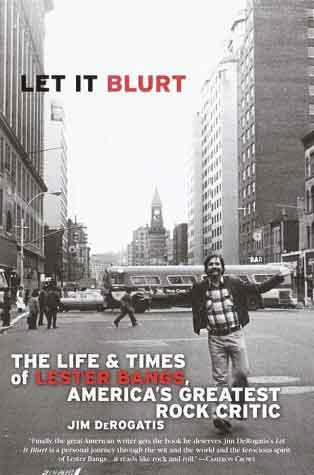
Let It Blurt

Title: Let It Blurt: The Life and Times of Lester Bangs, America's Greatest Rock Critic
Author: Jim DeRogatis
Year: 2000
Genre: Biography
Rating: 2

I'm not usually a fan of biographies-- after all, who puts the work into a biography of someone that they're not a huge fan of?-- but there's something to reading about someone's full life. We usually only get snippets of someone's life, like an anecdote on a news show, or a blurb in a textbook. But with a full narrative, we see how some things come full circle, or mean something truly important to a person's life. Biographies give us the cliffnotes on the subject's personal struggles as they developed. Separating the person from the book becomes almost impossible-- after all, we hear their voice, see their face, their actions, their family, everything they ever knew.
Jim DeRogatis, himself a journalist and music critic, introduces us to a character that most of us have at least heard of-- the enigma of the rock world, Lester Bangs. Anyone who knew anything about rock and roll writing in the late 60s, 70s, and early 80s knew who Lester was. With a distinctively outrageous, sometimes abrasive voice, Lester injected himself into every review that he ever wrote, endearing himself to readers across the nation more than any other critic ever had or perhaps ever will. Not only did Lester endear himself to the fans of the music, he himself had fans-- aspiring writers and musicians carried around clippings of his articles from Rolling Stone or Creem until they disintegrated into dust, laughing at his ridiculous vocabulary and ruthless style.
Lives are composed of thousands of moments that define us, that make or break who we are, and we hardly ever think to write them down in case we're important one day and someone wants to write a biography on us. Individual people don't have research libraries containing observations about what may have made them the way they are. DeRogatis has done his research the long, meticulous way-- interviews, reading, and the occasional speculation. Who knows if Lester would have agreed with some of the observations that he makes about what made him the mad genius that he was, but no one can deny that the facts are certainly solid. The author tracks the critic through his childhood in a podunk town in Southern California to a crowded trailer in Detroit to his rat-infested apartment in New York City, picking up the threads of old friends and rivals along the way.
One of the chief problems with most biographies is the fact that they're boring. Not so here. Let It Blurt is cheekily told in Bangsian style, spiced with slightly offensive quotes and out-there moments, characteristic of Lester's life. And yet, we are also drawn closer to Lester than many of his contemporaries were; we see how he struggles for love throughout his life, always eventually losing the women that he loved most, divided between his passion for the wild life of music and his yearning for a quiet life with a family. People always present facades, but underneath, they're all uncertain and questioning about their own lives, and we never see that better than with Lester's many faces.
Refreshingly, DeRogatis doesn't make Lester into either a hero or a villain. We see his faults-- drug addiction, alcoholism, irresponsibility-- as well as his virtues, and they synthesize to form a portrait of a very human, less than perfect man. The biography is not a review of Lester's life; we don't get an idea of whether he was a "good" or "bad" person. At the end, we only know that he did some great things and some terrible things, and all of them brought him to who he was at the end. Although it's impossible to separate the book from Lester's life, the shaping of the writing is very well-executed, cutting out long ruminations and side characters, just as Lester might have done. 
Obviously, this book is very special interest-- not everyone is interested in rock criticism, anyway-- but it's worth a read to just about anyone who enjoys music or journalism. For those who lived during those eras, the liberal splashings of references to bands and shows are an accurate shot of nostalgia, and for those of us born after 1982 (the year that Lester passed away), it's a whole new world that shaped ours into what it is. Plenty of humor lines the pages, and if it strays into moments of long-winded recitations, they stay amusing and fresh.
If a biography can accurately represent a life, then Let It Blurt may be the closest that we can come to knowing the scruffy, beer-stained writer who hung out in bars with bands in New York City. Lester Bangs is remembered both fondly and not so much, but the things that he said stay true for music both then and today. His passion for writing and music were one and the same, and it pours out through both-- the words are a clear mirror for his divided, whirlwind of a soul.
DeRogatis has also included selections of Lester's lyrics (from his jaunt into music) and writing, which are a nice touch, as he references several of the songs in the book-- having the full text helps to give the context for the line and the feeling of the song. The title of the book comes from one of Lester's songs, which is also included in the back of the book, and it gives the title another, deeper meaning.
Let It Blurt is twelve years old now, so it's available on Amazon for as low as $8.95, and you can get a Kindle copy for $13.99. You could probably get through this book in a week or two, as it's not a long read, and it's definitely worth the buy. Music fans and writing fans alike will find plenty to enjoy here, both in reading the book and remembering its subject.

Tuesday, February 21, 2012

The Big Thirst

Title: The Big Thirst: The Secret Life and the Turbulent Future of Water
Author: Charles Fishman
Genre: Non-fiction
Year: 2010
Rating: 2

Water is kind of a strangely common topic to write a book about, but Charles Fishman manages to reintroduce us all to the most unique feature about the planet we call home. In journalistic style, he presents water to us in a roundabout fashion, forcing us to see in in the light of what it is: a truly magical substance that we need to respect and preserve.
Fishman, the author of the bestselling The Wal-Mart Effect and winner of the Loeb award for investigative journalism, first reported on the bottled water industry in 2006. "I'm not afraid to ask stupid questions," Fishman responds to how he became interested in the broader topic of water. "How did bottled water get here? It's a completely absurd product. Why do we need to pay for bottled water?"
That stupid question led to four years of research, travel, and carrying jugs of water on his head for three kilometers with Papua New Guineans.
Fishman takes us on an extremely logical journey through the origins of water-- by the way, that Aquafina on your desk came from intergalactic space-- to the usages in different countries, and the history of how water has been treated throughout the past century of easy access and abundance.
But as all our friends in Arizona and Las Vegas know, water is a precious commodity, and it won't be abundant forever.
Fishman's writing style is straightforward, well-informed, and to the point. Although the paragraphs and elaborations can be long, they read easily and conversationally, as if you were speaking with a very well-read friend. He presents more of the facts than an actual argument, simply showing us what he's discovered and where this journey of learning about Earth's most precious resource has led him.
This is the first non-fiction book I've reviewed, and it's been a pleasant experience for me. I was given the chance to chat with Mr. Fishman a week ago, and he explained to me the very simple reasons that he became interested in the topic of freshwater: its effect on our daily lives. At any given moment, you'll see someone with a bottle of Evian or Polish Spring in their hand, and he says that he wondered how it got there. Not just from the plant, but where in the ground it sprang from, and where water came from ultimately. "Having a sense of history, and asking why things happen, I end up talking to astronomers," he joked.
The Big Thirst is a fascinating exploration of something that we already thought we were familiar with. We all learn the water cycle in sixth grade (precipitation, gathering, evaporation, condensation, etc) and likely never think about it again until our kids ask us for help on their science homework. But what if, one day, we woke up and found ourselves wondering where the water in the ice maker came from in the beginning?
Altogether, I give this book a 2. That's probably just my affinity for fiction speaking, but it is kind of a long book, at 405 pages. You can pick up a copy at the Kindle store for $9.99, but this book is actually a super good deal at Barnes&Noble, with the hardback going for $16.25. Either way, see if you can borrow a copy from a friend, but if you can't, definitely go pick it up. It's a thought-provoking book, and you'll feel really well-informed by the end.
That's all for day, you pageturners, you. Open your mind and try some nonfiction.

Tuesday, December 13, 2011

The Devil in the White City

Title: The Devil in the White City: Murder, Magic, and Madness at the Fair That Changed America
Author: Erik Larson
Year: 2003
Genre: Historical non-fiction
Rating: 1


If you could define a masterpiece, this might be a good example.
The Devil in the White City, a national bestseller, is a stunning portrait of dark and light America in the 19th century, a picture of realism and idealism. Very often, we tell our children the best stories of America and focus on the beautiful and cheerful and positive and neglect the shameful and petty. These disillusions are not dispelled as we grow up, and we remain blithely unaware of the dark past that many of our most beautiful places have. In order to interpret our future, we have to know our past, and The Devil in the White City is an enlightening piece of our own history.
Larson tell the story of the 1893 Chicago Columbian Exposition- The World's Fair- in enrapturing, grisly detail. Beginning with the designation of the location and Chicago's determination to have it, he outlines the political winds of the time period and the reasons for why it was in the Midwest instead of the obvious choice, New York City. Larson focuses on the main architect of the fair, Daniel Burnham, who is a household name in Chicago even today, and follows his struggles, frustrations, and ultimate triumph in the legendary World's Fair.
However, Larson also tracks a nightmare in a parallel story. The tale of H.H. Holmes, a psychopathic murderer lost to history, is interspersed with the larger tale of the Exposition. In grisly, meticulously researched detail, Larson follows the quiet threads of the man who murdered at least nine people and possibly more than fifty over the course of five years. Larson paints a dark human picture, leading readers down a dark path of either madness or sick, disturbed thought.
You thought you knew history. But Larson takes his readers through their own history, rediscovering details that they thought they had forgotten and clearing away foggy parts of that time period as he goes. I don't want to spoil too much of the story, but did you know that Aunt Jemima's pancakes had their start at the Fair?
Perhaps the most astonishing part of this book is the historical accuracy. Most of us slog through history textbooks in high school and college and then never read another one until our kids ask us for help with homework, but The Devil in the White City reads like an enrapturing novel. With the skill of a historian and journalist, Larson retrieves hundreds upon hundreds of quotes from the annals of history, filling them in like dialogue. His sardonic sense of humor and irony also keep the novel funny, despite the dark overtones.
So even if you didn't think you knew history, this book is worth the week it takes to read. It's not long, and you'll rip through it. It's a little older now, so I got my copy at a consignment store for $2.00, but you can get your copy at Barnes and Noble for $16.95 or on eBooks for $9.99. And trust me, it's worth buying, because you'll read it two or three times. Then tell your friends to read it. Then recommend it to your coworkers. And so on.
Anyway, it also makes a great Christmas present. Merry Christmas, everybody!

Friday, January 28, 2011

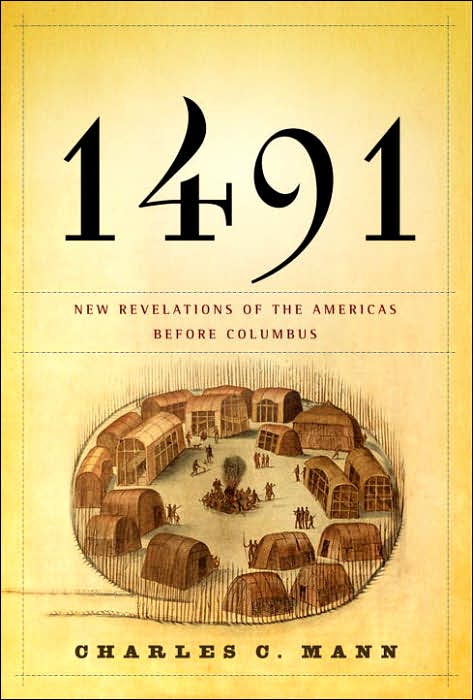
1491

Title: 1491: New Revelations of the Americans Before Columbus
Author: Charles C. Mann
Year: 2005
Genre: Non-fiction: History
Rating: 2

I don't really make a habit of reading non-fiction, but this is one book that I had been meaning to read for about two years. It was worth it, even though sometimes reading non-fictional facts was like chewing dry bark. 1491 is excellently researched, compiled, and written, the topics all referring back to the main heading and overall idea of the book. Charles C. Mann tells a beautiful, tragic story through the facts of the history of many societies lost.
1491 has a somewhat interesting format. It starts in the present with Mann flying over the Beni, an immensely historical savanna in Bolivia. He comments on the mounds, then moves gracefully into the book itself (that was only the introduction). He first talks about the Native Americans with which we are most familiar- the Wampanoag, Tisquanto's people- and follows their history up until the time of the Pilgrims. Here, the story is engaging and fascinating as Mann weaves together creative non-fiction with the real and true facts of Tisquanto's life. He then moves to talk about the devastating and horrifying effects of disease on the Native American population. Smallpox is a terrifying thing indeed- a weapon that thinking Europeans could never have matched.
Mann shifts from the colonial New England to the great fall of the Inka (I choose to spell it like that because Mann spells it like that, the original spelling), or Tawantisuyu- the land of the Four Quarters, in Peru. He details the Inkan empire extensively, following the stories of kings and their people, of cities and their conquest. They too fell to disease and Pizarro, but they were torn by civil war long before that. But I shan't spoil the entire book for you- these are only the first two chapters.
Mann is a masterful writer, but even he cannot dislodge my inherent dislike for non-fiction. I lost interest in the book somewhere in the chapter called "Pleistocene Wars"- it was not that the facts were not interesting, only that they became a little tedious. He goes on and on for pages about the "Low Counters" and the "High Counters", which makes the book drag heavily in the middle, glutted with too much information. I think he could have gutted the middle section a little bit more, but it picks up again toward the end when he synthesizes the real story of the history with our perception of it.
I really enjoyed 1491. It took me a while to get through, but it was completely worth it, and made me realize my ancestors' mistakes indeed. The Native Americans made their mistakes, but the Europeans' were far more grave and long-reaching. True, the circumstances of the invasion of the Americas is unlikely to be repeated (Mann recounts the Indians' genetic makeup as "virgin soil" for European diseases, uniquely vulnerable), but we can still learn from their mistakes.
I have this one in paperback, and it's pretty affordable at $16.00. I couldn't find it on eBooks, but because I have in paper copy, I didn't look very hard, so I think it likely that it could be found there. I didn't buy this one from Barnes and Noble, either; I got it from a teeny little bookstore in Iowa City, Iowa, so it is likely available in your local Borders' or Bookman's.
Anyway, that's it for today. Happy reading, my dear pageturners!