Showing posts with label fiction. Show all posts

Monday, June 24, 2013

When Captain Flint Was Still a Good Man

Title: When Captain Flint Was Still a Good Man
Author: Nick Dybek
Year: 2012
Genre: Drama/suspense
Rating: 2

Thinking of the people you know the best, you think you can estimate what they'll do, what they think, who they are by the decisions they've made in the past. They might be impatient, indecisive, peacemaking, passive, aggressive, impetuous, good or just plain mischievous. But the real questions is this: can you really ever know for sure what someone might or might not become as a reflection of their choices and their desires?
With masterful storytelling and paced gravity, Nick Dybek's When Captain Flint Was Still a Good Man peruses the effects of our choices and what they mean for who we are and what we might become. The smallest thing might change the course of someone's identity, but only if they want to change. The young voice of the narrator begins as reminiscent but fades to disillusioned as the story progresses.
Set in the rainy town of Loyalty Island in northeastern Washington State, the grey and misty air of a wet day in late November pervades the whole novel, despite the passage of time through the regular seasons. Cal Bollings, the fourteen-year-old protagonist, relates an incident surrounding the crab season in the 1980s when the heir of the Loyalty Island crab boats decides to break up his father's company, dooming the fisherman to unemployment. Richard Gaunt, the heir, is an interesting enigma to both Cal and the rest of the town: half crazy but strangely lucid, he is one of the few people that has left Loyalty Island for various destinations, but always returning because of some unnamed tie to the overcast land and dark waters. However, when fishing season comes around, Cal's father and the fishermen report back that Richard has gone overboard in the Alaskan oceans and drowned. Some weeks later, Cal finds out the truth and is forced to make a dreadful choice: defy his father and the men he has admired all his life, or do what might be right for the moment but will kill the island and all he has known.
The novel is told in flashback, which accounts for some of the grave maturity of Cal's voice, but is by no means dry. In some places, where the telling drops into vivid memories, we catch glimpses of what a fourteen-year-old might actually feel in this situation. Punctuated by poignant observations and proverbs, the writing is crisp and haunting, lending the book strength that the story might not have carried all of its own.
The characters themselves are striking. Cal's mother, for example, is a mystery to everyone on Loyalty Island, including his father, who goes off to fish in Alaska instead of trying to understand his wife. Even Cal is unsure of how he feels about her: love, anger, loyalty, bitterness and admiration all swirl around her at various points in the story. Richard Gaunt, one of the central figures of the story, is a beautifully developed character, not easily summarized or understood, even to an outside observer. Dybek is an incredibly intelligent observer of human nature, and When Captain Flint Was Still a Good Man lives and breathes with human life.
Cal's father, too, is a mixed figure, and we spend the whole story trying to determine whether he is a hero or a villain- which, of course, is the point. Perhaps we are all good and bad, and one decision can make us good just for the moment. After all, who is so bad they cannot be redeemed, and who is so good they cannot fall?
Dybek illustrates a great understanding of human nature and the suspense to tell a riveting, moving story. This novel is heavy, but not so much so that it will drown readers. Dybek is brave enough to ask questions that he doesn't answer, leaving readers to wonder what it all meant: hard for those looking for just entertainment, but for those who have the time to wonder, this story will echo.
Because it's relatively recent, When Captain Flint Was Still a Good Man is available for $10.28 in hardback from Amazon, or $9.99 on the Kindle. I was lucky enough to spot mine of the shelf of a used book shop for $2.00, so they are floating around out there, and your library might have a copy if you live in a city or a larger town. Make time for this novel, though; not a lighthearted read, but certainly valuable just for the quality of the storytelling. I would relate its tone to American Rust, which I reviewed late last year, but infinitely better done.

Saturday, June 8, 2013

The Left Hand of Darkness

Title: The Left Hand of Darkness
Author: Ursula K. Le Guin
Year: 1969
Genre: Science fiction
Rating: 2

The concept of negative space is confusing. Who ever heard of calling nothing something? And yet, in art, the first thing you learn is how to use negative space to define the positive space. In sociology, this often translates in a negative way: we define ourselves by what we're not, creating an "us" and an amorphous "them." But, reflecting back, don't we need "them" to be "us?"
In her 1969 novel The Left Hand of Darkness, Ursula K. Le Guin presents us with a conundrum of a people so foreign that they can't possible be us, but still strikingly human. 44 years later, the theme of cultural understanding in the novel still rings eerily true, with the marriage equality battle and more and more international contact every day.
Tucked neatly between several of her other science fiction Hainish novels, the story takes place on a frozen planet called Gethen, or colloquially Winter. The people of Winter are human in every way except one: they are physiologically bisexual, meaning that they are essentially androgynous but hermaphroditic and can change gender during a sexual phase of each month. While this is initially shocking to any reader– our lives are so dictated by our genders, it's nigh impossible to imagine not having one– this is essentially the point. The main protagonist of the novel, Genly Ai, is a human envoy sent to prepare the planet to join a coalition called the Ekumen. He is, however, the only human with a fixed gender on the planet, isolating him so completely that he is forced to reevaluate how he sees other life forms. In his negotiations to prepare the planet to join, he meets with insane kings, curious exiles, double-crossing diplomats and prisoners on the brink of the world.
One thing to note is Le Guin's brilliant use of the first person. Much of the time, when novelists revert to first person to tell a story, it becomes borderline autobiography, or the character at least becomes a direct reflection of the author. Not so here; Genly is a clear, strong voice, distinct from Le Guin's protagonists in her other works (such as the fabulous A Wizard of Earthsea cycle and Rocannon's World). She also departs from Genly to tell the story through the other main protagonist, Estraven, a resident of Winter, and to use "documents" to illustrate the fullness and history of Winter and its people. A full chapter about halfway through the book describes in detail the sexual functions of the people, which is incredibly helpful and interesting to readers.
Duality is the main theme of the story. Besides the obvious (switching between storytellers) we also feel the sharp rift between Genly and the rest of the world he lives in each time he interacts with a Gethenian. Surprisingly enough, Le Guin does not focus overmuch on the sexual frustration Genly feels, but instead on his feeling of isolation amid a society that does not have any definition of male or female. He makes some astute observations about human nature, now stripped of gender expectations, and it gives us a surprisingly raw view of what our nature really is.
The friendship between Genly and Estraven is another buried gem of the book. We meet Estraven in the first few pages of the story, but the relationship between the two develops in a non-linear way that keeps readers guessing up until the end. After all, Estraven could become a woman at any time, but is undeniably a man in others. In some ways, that subverts all elements of friendship that we are familiar with (especially between the sexes) but also solidifies it as a friendship between two souls.
It should be noted that Le Guin was and is one of the few women authors in science fiction. Especially in the 1960s and 70s, that field was particularly domineered by men, and her strong presence there is remarkable in and of itself. Her writing is a little more long-winded than many sci-fi readers might be used to and drags in some places, but it definitely stands on its own as a beautiful work of literature with all the complexity of a space novel.
All in all, Le Guin has created a pithy novel that still cuts to the core of multicultural understanding today, particularly between the gay and straight communities. However, it's larger than that; Genly's struggle to understand a culture both so far and so near is our own, even from block to block. We don't have to travel to other planets to find a dissimilar, misunderstood people.
The Left Hand of Darkness is not available on Kindle, but is available in mass paperback from Amazon for $8.99, or on the Barnes and Noble nook for $9.99. Even if you're not into science fiction, this is a great book to read for your own personal gain, and Le Guin is a great author to get into; she has written a host of books on a variety of subjects, and all possess her deep thought and broad ideas.

Tuesday, May 7, 2013

The Light That Failed

Title: The Light That Failed
Author: Rudyard Kipling
Year: 1890
Genre: Fiction/Classics
Rating: 1

Oh, the works that get passed over. Some of the greatest work of the greatest authors is ignored because it's missing some of the charm of their more popular works. Rudyard Kipling may be known best for The Jungle Book, Kim, and Captain Courageous, but he possessed a deeper observation of the world than just the adventures palatable to children. The Earth he lived on was full of failures, darkness, and pain, and any man given to the arts has the tools to express what he's seen.
The Light That Failed is just such a book. I originally picked it up off a corner bookshelf in an obscure bookstore in my hometown (the 1910 Art Type edition; I absolutely adore it) and only bought it for the author's name. However, after a year of trying to find time to read it and constant interruptions, I was able to immerse myself in the story and see the real beauty and skill that Kipling is famous for.
The book tells the story of two orphans, Dick and Maisie, who form a naive childhood relationship while under foster care before going out into the world. Dick goes abroad and to war, and Maisie goes to France for her education. The book skips forward about ten years, and we find Dick a talented artist who is injured in combat and sent home to London. There, in a chance meeting, he finds Maisie again, who has grown into a beautiful young woman with the same airy charm he remembers, and he renews his love for her. They are both artists, and he instructs her in a competitive way, but his unrequited love for her tortures the relationship. Then, to his horror and disbelief, Dick finds himself going blind from an old wound and must deal with the repercussions.
The primary attraction is the beautiful prose. Kipling is best known for his command of the English language, simultaneously making us snort with laughter and ponder what it means, turning us to and fro with quick but thoughtful words. Few other authors show his sense of humor in tandem with heavier thoughts. The Light That Failed is definitely of a different breed than his other works, but it is not out of character nor his style.
That being said, the symbolism is thick here. The concept of Dick being essentially castrated and removed from life by the old wounds of war is something that translated to today's soldiers (PTSD, anyone?) and Kipling's distaste for Britain's foreign involvements is clear. Of course, he takes a good-natured English stab at the French by his descriptions of the ridiculous art instructor Kami, but the serious current of concern runs beneath. Distance separates Dick from everything he loves, and even when he tries to go back, nothing is the same ever again after being exposed to the world.
The title is twofold: both literal, for his blindness, and for disappointed hopes.
Beware: this book is a tearjerker in some places. Kipling holds no details back when going down the disappointed hopes vein. He clearly believes that our efforts, no matter how much talent or time backs them, can still result in nothing when faced by the whims of the world. This fits perfectly in line with the sentiment of the time— the fin de siecle era was full of decadent and disenchanted modernist writers— but it is nonetheless upsetting to those who are looking for hope. In particular, the scene where Maisie finally visits Dick after his blindness completely takes over is moving. Kipling uses the full power of detached observance and vivid adjectives to convey how pathetically we can decline when struck by powers that we cannot understand.
In line with one of my other absolute favorite books, Till We Have Faces by C.S. Lewis, The Light That Failed has been passed over with time. That's terrible unfortunate, because I would contend that this is a landmark in the modernist movement and one of the better novels I have read from that era. Brief, poignant, and deeply felt, Kipling has given us a moment in time that we've all felt: something is irretrievably lost.
Because it's not popular, this novel is available for as little as $3.99 on the Kindle or $9.41 in paperback from Amazon. Or, believe it or not, it's cheaper on the Barnes & Noble Nook for $1.99. Your library is likely to have a copy because it's been 113 years since this book first appeared, but I would highly recommend buying yourself a copy. This book will not take you a long time to read, but I suspect it will hang around in your thoughts for quite some time after.

On a side note, I am not dead. I took a job back in January that requires an inordinate amount of time and have not had time to patronize the Chicago Public Library for anything other than 19th century French fiction (I'm taking a class on it— Rimbaud and Flaubert forever!). Over the summer, expect to hear a lot more from me! That's all. Thanks for reading! <3

Saturday, January 26, 2013

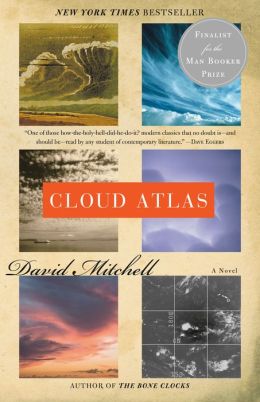
Cloud Atlas

Original image at barnesandnoble.com
Title: Cloud Atlas
Author: David Mitchell
Year: 2004
Genre: Science fiction/short stories
Rating: 1

Articles of life that we barely understand are sometimes the most beautiful. Those great mysteries that we realize can never be solved attract us over and over throughout our lives, preying on the backs of our minds, nagging, wondering. How is it that we cannot put them out of our minds? We know they have no answers, and never did, but some little part of human nature says that we cannot help ourselves. It’s better to wonder and never know than to be forever incurious.
Cloud Atlas is that balance of curiosity and answer, like echoes down a long canyon, leaving us to wonder if there really is a source at the other end. Woven artfully through difficulty and oppression, all of the characters of the book are victims of some heinous thing, but all heroes by their own spirit. Even if their stories end ingloriously, the meaning still stands, and that fact is the whole point.
            Summarizing David Mitchell’s abstract work is a bit like trying to make a Da Vinci out of cat’s cradle. So many different pieces pull against one another and seem separate, but are still knots on the same rope. We follow, more or less, a stream of consciousness on its path through six different lives, watching and guessing how they impact and change one another through the upheavals of time. From earthy, grounded Adam Ewing on the Pacific in the late 19th century to an unspecified, post-Apocalyptic Hawaii, Mitchell leads us along his twisted storyline of broken lives, and we wonder what anything means for the first 300 pages. And then, like a ball that’s made its weary way to the top of the hill, we slowly unwind to the bottom in a rush of emotions and revelations that both end our wondering and launch it into a new stratosphere.
            Mitchell is not only a literary master, but also clearly an outright genius. The organization and ingenuity it took to engineer the crisscrossing, complex, interlocked lives chronicled in Cloud Atlas would make the average novelist dizzy, let alone the invention of the unique structure. Formatted like a series of short stories, we are cut off at crucial moments and left to wonder for unnervingly long page numbers. For instance, we part ways with Adam Ewing after 39 pages and don’t meet him again until 475. If Mitchell were an average writer, we would hardly care for any of his characters by the time we see them again, but thankfully, he is not.
            Mitchell is renowned on both sides of the pond for his vivid imagery and evocative characterization, much stemming from this novel. With remarkably few lines, he attaches us so firmly to a person that never existed and never could (e.g. clone Sonmi-451, an artificially grown human that becomes sentient).
            Another feat of writing is the center segment, “Sloosha’s Crossin’ and Everythin’ After.” Written in a pidgin English style that evokes Brer Rabbit, Mitchell flexes his imaginative and technical muscles, detailing a world completely foreign to us in language difficult for us to understand. Somehow, it comes out clear and endearing, and that alone earns him a star.
            Another star comes for the sheer beauty of the ending. Many modern authors have lost the ability to move their readers by the sheer beauty of their prose, but Mitchell clearly feels deeply about the written word and the power it can bestow. He uses the last, poignant moment to reflect on what it is we are, summarizing the novel in one way and in another dispersing it.
            In essence, Cloud Atlas tells the story of what we mean to one another. Just as there is no way to accurately summarize a life, there is no way to summarize them all. We study, we learn, we pull meaning out of the past and apply it to the present, but each second creating a past that will only be changed in the future. The truth of history is what we make of it; the truth of the human experience is what we are.
            Mitchell delivers us this observation in an airy package full of printed sounds, black and white colors, and souls wrapped in words.  Something undefined fills the karma that he implies—that no matter if we live alone, feel alone, and die alone, as long as we are alive, we are never truly alone.
            Cloud Atlas is available on the Kindle for $11.99, or in paperback from Amazon for $12.98. This is not your average light weekend reading, nor is it pure entertainment—no, this book requires your attention and consideration as the pages turn. It was recently made into a film starring Tom Hanks and Halle Berry, and I have not seen it yet, but I cannot fathom how the screenplay runs. I’ll have to watch it just for pure curiosity as to how it flows.

Wednesday, January 16, 2013

The Dark Lord of Derkholm

Original image at Wikipedia.org
Title: The Dark Lord of Derkholm
Author: Diana Wynne Jones
Year: 1998
Genre: Fantasy
Rating: 1

Everyone has one of those silly books that they're incredibly attached to. Something about it just stirs your heart, and even if the language is simple and the concepts basic, you laugh every time and read it again and again. For many people, these books are those like the Harry Potter series; for others, it's The Enchanted Wood.
The Dark Lord of Derkholm is mine. And it's not because I read it when I was very young; in fact, I picked it up off a neglected bottom shelf at my small town library when I was 15 because it happened to be next to Howl's Moving Castle, which I was reading in preparation for the animated film. Something about it snagged my attention, and I proceeded to read it twice before I had to return it. I ordered my own weatherbeaten paperback and have read it at least twice a year since.
Diana Wynne Jones, who has a knack for bringing a sense of humor to the genre of fantasy, has created a world with charm, wonder, and intrigue. Derk, a homely wizard who creates unique animals (e.g. daylight owls, pigs that fly, and intelligent griffins) finds himself pegged to play the role of the Dark Lord for the Pilgrim Parties, tours that annually come through Derk's world and make a proper mess of everything. Derk and his people are contractually bound to play along, pretending that their fairly well-developed world is a medieval waste living in fear of the Sauron-like Dark Lord, and the Pilgrim Parties each think that their role in their tour is to kill him and liberate the world. However, as Derk scrambles to put his life aside to perform the role, other wizards work behind the scenes to end the Pilgrim Parties forever.
We meet dozens of hilarious, colorful characters, such as Derk's family, which is composed of his wife, son, and daughter, and five griffins he has mixed with human cells "to make them people," as one of them explains. Each one behaves just like a peevish human teenager, and Derk's relationship with each of them is heartfelt. By the end of the story, we've nearly forgotten that they're griffins. Jones also presents ordinary domestic stresses to the story, weaving them neatly in with the magic of the world, creating a believable family with believable problems.
Oftentimes, fantasy writers are so caught up with creating their worlds and developing the science, characters, and plot, they lose their voices as storytellers and become mere documentarians. Jones skilfully paints her world with so many joyful details, kingdoms, and stories that we are dazzled from the beginning; add her dry, subtle sense of humor, and you have a masterpiece. She masterfully satirizes the fantasy genre while adding an unforgettable piece to it.
Derk is, of course, the man around which the entire novel whirls, but Jones easily transports us to and fro across the world to catch up the most important pieces of the story without losing us along the way. Communicating stress in a novel can be a dangerous thing (you don't want your readers to become too stressed themselves to keep reading) but Jones does it playfully, yet strongly enough to induce her audience to pitying our favorite wizard. Derk is just a harassed, unfortunate man, and yet a symbol of strength and steadfastness; just what a father should be. And yet, everything goes wrong.
Jones's main point in the story is to remind us how very little we are in control once we give ourselves away. Sometimes, giving up control can be a good thing, like submitting to those we love; however, sometimes it can be so easy to just give in to those who want control, and for the sake of those we love, we cannot stop watching for what is best for our world. The end does not justify the means; collateral damage is necessary, but people's feelings must always be considered.
Maybe this novel doesn't change the earth, but it worms its way into your heart, never to be forgotten. With lighthearted love for that world, readers of every age can enjoy The Dark Lord of Derkholm and its manifold virtues. At any rate, it's worlds better than your average R.A. Salvatore novel. All of Diana Wynne Jones's novels satirize fantasy, but this one does it best.
The novel has no conclusive ending, but in the mood of the story, we don't miss it. Life goes on. Its sequel, The Year of the Griffin, was published in 2010; I have yet to read it, but be sure I'll get around to it.
Because this novel is quite old now, it's available in most book stores, or on the Kindle for $6.64. Or, if you want a printed copy, it's available at Barnes and Noble in paperback for $7.99, which I recommend. Pick up one from your library if you can, but if not, it's worth the purchase. It's pretty bloodless and devoid of serious swearing, so kids can enjoy it. That is, once their parents are done with it.

Monday, January 7, 2013

Mockingjay

Original image at suzannecollinsbooks.com/
Title: Mockingjay
Author: Suzanne Collins
Year: 2010
Genre: Teen/thriller/sci-fi
Rating: 2

The end of a series is supposed to settle the readers' minds, even if it's not a happy ending. We want to see our heroes reach a resting place to nurse their wounds and work their way toward happiness after the battle is over.
But for a hyperactive, ADD plot like Mockingjay's, concluding is synonymous with death. Had Suzanne Collins not committed to a trilogy, she would have probably drawn out Katniss's story for another two books or so, and if it would have helped to pace this novel better, she would have been right to do so. As it stands, Mockingjay reads like twenty climaxes smashed together to make a jarring, heaving, ponderous plot laced with gratuitous gore and little meaning. The only thing that keeps us going is an attachment to the central characters.
At the beginning, we find Hunger Games victor Katniss Everdeen broken, bruised, and confused after her dramatic rescue from the arena and removal to the mythical District Thirteen, which resembles some kind of industrial distopia. Katniss chafes at the rigorous rules of her new home and at the expectations placed upon her to become the Mockingjay, the symbol of the rebellion now seizing Panem. For the past two years, Katniss's presence on national TV has been sparking these seeds of discontent, and now the rebels see her as an icon of hope, of defiance. All she wants to do is go back to District Twelve with Gale Hawthorne and her family, but her home has burned to the ground, her friends either dead or refugees, and Peeta Mellark in captivity in the Capitol.
Katniss, besides being faced with the decision to be the face of the revolution or not, is also faced with that omnipresent question of romance: her best friend Gale, or her fellow victor Peeta. As the violence spins more and more out of her control and she begins to question her own dedication to the cause, the world exerts more pressure on her and on her fellow soldiers, driving their war to the bitter end.
The most interesting thing that Collins does with the idea of revolution is the PR face. Katniss is by no means the great general that the rebels need to command them; she is merely the symbol that they all recognize to keep fighting, and the hard-hearted president of District Thirteen is set on using her as propaganda to propagate her war. The executives of the movement tape clip after clip of Katniss and her team to indoctrinate the people, constantly considering her behavior and how it will affect mass opinion of the war. Katniss knows this and feels ill-used, which is the most complicated emotion in all the books that Collins puts forth: are the deaths of all the people she encourages Katniss's fault?
When it comes to sheer surface entertainment, the Hunger Games series is unrivaled. Loaded with suspense and danger, Mockingjay keeps readers on the edges of their seats and guessing until the end, the plot careening down a wildly twisting path until the conclusion. And it is twisting: any sense of restraint that Collins felt about her violence is suddenly stripped away in her third installment. The first two books were graphic, but there was always a subtle hint of reluctance to kill characters that we had grown attached to. Not so here. Just like her characters, Collins seems to have driven herself to the edge and held her ground strongly enough to kill off rebels that she had written extensively about. This lends the story a feeling of reality-- revolutions are horrifyingly bloody, and many beloved people die every time. It would have been laughable had all of Katniss's allies made it through unharmed.
Oh, do the parallels of the evils of socialism continue. District Thirteen is an eerie shell of Soviet Russia, with toe-trampling rules and over-the-top punishments for tiny crimes. Freedoms are restricted to the bare minimum, and the people don't seem to mind. Only Katniss and Gale, the brave champions of freedoms, are willing to defy the rules of the overbearing society, braving the anger of the ruling powers for the general good.
However, that's the only real parallel. The surface entertainment is about all the value available in Mockingjay; Collins awkwardly skirts around any pithy topics, even if she has set up a perfect situation for them to be explored. One theme that appears over and over again is the question of what it truly means to kill another person. She repeatedly mentions this struggle in Katniss's thoughts throughout all three books, and yet after roughly 1100 pages, we still don't know what it really means. Death after death goes by, and the only one that really comes close to touching that question is Rue's death in the arena in the first book.
(On a side note, does Collins really think she's being clever with her Latin? Maybe for a monolingual society she is, but seriously, I saw the Rome parallel before I even read the book. She didn't need her whole Panem et Circenses bit. Plus, Avox is a really pathetic attempt. When the characters think 'hijack' is an archaic word, how on Earth do they know enough Latin to name various things?)
The most disappointing part of Mockingjay is the ending. With all this colorful, thrilling writing under her belt, one would think that Collins could piece together a conclusion worthy of the characters that she has spent so much time developing, but we're left with a twenty-five page slop that is like staring at grey wallpaper with grey patterns on it. Sure, she's trying to portray a fog of grief, but the writing should induce tears of sympathy, not boredom. Even the epilogue is arbitrary and pointless. The bare facts of how the story ends are sort of bittersweet and touching, but change in pace drops us like a stone into the cold water of the book being over. Something tells me that her publisher was pushing her toward a deadline and she had to crank out an ending.
Altogether, the Hunger Games tells a beautiful, terrible story, filled with characters we can believe in images we won't forget. Perhaps the meaning is meant to come from us as we read. Collins has provided us with a beautiful wilderness of story; it's up to us to make it mean something.
 Mockingjay is available on the Kindle for $5.99, or in hardback from Amazon for $9.86. Because the Hunger Games is such a book of our times, it's worth a read, but don't go in expecting deep thoughts. Consider the series a light weekend thing, but definitely don't read it to your kids. It's a little graphic even for adults.

Monday, December 31, 2012

Catching Fire

Original image at suzannecollinsbooks.com/
Title: Catching Fire
Author: Suzanne Collins
Year: 2009
Genre: Teen/thriller/popular
Rating: 2

The second installment of a trilogy is almost always the best of the three. Take for example The Two Towers, which captures the soul of the whole story, or The Empire Strikes Back of Star Wars. Because the central story doesn't have to introduce strangers into a brand new world or say goodbye, it nearly writes itself. The tension strings the two together, and the book can act like the climax of the whole.
Catching Fire, the second novel of the acclaimed Hunger Games series, acts like the first. After the choppy, rushed introduction of the first book, the second flows much more naturally and freely.
Suzanne Collins brings us back into her futuristic country of Panem, where Katniss Everdeen and Peeta Mellark have returned to their home district and prepare for their forced tour of the districts. Their relationship is forced and awkward now that the games are over and they must go back to their original, simpler lives. However, the world has changed since Katniss's explosive presence on the Hunger Games. The twelve districts are on the brink of revolution, and the remarkably revolting President Snow approaches Katniss to enlist her to defuse the rebellions steadily growing in the country.
But Katniss has other problems. And as her personal life spins out of control, so does the feeling in the country.
Collins has clearly realized that in the face of the immense popularity of The Hunger Games, she needs to refine her writing for a larger audience. The syntax of this novel is much cleaner and more mature, and the characters think in much more logical, mature manner. Peeta, who was borderline childish for large sections of the first novel, is suddenly an adult and full of much more relatable pain. Gale, who was pointless and flat, suddenly folds out like origami into something far more complicated and able to stand on his own. He remains a little cliche in places, but his interactions with the citizens of District 12 glow far more than those with Katniss.
Better yet is the unpredictability of the novel. While The Hunger Games is both somewhat predictable and even a touch corny at times, Catching Fire pitches a continuation of the story in a familiar direction with the touches of Suzanne's overall goal for the story. Katniss, Haymitch, and Peeta are pitched into a sort of dysfunctional family relationships because of their one horrid commonality-- they were forced to kill their peers for the entertainment of those around them.
And yet, despite the improvement of the entire novel, there is a hollowness, as if Collins has written the body of the story but sucked the marrow out of the bones. It has a skeleton, but the bones are empty and there's no blood in its body. She tried to make up for it with the gratuitous amount of violence, but this does not stop us from feeling a certain emptiness for a true meaning in the story. One of the themes that screams to be explored is also the most obvious: what does it mean to kill another person? What has to change inside of us to be able to face someone just like us and kill them to save our own life?
Sadly, Collins skirts these great questions for the entertainment value. Not that it is lacking-- the story is fast-paced, gripping, and tear-jerking in places. Great new characters are introduced, and the relationship between Katniss and Peeta changes into a form both more complicated and more simple. Katniss does all she can just to survive, even when that means hurting the people she thinks she might love.
The title is a double entendre and refers to the first Games, which takes about half the book to figure out. However, the scene in which she fulfills it is strikingly unforgettable; even if she is no Dickens, she has the visuals of a master.
Altogether, though, Suzanne Collins has done that thing that authors dream of: writing a sequel that improves on the original. Available for $5.99 on the Kindle or $9.87 for the hardback on Amazon, Catching Fire is worth the read for anyone, but read the original first, because otherwise confusion is inevitable.
The film is due out in September 2013, with a much larger cast (including Philip Seymour Hoffman as Plutarch Heavensbee). Look for the long line of screaming teenage girls outside the movie theatres.

Tuesday, December 25, 2012

The Hunger Games

Image credit to suzannecollinsbooks.com/
Title: The Hunger Games
Author: Suzanne Collins
Year: 2008
Genre: Sci-fi/thriller/teen
Rating: 2

Action! Danger! Tragedy! Oppression! Romance!
You couldn't ask for more on a movie poster. Perhaps, in fact, if any book could have skipped the written phase and gone straight to film, it would be The Hunger Games. Rapid-paced action and visceral imagery make this book a top-notch story, and even if the language leaves something to be desired, it hits its target crowd exceptionally well. After all, sometimes all we need is a good story, right?
Suzanne Collins is an experienced children's writer; she has written multiple episodes for 1990s TV shows like Little Bear, Oswald, and Clarissa Explains It All. She has also written a five-book series for children known as The Underland Chronicles, which are an interpretation of the classic Alice in Wonderland.
However, with The Hunger Games, she takes a step into the gritter world of teen fiction, leaving behind squeaky-clean genres for a heftier tale. The novel tells the story of 16 year-old Katniss Everdeen, a poor girl living in the 12th District of a post-apocalyptic North American country called Panem. She is content to lead a quiet, meager existence by illegally poaching off of government land to feed her family until her younger sister, Primrose, is called out to be a participant in the bloody gladitorial contest known as the Hunger Games. In desperation to save her sister's life, Katniss volunteers to take her place, sealing her fate to kill or be killed.
To make matters more complicated, a boy that Katniss owes her life to, Peeta Mellark, is named as the other participant, obliging her to kill someone that she feels indebted to. Thus, she explains, is the horror of the Games: in order to survive, you must give up all your dignity, which is the government's aim. As the book progresses, the relationship between Katniss and Peeta becomes much muddier and more complicated, and even she is not sure how she feels about the boy who saved her life, the boy she is obliged to kill.
Told in the first person, the book places the readers firmly inside Katniss's mind. We hear her thoughts, her gut reactions to things, and see the grossly unfair world of Panem as she sees it. Grammar fanatics will squirm and squawk as they read turns of phrase (think high school language, written down) and the truncated fragments of thoughts are jarring, but the argument stands that they do place you into the mind of a coarse teenager.
Collins has created a marvelously dark, creative world replete with extensive details and logical, ordinary, yet beautiful characters. Although some of the people we meet are rather two-dimensional (Prim and Effie are exceptionally flat, and Cato runs a close third) Katniss and Peeta are fully fleshed out, and blend together beautifully. As time progresses, we understand more of the darkness and complete victory that the Games are to the Capitol, dehumanizing their victims and their audience in one blow.
The story is a thinly veiled allegory for the evils of socialism, what with the rigid rule controls on each district's product and the omnipotence and omniscience of the government. Katniss and Peeta represent the young capitalists defying the shackles of governmental regulation, shaking off the social expectations of submission and fear. Collins has essentially created a effective propaganda piece for republicanism with a action-packed, fast-paced, driven plot filled with believable people and graphic imagery.
The target audience is most definitely teenagers and young adults. The language is easy and flows much like an average American talks, and there are few moments without some sort of action or plot-centric exchange. Collins draws in a female audience with the sweet, innocent romance between Peeta and Katniss and the male audience with the sheer horror of the Games that she describes. (Cato's death is particularly horrifying, and will shock anyone with a visual imagination.) Intuitively weaving all of her different articles together to create one enormous, lumpy tapestry, Collins introduces us to a plot that we can love and remember, cheer and grieve for, and step easily into with the tightly-woven words she has written.
Because it is told in first person, the book stays with Katniss nearly every waking moment for a few weeks, but at just over 300 pages is surprisingly short. While that style necessitates some dull moments, some of the scenes are exceptionally poignant, such as the reaping (where the participants, known as "tributes," are named) when Katniss throws herself forward to save her sister. Rife with passionate language and the impulsive nature of the action, we are gripped throughout the telling and tied tightly to the brave girl as she sacrifices herself for love of family. Because it is told in the present tense, the readers experience the events in hypothetical "real time," which places us even more inside the mind of Katniss, lending us her emotions and distractions. Perhaps it is because we nearly become her, but our heroine is one of the most complete characters in popular literature.
The film, starring Jennifer Lawrence as Katniss and Josh Hutcherson as Peeta, came out in March 2012 and drew an enormous audience for its extended run. Catching Fire, the next film, is expected in September 2013.
The Hunger Games is available for a meager $5.00 on the Kindle (it's free if you join Amazon Prime), or $10.89 in hardback. The entire trilogy, which includes Catching Fire and Mockingjay, is available for $18.99 on the Kindle or $29.50 in hardback. Because of the popularity and timeliness of these books, they are probably taken out of most libraries most of the time; if you can't borrow them, they're worth the purchase. Mine were given to me by some wonderful people as a Christmas gift, and I profusely thank them. It's taken me a really long time to jump on the bandwagon.
Merry Christmas, everyone! Hope you got or gave at least one book today. Enjoy your break and keep reading!

Monday, December 10, 2012

We, the Drowned

Original image from stevementz.com.
Title: We, the Drowned
Author: Carsten Jensen
Year: 2010 (English)
Genre: Historical, exploration
Rating: 1

What do we base our identities on? Does the shape of the whole define the shape of each individual, or the other way round? Perhaps both.
W.B. Yeats once wrote, 
              The finished man among his enemies? 
                    How in the name of heaven can he escape
        that defiling and disfigured shape
 the mirror of malicious eyes 
          casts upon his his eyes until at last 
                 he thinks that shape must be his shape?
                            And how in the name of heaven can he escape
            if honor find him in a wintry blast? 
--A Dialogue of Self and Soul
  Carsten Jensen's seafaring novel We, the Drowned not only explores the ending days of sailing ships and the Danish world, but also delves into the heart of those questions that purse us every time that something ends. Where do we go from here? What am I without it? 
Told from the perspective of no particular character, only the we of the town, the novel tells the story of a Danish seafaring town called Marstal off the northeastern coast of Denmark. For generations, men and their sons and their grandsons have gone to school until confirmation, then taken to the decks of ships to sail around the world, only returning once every two years or so. Those left behind, the mothers and children and parents, wonder if they will ever see their sons again, but have to learn to live around it-- Marstal is a seafaring town. The men take pride in it, and don't care if they drown. To them, that's just collateral damage in their line of work.
The book tells the story of Marstal from 1848 until the end of World War II, sharing the lives and adventures of several people along the way, but never from their perspective. It is always the townspeople sharing the story from the outside, as if they were reading diary entries or sharing the tales over beer in a pub. We begin with Laurids Madsen, the heart of Marstal seafaring, a man who trusted nothing save his own skills and his sea boots. He disappears into the South Pacific, and fifteen years later, his abandoned son Albert goes looking for him to give his family some closure. We trace Albert's life from beginning to end, and we meet Knud Erik, a boy who was denied the sea by his mother, and wanted the adventure with his whole heart. Dozens of other names float by, like acquaintances we only knew a little, living their lives and passing away as time goes by.
The first chapter is a bid muddled, as you are walking in on a complex world that you know very little of, but everything soon falls into place. The crew is the "we" in this case, and they tell the stories of the legendary Laurids Madsen, like a hero that they all knew, who did nothing more than survive. That is the legacy of Marstal-- those who survive are the heroes.
The greatest majority of the book, though, involves Albert. After becoming a hero for sailing the South Pacific and returning with tales of cannibals and shrunken heads, Albert watches his friends die and his town grow old, and he can do nothing to stop it. He watches his own life drift idly by after he comes ashore, constantly longing for the danger of the sea, and conflicted by his own desire. After all, who is he without the sea? He is a sailor, and if he no longer sails, he's drifting.
Knud Erik, too, is an vividly living character, full of latent desire, suppression, and longing, pursued by his own dreams. He was shaped from a young age to love the sea and sailing, and once he reaches it, it's so different than his expectations that he's not sure what to do. His whole life has been about sailing, and when his desires change as he ages, he falls stagnant, trapped by his achievement.
Jensen is brilliant. Even though We, the Drowned has been translated from the Danish, it reads smoothly and beautifully in English, even the idioms and quotes falling into place. He clearly has a passion for this town and its history, and as he grew up there, he understands the dreams of the people and the things lost. Marstal comes to life in its biography, fraught with danger and very real characters.
The novel is gritty, dark, and gruesome where it needs to be, but no more so than necessary to be real. Many times adventure novels become romanticized, and while this book has its fictional elements, the core of it is so deeply human and real that even the words of the characters come to life. Every Marstaller walks the streets, warm with the blood of their ancestors that we knew, full of the dreams that they know will never come true.
The core is all about identity. We all know that nothing lasts forever, even if we hope it will, and life is all about learning to say goodbye and change ourselves. Marstal faces the extinction of its way of life, and even though the men are the greatest sailors in the world, they cannot stop the end of the sailing ship as they had known it for centuries. Laurids' identity is in his thirst for adventure, and it ruins him; Albert's identity is in his skill and experience as a sailor, and once he retires, he is forced to change himself. Knud Erik's identity is in his dreams and ambitions as a sailor and defiance of his mother. There is a drawing point where each man must face failure or change, and some do, but some fade away.
The second chapter is the most strikingly poignant. We are placed amongst the schoolboys of Marstal, tortured by Isager, the abusive schoolteacher. He teaches them to accept pointless abuse, because that is what they will get aboard ships their whole lives, and the readers recoil against it. And rightly so-- it is horrific, but real. In the middle of the chapter, the boys have a quiet moment, and they say poignantly,  "We committed appalling acts and only realized the horror of what we'd done when we stood gathered around the evidence of our atrocity. Violence was like a drug that we couldn't relinquish. He planted a thirst for blood in us. One that could never be quenched."
In addition to the brilliant main characters, every side character is unique and colorful. Jensen has painted a full picture of a town, leaving no one out and nothing corrected. For example, Lorentz, a contemporary of Albert, is constantly seeking acceptance and only learns to accept himself by years of rejection. Another striking character that is nearly impossible to sort out is Herman, a darkly suspicious man who does what he will, but he is still a Marstaller and therefore "one of us."
At 678 pages, We, the Drowned is a hefty novel, but it wastes no time on unnecessary moments. Capturing the very real parts of life is the challenge to the novelist, but Jensen has done it so poignantly that his work will survive amidst names like Moby Dick, The Old Man and the Sea, and The Odyssey.
Available for just $9.32 from the Kindle store, We, the Drowned is one of the best books I've ever read. I have a deep fondness in my bones for seafaring novels (stemming from a childhood copy of Carry On, Mr. Bowditch) but this one goes even deeper. Because of its raw emotion and beauty, this novel will live forever in the hearts of those who quest for adventure and identity. We all want to know who we are, and we belong to each other just as much as everyone belongs to us.

Monday, November 19, 2012

American Rust

Title: American Rust
Author: Philipp Meyer
Year: 2009
Genre: Crime/drama
Rating: 4

Okay, we get it. America has no jobs, the Rust Belt felt the worst of it, our youth is flailing without a direction, and we need to reach inside ourselves to find a future. Anyone who has lived in America for the past five years knows that, and while the situation in the old industry centers is pitiable, we need to move on now, kay? Thanks.
Philipp Meyer's novel American Rust attempts absolutely nothing daring. Novels of the times are all too common, and it's not like any of us don't know what's happening in the factories and mills of the old production towns. We've all stepped inside what it means to be an American in these times, when the American Dream is dead and we need to find a new dream to pursue. Meyer is not touching any new ground here; in fact, he may even be wallowing in the past, depending on how you look at it.
The novel runs like the ripples in a pond-- a story of aftereffects. At the very beginning of the story, twenty year-old genius Isaac English has already stolen $4,000 in cash from his crippled father and strikes out into the dark with his best friend, Billy Poe, to make their way out of their economically crippled Pennsylvania town of Buell. However, a run-in and subsequent fight with some homeless men leaves one dead, and the two boys must face how that small act of desperate, poorly considered violence will change their lives forever.
Poe's mother Grace, police chief Bud Harris, and Isaac's sister Lee also tell chunks of the story from their perspective, but all speak from the same voice: stagnant hopelessness. Even Lee, who has escaped from Buell and married into a rich family in Connecticut, has little direction and feels trapped by her past. Grace has slid into her present with little ambition, and now regrets her choices, and Bud has tried his hardest to prevent Poe's inevitable time in prison. The novel plays out in bad choice after bad choice, all of which make sense at the time, but have negative consequences in the long run.
Shadows of the Great Depression are nearly tangible throughout the novel. The most omnipresent wound in Buell's wallet is the closure of the steel mills in the 80s, which shut down the entire Valley where the town is located. Poe, Isaac, and Lee often comment on how beautiful the landscape is despite the heavy air of economic suffering on the town, but they talk about little else. Meyer certainly understands what it's like to have little money and no job, but he doesn't seem to understand much else.
The one interesting facet of this novel is writing style. Told in stream-of-consciousness, the style is evocative of James Joyce's Portrait of the Artist as a Young Man. In fact, Meyer is probably a Joyce fan, as he slips in a subtle mention of the author in one of Lee's segments. The format lends the novel an element of sensitivity, like stepping inside the minds of the characters, bringing them to the human level the reader sitting in their heated home with enough to eat and an alarm system.
However, that is the only humanizing thing about American Rust. Very little of it seems real, and the author may argue that that's how it really is, but having lived in America all my life, this seems rather romanticized and farfetched. None of the characters is relatable, or even realistic: Isaac the genius, removed from society, Poe the jailbait, Lee the nostalgic rebel, and Grace the regretful waiting mother. All of them neatly fit into stereotypes that we expect in a novel about a crumbling society, and though they may exist somewhere in the world, people tend to be a great deal more complicated than Meyer makes them out to be.
Bud Harris the only interesting bright spot. He is conflicted about his life, stagnated, and unsure of why he does what he does. His chapters, rife with a kind of sadness about the state that both his country and his life are in, bristle with a resigned anger, and that is the only unique thing about this book. If the whole novel had been about Bud, it would have been time better spent.
American Rust is available for the Kindle for $11.99, or $10.20 in paperback from Amazon. It's three years old now and 367 pages long, so skip buying it if you can and check your library. Overall, a pretty dull read, and dragged out far longer than it should have, but the writing style is worth a shot if you want something simple and gritty to get you through your Thanksgiving break.
On that note, happy Thanksgiving, everyone! Read a book. If you're looking for some good ones, try An Imperfect God, or if you're in a fiction mood, The Whiskey Rebels is fantastic. Or, I've heard The Jefferson Lies is great, but I haven't gotten my hands on it yet. Enjoy your break!

Sunday, October 28, 2012

The Beekeeper's Apprentice

Title: The Beekeeper's Apprentice
Author: Laurie R. King
Year: 1994
Genre: Fiction/crime/mystery
Rating: 1

The felt cap, the magnifying glass, the pipe. The sharp nose, the serious grey eyes, the angular cheekbones, the thin long legs. Quick with words, sharper with action, hardly sleeps, always works, and keeps his associates in the dark. In other words, Sherlock Holmes.
Over the century since Arthur Conan Doyle's mysteries were first published in the Strand, hundreds of adaptations of his character have appeared on stage, film, print, and music. Many of these adaptations have taken considerable liberties with the original detective so beloved to millions worldwide, resulting in interesting if non-canon stories. Doyle expressed distaste for his detective, hoping in the end that Holmes would not be his legacy, and unfortunately for him, that is the end of the story. His other works, including The Lost World, are excellent, but all pale in comparison to the astute and acidic observations of the Baker Street resident.
Few authors are ever praised for being uncreative, but Laurie R. King deserves a medal for doing just that: sticking to the original character. Far too many adaptation authors take liberties and alter the characters to their whims, betraying the original fans, but King has taken Holmes delicately into her hands and shaped him as Doyle might have, aging and retiring but by no means ordinary. The Beekeeper's Apprentice offers readers a look forward into the Holmes's later years on the Sussex Downs, patterned carefully after the original stories but with an air of progress.
The novel is narrated by a young girl named Mary Russell, who has just relocated to a family-owned farm on the downs and literally stumbles into Holmes on her walk one day. He is intrigued by her sharp, cynical mind, so very much like his own, and a casual friendship develops between them. There is no partnership between them, however, until Mary takes on a case of thievery on her own initiative, and Holmes sees that she has a capable mind "for a female." They forge a stronger friendship as the story progresses with the kidnapping of an American senator's daughter and a plot against Holmes, and they are tested both as individuals and as a pair.
Mary stands up to Watson in caliber, endearment, and appropriateness, but outshines him for intellect. Many an author's mistake is to "fangirl:" to place their character in a position where the adapted main character either becomes best friends or falls in love with them, often awkwardly. Not so in this case: Mary is a woman pulled vividly from the early 20th century, representing a shift to modern thought, and Holmes is fascinated with her both for her traditional education and intellect and modern scorn of propriety. Not only does this make her interesting for readers, it makes their relationship plausible, possible, and even likely. Despite being a Victorian gentleman, Holmes has always had a flavor of the unorthodox about him.
King has also been careful about her language. Writing the entire novel in Doyle's dense Victorian prose might be difficult for modern readers, but abandoning it entirely would be a betrayal to the dignity of the stories and take away from Mary's voice. Instead, she has struck a balance that works well, with a strong feeling of education and poetry but still captivating and understandable to her audiences.
Seeing Holmes at the age of 54, retired with beehives on the Sussex Downs, seems somewhat inglorious for the fans of his wild days as a London detective. Conducting experiments in his basement and walking to the village with honey alone hardly seems like the cocaine-addled, rapid-fire mind that we know, and at first we protest, "This can't be right! Where's the running and the hunting and 'the game's afoot'?" (by the way, that line belongs to Shakespeare anyway). However, King gently reminds us that people change, even the most rigid and machine-like of people. Mary tells us this in the beginning of the novel, that the Holmes she knew was different than the one she had read of.
After adapting to the first jolt, this older, quieter version of the detective is just as maddeningly endearing as his younger counterpart, perhaps even more so. Because this story does not focus entirely on Holmes and the crimes he solves, we see more of the man and the quick, methodical reasoning that plays a part in his life. The engine of his mind has struck a balance with his body, and Mary describes an aging Holmes that draws out a new flavor: bittersweet. For even this man, so permanent and implacable, is mortal.
The relationship between Mary and Holmes develops well as the story progresses, and if it errs a bit into over-sentimentality, it only lends to the idea that maybe Holmes is human after all. King uses a pair of intellectual equals to explore how they can spur each other to explore the gaps in themselves, progressing beyond just the salving stage of relationships and into a place where they literally shape each other, making each other better people. Surprisingly vivid and touching, we see the lonely lost orphan girl adopt the broken, stiff old man and fill him with life as he fills her with wisdom, each completing one another in small ways.
Conspicuously, Watson is largely absent, though this is only the first of many Mary Russell novels that King has written. Perhaps Watson (whom Mary refers to as "Uncle John") will make a larger appearance in the later books.
Having taken a nearly sacred figure in hand, King has woven him deftly into a story that not only stays true to the originals, but develops him even more into the man that he became after his years in London ended. Avid Holmes fans will find plenty to love, and newcomers will meet a spectacular set of characters, sure to live in the hearts of readers in all generations.
The Beekeeper's Apprentice is eighteen years old now, so it's available in most libraries, but for only $9.99 on the Kindle or $10.20 in paperback, it's affordable and worth the purchase. Rather than a sweeping story of epic proportions, King has woven a deep, moving tale with just a few pages and words, quiet and complex, to press gently into our hearts and stay.

Thursday, October 11, 2012

The Winter Vault

Title: The Winter Vault
Author: Anne Michaels
Year: 2009
Genre: Historical fiction/romance
Rating: 4

Everyone knows that one guy that's just too articulate. You know, the guy who uses phrases like "his soul is courage," or maybe "it rolled out like a papyrus scroll in my palm." After awhile, it crosses the line from pleasantly odd to creepy to just plain annoying, no matter if he's right or wrong. Don't get me wrong, I appreciate those people-- they spice up life, give me something to think about when we're chatting across the table. But that kind of wording just doesn't really belong there, even if it is creative.
That is exactly the problem with Anne Michaels' The Winter Vault-- something about it is just off. The words all go together in beautiful order, lining up and falling into place with imagery that makes sense, but when compiled only make an enormous pile of pretty phrases. Not entirely unexpected for a poet, but still disappointing.
The novel follows the story of Avery and Jean, a Canadian newlywed couple come to the Nile valley to help with the relocation of Abu Simbel in order to build the Great Aswan Dam. Avery is an engineer and a "machine worshipper," whose mind works in a whirl of cogs and gears into a perfectly oiled machine. Jean, on the other hand, is a botanist, interested only in the growth of the exotic plants of the Egyptian river valley and the destruction that the dam is going to do to them. Tragedy unfolds and pulls the couple apart as they go back to the cold north, where Jean becomes involved with a Polish immigrant named Lucjan and Avery tries to get on with his life. Instead, they find that they're still caught up irretrievably in one another.
Unfortunately, the novel is not told nearly so cleanly. First, Michaels does away with all that "chapter" rubbish that us readers have been clinging to since the Dark Ages, replacing it with short sections that have no notation of time. This might have been fine if they didn't attempt T.S. Eliot-style time jumps, lurching back and forth between the past so suddenly that the reader is left seasick before twenty pages are past.
Avery and Jean's relationship, while soft and gentle in some places, is eyebrow-raisingly strange in others. For one, they always seem to end up talking about their parents in their spare seconds between cuddles, and is constantly interrupted by poetic epiphanies. From my experiences in the real world, poetry is the last thing that comes to my mind when I'm on a date.
The biggest, greyest, most awkward elephant in the room here is the language. Now, I'm pretty lenient about poetry in fiction-- after all, Homer and Shakespeare were both great novelists and poets-- but this book crosses the line into illegibility after awhile. Drowned in turns of phrase and tropes, the real thoughts of the characters become lost in the prose, and they become mere red blood cells for the oxygen of Michaels poetic thought. She ought to stick to poetry if she wants to make points about life without developing characters into human beings that her readers can relate to.
Not to say that the poetry is not breathtaking; Michaels clearly has talent as a writer. There are phrases and paragraphs that are deeply moving, thought provoking, and memorable, each clearly meditated and contemplatively written. Too bad they're just in the wrong place at the wrong time in the wrong book.
(On an unrelated note, ever read a novel by a Canadian? Americans with a penchant for foreign dialects will enjoy the Joyce-style quotations and the spellings of words like "tonne" and "colour.")
Some of the greatest books known to bibliophiles are those rife with beautiful phrasing, flowing with the deepest thoughts of their writers. And yet, they still create between those words the characters that have taken root so deeply in our hearts that they become inseparable from our very souls-- in other words, they are a part of us. That is the mark of truly good fiction: as Mr. Nabokov says, "the merging of the precision of poetry with the intuition of science."
The Winter Vault is available on the Kindle for $11.99, or $14.50 in hardback from Amazon. A copy was logged away in the back shelves of my local library, so unless your local branch has one, I wouldn't advise going and looking for it. The language is worth a glance, but no more than if you pick it up on the coffee table and read a page or two.

Saturday, September 22, 2012

The Thousand Autumns of Jacob de Zoet

Title: The Thousand Autumns of Jacob de Zoet
Author: David Mitchell
Year: 2010
Genre: Historical fiction/conspiracy
Rating: 2

Places and times can capture our souls. A wise man once told me that we spend ten percent of our lives making new happiness and ninety percent trying to stay there rather than trying to find new ways to be happy. Have we not all felt that tug of nostalgia for a day long gone, perhaps a golden afternoon from childhood or the memory of a young love?
In David Mitchell's newest novel The Thousand Autumns of Jacob de Zoet, he explores the bittersweet realities of losing your heart to something you can never have. With the light-fingered writing that he first showcased in 2004's Cloud Atlas, Mitchell draws us in again, this time to a far more grounded story of how enchantments really do exist.
When we first meet the titular character, he has just had his nose broken by a cheating former official of the Dutch East India Company. Jacob de Zoet is a humble clerk, hoping to earn the hand of the woman he loves back in the Netherlands by serving at the Company's Japanese port, Dejima, for the next five years. Little does he know that the land will change him and his life so drastically that he will never be the same. He quickly meets a number of fascinating characters, both Dutch and Japanese, but none so mysterious and deep as the burned girl Orito Aibigawa, the only female ever allowed to study medicine. With his utmost effort, he finally forges a hesitant friendship with her, attracted by her reticence and her quiet nature.
However, things are changing in isolationist Japan. As the story moves on, the characters disperse to their various fates, unable to fight the march of time and ambition, each wronged in a way that maroons them without a ship to carry them back.
Mitchell makes use of the factual Japanese law against foreigners not just to push the story along but to make a point: if we know a land and its people inside and out, we can still be strangers. It takes more than knowledge and familiarity to be welcome in a world. That is the heartbreaking core of the novel-- Jacob can never belong. He has a name given to him by the people, respect, money, status, and can still never be one of them.
The organization of this novel is a little disconcerting for traditional readers. Mitchell reeducated us with Cloud Atlas; by comparison, The Thousand Autumns of Jacob de Zoet is a little gentler. We see parts of the story through the eyes of nearly every character at some point or another, which definitely throws the story around like dice in a cup, but lends a full feeling, like a blind man feeling the walls. Every perspective, every attitude, and every voice chips something in to make the tale the most it could be-- a time, a place, a people.
On an interesting historical side note, the end of the Dutch East India Company is an incredibly important and surprisingly overlooked moment in time. At one time, the Company was so powerful that it was basically an independent country, with its own flags and fleet of ships. Its ships traded from Batavia to Japan to Malaysia to the Netherlands and back. And yet, at the end of the 18th century, it imploded suddenly and violently, leaving an enormous economic gap in Southeast Asia, which in turn affected Europe. Mitchell does an excellent job of depicting this confusion and ambiguity in the novel, thorough for his readers but accurate to the sense at the time.
Despite the beauty of this novel, the construction is a little unbalanced. All the symbolic power is packed at the end, finishing on a terribly serious note, but many parts of the first half give a light-hearted air that belie the undertones of the story. This does appropriately endear us to the characters quickly, and we certainly know Jacob and Orito well by the end of the story, but the amount of ground that Mitchell covers in 477 pages just doesn't give us enough time to probe to the bottom of such interesting personalities.
And yet, the simplicity lends to the air of the novel. The last chapter is heart rending, breathtakingly beautiful, and quiet, just like the end of life-- as T.S. Eliot said, "this is how the world ends, not with a bang but with a whimper." Jacob de Zoet, our brave and awkward hero, cannot change his world, because he's just a man that doesn't belong, but in doing that he has changed the world for good. People pass in and out of our lives for brief moments, their presence and their absence alike leaving marks.
Two years old, The Thousand Autumns of Jacob de Zoet is available on the Kindle for $12.00 or in paperback for as low as $10.20 from Amazon. Some libraries may have a copy, but small ones won't, and this book is definitely worth the time you spend reading it and the hours you'll devote to thinking about it afterward. Quiet and beautiful, just like the land it is set in, this novel flows like a quiet stream through your heart and leaves a coolness in its wake that aches for understanding, for belonging.

Thursday, September 13, 2012

The Last Prince of Ireland

Title: The Last Prince of Ireland
Author: Morgan Llywelyn
Year: 1992
Genre: Historical fiction
Rating: 3

Anyone who's been reading this blog for awhile knows that I've got a penchant for history. My grandfather was a professor of history, my sister is a history teacher, my father was a history buff, and my favorite classes in school were always history. In the American school system, we usually focus on the "usual" docket of historical events, meaning European history and American history, with a sprinkling of ancient history thrown in. But what about those parts of the world that we've completely passed over? Those are my passion, my curiosity, my real love of history-- there are so many stories out there, each more fraught with passion and fear than the last. It is our privilege and our duty to learn and share them, to gain a fuller understanding of this wonderful world we live in.
But enough of my ranting, and on to the book of the day-- The Last Prince of Ireland, by Morgan Llywelyn (pronounced a bit like hly-WE-lin).
Based in Ireland during the end of the Elizabethan era, this book follows the journey of Donal Cam O'Sullivan and his thousand followers on their long, hungry, cold march out of the district of Munster, fleeing the wrath of his former friends and kinsmen. Although it takes place over just fifteen days (each chapter covers one day), the story seems much longer than that-- more like a slow fall into ruin and decay. Each day, the ragged survivors lose more friends, more animals, more dignity and more hope, and we can't help but wonder if it would be more of a mercy to let them just give in somewhere along the way. Donal Cam, the commander of his bedraggled and wretched army, wonders the same while struggling to lead them to life.
And yet, we see hope growing between the cracks of despair. From the earliest pages we see a lovestruck Niall spy Maire Ni Driscoll and attempt to win her heart with kindness rather than bravado, even in the depths of starvation and fear. Joan Ni Sweney and her husband, Dermod O'Sullivan, provide a wry sense of humor and determination, struggling onward and depending on one another more and more as their provisions and strength run out. And Orla Ni Donoghue, a strong woman married to Rory O'Sullivan, struggles with the past and her faith as she fights for life and fierce loyalty to her leader.
Although the novel is protracted and somewhat basic in its choice of words, the burning passion of the writer is obvious. He sees Ireland itself in these pathetic survivors, relics of a noble and strong past being exterminated by the betrayal of the modern world. This is the time when Ireland finally succumbs to the rule of the expanding British, whose influence will change and shape Irish culture for the next four hundred years. Llywelyn, while recognizing this force, clearly believes that there is a deep individuality and strength within the Irish people that cannot be extinguished by oppression.
This, too, can be extended to the human soul in general. The factual march of Donal Cam and his survivors is a tribute to that, but Llywelyn's narrative of the horrific suffering and losses of those people in their struggle for that most basic of human rights-- freedom-- is heart wrenching. As the readers, we find ourselves growing more and more attached to characters we know are considered traitors and are sentenced to death, as if that bright glimmer of light just before it goes out is the most beautiful thing that a person can ever be. And despite the fact that they are bony, dirty, and desperate, these people are beautiful, if only for the sheer strength of will that carries them forward.
The whole novel feels like a slow decline into ruin, which may be intentional, but definitely detracts from the book's readability. There is no clear climax, only a long, drawn-out journey to the end. While the story is character-based, this can only carry on to a certain extent before it become dry and-- dare I say it?-- boring. Every tale needs some sort of arc, some sort of rising action, and while this one doesn't lack for battle scenes, it just seems like disaster after disaster before long.
But in the end, The Last Prince of Ireland is still a tale that needs to be told and understood in its fullest, for the true tragedy it is-- a betrayal of trust, and a shift in patriotism. Most of the princes of the island gave up in order to save their houses, which seems pathetic and selfish, but the motives are understandable. While practically foolish, Donal Cam's protest and subsequent rebellion are noble and contain a spirit of pride; we treasure that kind of national pride and look for it in our leaders, which makes Donal Cam a truly full, admirable, nearly tangible character.
Not exactly a best seller or common, I pulled this book off the shelf by pure happenstance and enjoyed it-- it's not a long read at 364 pages. It's actually fairly difficult to find on Amazon, but if you live in a city with a good library, they should have it. You can get a copy from Amazon for $15.00, but the next lowest price was nearly $40. Go figure on obscure books.
History is vital to understanding the present, even if it is obscure history. Every story weaves together to make the present, which makes it vital to appreciate the past before we move toward the future.

The Whiskey Rebels

Title: The Whiskey Rebels
 Author: David Liss
Year: 2008
Genre: Historical fiction/Thriller
Rating: 1

We all believe that we know what America is, don't we? After living here our whole lives and being so saturated with the ideas, values, concepts, and freedoms of this grand experiment of a country, we think we know what constitutes our society and freedoms. But that's just the trouble-- when we think we know what is right, what happens when a dilemma comes from within? If we must adapt our values, how do we adjust afterwards?
These are the questions that David Liss addresses in his finest novel yet, The Whiskey Rebels. Deeply American in conception and execution, we see in its pages a wrenching question of patriotism versus justice: if the country that nurtured you is unjust, is it our duty to rebel and right the wrongs? Or does that simply fall under the category of revenge? In a gritty story woven with masterfully tangled threads, Liss explores the conflict and is brave enough not to offer an absolute answer.
Split into two intertwining narratives, the book follows the tale of the disgraced Captain Ethan Saunders, an alcohol-sodden ex-spy destitute in Philadelphia, and that of Joan Maycott, a grievously wronged pioneer on the western border of Pennsylvania. We pick up the story in early 1792, an era of tangled politics and tenuous economics, ruled by veterans and strongly opposed idealists like Alexander Hamilton and Thomas Jefferson. Saunders, by all appearances a disreputable, philandering ruin of a man, soon becomes caught up in a complicated web of events involving the disappearance of a former love's husband, mysterious strangers, and the fragile Bank of the United States. Someone threatens the Bank, and despite warnings from Hamilton and several agents, he gets deeper and deeper into the threats against it-- and him.
The parallel story is one of tragedy, deception, and failed dreams-- and vaguely reminiscent of the tales of unemployment, foreclosure, and woe from today. Told in the format of a memoir, we meet Joan Maycott when she is just a child and follow her from her family's farm in rural New York through her marriage to Andrew Maycott, their removal to New York City (which Liss evokes in all its glorious 18th century squalor and improvement upheaval), and to the barren, hopeless land west of Pittsburgh. There, she and her husband are beset by difficulty, oppression, and before long it is all that they can take before being inspired to rebellion.
Liss has clearly improved as a writer since his bestsellers A Conspiracy of Paper and The Coffee Trader. Here his characters are deeper, more complex, and passionate, both in writing and in action, without losing that lighthearted charm that the author is so well known for. Ethan Saunders is a marvelous conundrum of a character, a murky mixture of honorable patriotism with nefarious lechery with a sprinkle of alcohol addiction thrown in. He is universally despised for being a scoundrel by his peers, but is simultaneously respected for his skill as a spy and honor for participation in the Revolutionary War.
One of the things that makes The Whiskey Rebels so fascinating is its particular focus on the post-Revolutionary America. Where the end of the 18th century was a period of enlightenment, bettering education, and expanding scientific horizons in Europe, it was a dismal, confusing tangle in the brand-new United States, and no one knew if this enormous experiment was going to succeed or collapse into shards of anarchy. Oftentimes, the two decades following the Revolution are skipped in the study of history, which is surprising-- during those twenty years, our Constitution was written, the economics of our country shook but stood firm, and the Whiskey Rebellion rose and was put down. Many important events that shaped us happened quickly after the Revolution, and Liss has finally opened up those years in this brilliant novel.
Another interesting relationship is that of Saunders with his slave, Leonidas. Most often, the master-slave relationship is exploitative, cruel, and abusive, but there were exceptions-- those more akin to a friendship. Sure enough, they were rare, but there are exceptions to every rule, and Liss has portrayed a fascinating co-dependency between Leonidas, a well-educated Americanized African, and Saunders, a gruff, lonely military fellow who won Leonidas in a game of cards. We spend the whole book guessing at whether he hates Saunders, disrespects him, or grudgingly likes him, and there are plenty of laughs along the way.
But perhaps the most important feature of The Whiskey Rebels is the questions that it raises about patriotism. Most of us regard ourselves as patriots if we support our troops, sing the national anthem, and raise a toast on Independence Day-- but what does it really mean to be a patriot? Is it just loyalty to one's country, or is it also an innate sense of responsibility, of holding one's government in check? And if the people are wronged, is it the patriot's duty to change the government to right those wrongs?
This masterful, thoroughly American work is available on Amazon for $10.20 in paperback, or on the Kindle for $12.00. In this day and age of questions and the changing American social landscape, it's important to understand our past and our duty as a people to our country. Novels may be fiction, but there are important truths buried even in the most fanciful of stories, and there are momentously important ones here.
On that note, happy election season!

Wednesday, August 8, 2012

The Help

Title: The Help
Author: Kathryn Stockett
Year: 2009
Genre: Historical fiction, social issues
Rating: 2

Self-examining fiction is always an interesting endeavor: a song about writing a song, a film about making a film, a book about writing a book. Obviously, as the author is a professional book-writer, the idea of writing is something dear to their heart and familiar, which makes the description of the process very real and accurate. What The Help attempts, in contrast, is to show the power of reaching people with your voice without them seeing your face.
All the evidence of today, despite America's creed of acceptance and tolerance, leads one to believe that racism is not dead, but buried under a thin sheet. We are so acutely aware of one another's color in our attempts to ignore it that any violation of this throws us into a tizzy of denials of racism and passing anti-hate crime laws and all sorts of nonsense. Kathryn Stockett takes on the heart of the most oppressive environment for African-Americans-- Jackson, Mississippi in 1962-- to show the true subtlety of the separations in "one nation under God."
Told from three perspectives, The Help follows the lives of Aibileen Clark and Minny Jackson, two black maids and best friends, and Eugenia "Skeeter" Phelan, a white college graduate and aspiring journalist. Aibileen's job is to look after two-year-old Mae Mobley Leefolt, whose mother doesn't want to be near her child. Minny, who "has a mouth on her," is fired at the beginning of the book from working for Mrs. Walters, the mother of the malicious Hilly Holbrook. Both of them think darkly of their white mistresses, but stuff down their opinions in order to keep their jobs-- one misstep could cost them their livelihoods and safety.
Skeeter Phelan, on the other hand, is a wealthy white girl whose parents own a cotton farm on the edge of Jackson-- and has been best friends with Hilly Holbrook and Elizabeth Leefolt since college. She gets a job writing a cleaning column for the local paper and enlists Aibileen's help, as she has never cleaned a day in her life and her own maid, Constantine, disappeared without explanation from Skeeter's very controlling mother. After coming to know Aibileen a little better, Skeeter is compelled to write about a book about what it's really like to work for a white woman as a maid in Jackson.
Stockett's first novel, The Help is a creative, enveloping read about a topic that was not well-known outside of the South. She draws from her own experiences of a maid close to her family when she was young to create the characters of the maids around Jackson, and is keenly aware of the social climate of a city like Jackson. The struggles of housewives to raise their children in the 1960s pales in comparison to the struggles of the black families to raise their children on dirt-low wages and poor working conditions-- little better than slavery in practicality, despite being a hundred years after the Emancipation Proclamation.
And yet, for all the activist intentions, Stockett does not make the African-American people into a heroic race. There is doubt, cruelty, spite, bitterness, and pettiness juxtaposed with the courage, longsuffering, and beauty. Minny's husband is abusive and alcoholic, and Aibileen's husband left her for another black woman with no warning. With all their achievements and failures thrown together into the facts, Stockett does what many novels fighting racism fail to do: make their heroes human.
Skeeter and her mother are a classical dichotomy: a rebellious child of the 1960s, questioning the standing laws, with a mother who treats the African-Americans who work for them as little better than mentally handicapped animals. Her mother, Charlotte, is prim and proper and constantly hounding Skeeter about how to dress and do her hair and act in public, while Skeeter would let her frizzy hair go and her clothes be mismatched. By the end of the novel, their love-hate relationship is also extremely, pulsingly human, making one wonder whether Stockett has drawn from her relationship with her own mother.
Aibileen, too, is a wonderfully deep and conflicted character. She clearly loves the white children she raises as her own, while nursing a bitterness that her own son was killed three years before the story takes place because of the negligence of a white man. Every time she holds Mae Mobley, it is clear how much more she loves this little girl than her prim and proper white mother, but we realize with heartbreak that Mae Mobley will grow up to be exactly the same as the other white housewives. Aibileen's voice is carefully hardened to protect herself, but we see the pain that she knows daily as she watches this little girl grow up in a world that tells her that the woman who raised her is dirty, diseased, stupid.
Many interesting insights regarding racism come forward in this novel, but nothing that we haven't seen or thought of before. Although the actual physical topic of the book is rather novel, the underlying themes of racism have all been dealt with in books that are, frankly, better-- like To Kill a Mockingbird. Understanding racism in the 1960s is important for our culture, but perhaps what we need more is a novel to help us understand the racism so prevalent today-- the more dangerous idea of pretending that racism is dead.
Altogether, The Help is an educating, entertaining, and fascinating read. Stockett masters the voices and accents of Minny and Aibileen, but still slips in literary turns of phrase that captivate. The organization and pace of the novel leave something to be desired, but overall the story sticks and is memorable.
And Hilly is a hilarious, ridiculous, malignant character that seems overdramatic and fictional but is unfortunately all too real.
Available for $10.00 in both Kindle and paperback, this book is very accessible and affordable, and should be available in most libraries. The movie, starring Viola Davis and Emma Stone, is an excellent reproduction, but the book holds more of the voice and power that the author intended. Somehow, reading always does.

The Hobbit

Title: The Hobbit
Author: J.R.R. Tolkien
Year: 1937
Genre: Fantasy
Rating: 1

Someone once said that he who does not read only lives once, but he who reads lives a thousand ways before he dies. Perhaps the fondness that we as humans have for stories inspires us to implant a little bit of our hearts into whatever story we read or, more markedly, write. Everyone has a tale that they smile upon remembering, from the story of Brer Rabbit to Harry Potter, and each one carves deep notches into the soft places of our souls. Some have more power than others, but all share the writer's earnestness. Can it not be that the stories we read and treasure change our lives forever?
One of the rites of passage of my family is to read the entire The Lord of the Rings series, usually before high school. As a young and voracious reader, I read The Hobbit when I was about ten years old. As I mentioned before, I had already read the sequels before I read this novel, so having the future of the Ring and Bilbo Baggins made a difference in the outcome of the tale, but this book is decidedly different in tone than the three which follow it.  J.R.R. Tolkien's usual writing style, so full of foreshadowing and serious, heavy language, morphs into a quick-paced, humorous story of thirteen dwarves and a hobbit and their long adventure together. The whole novel feels compressed, like he could have expanded it into at least two books, but altogether works well enough to keep the pace high and lively.
The Hobbit takes place some eighty years before the events of The Lord of the Rings, following the tale of Bilbo Baggins of Bag End. His mid-morning smoke is suddenly interrupted by the arrival of one Gandalf the Grey, who invites him on an adventure and invites himself (and thirteen dwarves) into Bag End the next day. Bilbo is quickly pushed out the door (without a handkerchief) and into an adventure which will change his fate, and the fate of Middle-Earth, forever. The dwarves are on a quest to recover the treasure of their people under the Lonely Mountain, which was stolen by a rather foul-tempered dragon called Smaug. Thorin Oakenshield, the leader of the dwarves, puts Bilbo to the test all along the way, barely trusting him but still entrusting difficult tasks to him.Bilbo has been inducted as "the burglar," a job for which he has no qualifications, but must quickly learn if he is to make it to the end of his adventure.
Everything about this novel is action-based and quick, making skimming not an option (if you do, you're likely to miss a character's disappearance or a name-drop). From beginning to end, there is hardly a chapter where the company does not outwit an enemy or move from place to place. Fortunately, in true Tolkien character, everything is meticulously planned out and thought-through, making the plot points as strong as rock, believable, and interesting.
In the adventure with the dwarves, we see a part of Middle-Earth that was largely ignored in the sequels-- the north and northeast. Although they venture through the Misty Mountains, it is a different portion than that which the Fellowship of the Ring narrowly escapes: Thorin and Company face the tunnels of the goblins and, most notably, the lair of Gollum.
On the note of Gollum, the chapter "Riddles in the Dark" is one of the slower portions but still highly interesting to any fan of Middle-Earth: this is the discovery and burglary of the Ring. Tolkien displays his full writing talent here in maintaining the tension despite the fact that readers already know that Bilbo will get away with the Ring. The ability to draw readers into the danger when they already know the overall outcome is a rare one, and Tolkien's vast amounts of it shine throughout The Hobbit.
The thirteen dwarves are endearing, hilarious, diverse, and enchanting. Despite the fact that we are bombarded with thirteen strange names at the beginning of the book and are immediately launched into a very active novel, we come to know each individual dwarf very well by the end of the book. Fili, Kili, and Thorin in particular are dear to us very quickly, and by the end, we can conjure exactly how they might react to each situation. Again, Tolkien flexes his writer's muscle-- only a master among authors can develop fifteen characters (the dwarves, Bilbo, and Gandalf) to heartwarming quality in three hundred and five pages interspersed with epic battles, dragons, captivity, dwarf-eating spiders, and goblins.
One interesting trick that the author uses to make the dwarves names easy to remember is rhyming. For example, Bifur, Bofur, and Bombur come in a threesome, and the rest of the dwarves (other than Thorin) have at least one that they rhyme with in the company. When they are introduced, they come in sets of two or three, and are usually paired together for awhile, so the reader knows all of the names by the third or fourth chapter.
The overall feeling of the novel is much more lighthearted than its sequels. Tolkien often breaks the fourth wall and steps in to inform us almost casually of future events or things that might be important, and his word choice is overall much more humorous than in his masterwork. Not that the characters are any less dark and deep-- to the contrary, they seem almost more guarded and mysterious in the midst of the laughter and antics, drawing us in to speculate what their deeper conflicts and thoughts might be beneath the dwarven armor and personality flaws. Gandalf is the only character who remains the same between the two works, still his somewhat bipolar self, rife with convenient timing and capricious appearances and disappearances.
The novel ends abruptly, but not inappropriately so. After the Battle of Five Armies, the Bilbo's return journey happens in the space of a few paragraphs. The humor returns with the air of the Shire, which is refreshing after the gravity of the great Battle on the slopes of the Lonely Mountain, and we see that subtle thing that Tolkien evoked in such vividness at the end of The Return of the King: bittersweet parting. All journeys must end, but unfortunately for Shakespeare, these do not end with lovers meeting. We see Bilbo go back to pick up the threads of his old life, but know immediately that he will never be the same.
The Hobbit is available on the Kindle for $7.26, but you can get a good paperback for as low as $7.00 from Del Rey Publishers. I would advise buying a copy, as this is such a wonderful book for both children and adults. Plus, on the part of all of bibliovores, I must urge you to read this before the first part of the movie comes out in December. Peter Jackson did a spectacular job with The Lord of the Rings, and because he is taking so much time on this one, I expect it to be equally wonderful-- plus, you can't go wrong with Martin Freeman as Bilbo. But to get the full impact of the story and fall as much in love with it as generations of readers have, pick up a copy of The Hobbit first.
Gandalf looked at him. "My dear Bilbo!" he said. "Something is the matter with you! You are not the hobbit that you were."