Title: The Whiskey Rebels
Author: David Liss
Year: 2008
Genre: Historical fiction/Thriller
Rating: 1
We all believe that we know what America is, don't we? After living here our whole lives and being so saturated with the ideas, values, concepts, and freedoms of this grand experiment of a country, we think we know what constitutes our society and freedoms. But that's just the trouble-- when we think we know what is right, what happens when a dilemma comes from within? If we must adapt our values, how do we adjust afterwards?
These are the questions that David Liss addresses in his finest novel yet, The Whiskey Rebels. Deeply American in conception and execution, we see in its pages a wrenching question of patriotism versus justice: if the country that nurtured you is unjust, is it our duty to rebel and right the wrongs? Or does that simply fall under the category of revenge? In a gritty story woven with masterfully tangled threads, Liss explores the conflict and is brave enough not to offer an absolute answer.
Split into two intertwining narratives, the book follows the tale of the disgraced Captain Ethan Saunders, an alcohol-sodden ex-spy destitute in Philadelphia, and that of Joan Maycott, a grievously wronged pioneer on the western border of Pennsylvania. We pick up the story in early 1792, an era of tangled politics and tenuous economics, ruled by veterans and strongly opposed idealists like Alexander Hamilton and Thomas Jefferson. Saunders, by all appearances a disreputable, philandering ruin of a man, soon becomes caught up in a complicated web of events involving the disappearance of a former love's husband, mysterious strangers, and the fragile Bank of the United States. Someone threatens the Bank, and despite warnings from Hamilton and several agents, he gets deeper and deeper into the threats against it-- and him.
The parallel story is one of tragedy, deception, and failed dreams-- and vaguely reminiscent of the tales of unemployment, foreclosure, and woe from today. Told in the format of a memoir, we meet Joan Maycott when she is just a child and follow her from her family's farm in rural New York through her marriage to Andrew Maycott, their removal to New York City (which Liss evokes in all its glorious 18th century squalor and improvement upheaval), and to the barren, hopeless land west of Pittsburgh. There, she and her husband are beset by difficulty, oppression, and before long it is all that they can take before being inspired to rebellion.
Liss has clearly improved as a writer since his bestsellers A Conspiracy of Paper and The Coffee Trader. Here his characters are deeper, more complex, and passionate, both in writing and in action, without losing that lighthearted charm that the author is so well known for. Ethan Saunders is a marvelous conundrum of a character, a murky mixture of honorable patriotism with nefarious lechery with a sprinkle of alcohol addiction thrown in. He is universally despised for being a scoundrel by his peers, but is simultaneously respected for his skill as a spy and honor for participation in the Revolutionary War.
One of the things that makes The Whiskey Rebels so fascinating is its particular focus on the post-Revolutionary America. Where the end of the 18th century was a period of enlightenment, bettering education, and expanding scientific horizons in Europe, it was a dismal, confusing tangle in the brand-new United States, and no one knew if this enormous experiment was going to succeed or collapse into shards of anarchy. Oftentimes, the two decades following the Revolution are skipped in the study of history, which is surprising-- during those twenty years, our Constitution was written, the economics of our country shook but stood firm, and the Whiskey Rebellion rose and was put down. Many important events that shaped us happened quickly after the Revolution, and Liss has finally opened up those years in this brilliant novel.
Another interesting relationship is that of Saunders with his slave, Leonidas. Most often, the master-slave relationship is exploitative, cruel, and abusive, but there were exceptions-- those more akin to a friendship. Sure enough, they were rare, but there are exceptions to every rule, and Liss has portrayed a fascinating co-dependency between Leonidas, a well-educated Americanized African, and Saunders, a gruff, lonely military fellow who won Leonidas in a game of cards. We spend the whole book guessing at whether he hates Saunders, disrespects him, or grudgingly likes him, and there are plenty of laughs along the way.
But perhaps the most important feature of The Whiskey Rebels is the questions that it raises about patriotism. Most of us regard ourselves as patriots if we support our troops, sing the national anthem, and raise a toast on Independence Day-- but what does it really mean to be a patriot? Is it just loyalty to one's country, or is it also an innate sense of responsibility, of holding one's government in check? And if the people are wronged, is it the patriot's duty to change the government to right those wrongs?
This masterful, thoroughly American work is available on Amazon for $10.20 in paperback, or on the Kindle for $12.00. In this day and age of questions and the changing American social landscape, it's important to understand our past and our duty as a people to our country. Novels may be fiction, but there are important truths buried even in the most fanciful of stories, and there are momentously important ones here.
On that note, happy election season!
“The very existence of libraries affords the best evidence that we may yet have hope for the future of man.” - T.S. Eliot
Showing posts with label Liss. Show all posts
Thursday, September 13, 2012
Wednesday, March 14, 2012
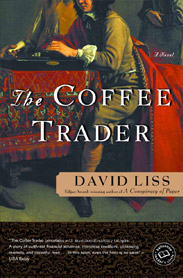
The Coffee Trader
Title: The Coffee Trader
Author: David Liss
Year: 2003
Genre: Fiction
Rating: 3
Admit it, we all drink a little too much coffee. We're all pretty well acquainted with that niggling headache around 2 o'clock if you'd made it that long without a cup, and most of us at one point or another have used it to cure a nasty hangover. Besides the TV and the microwave, the coffeemaker is a staple of the American home.
David Liss's fast-paced conspiracy novel centers around the induction of coffee into European culture as "the drink of commerce." The book reads like a long night with a little too much caffeine- always interesting, but sometimes it would be better to just go back to bed. The cast of characters is colorful and well-developed, but the whole story just tries a bit too hard.
The story opens on Amsterdam in 1659, the amazingly tolerant center of capitalism and the site of the Exchange. Our protagonist, Miguel Lienzo, is a Portuguese immigrant and a Converso-- a Secret Jew, one who outwardly professes Catholicism and keeps his faith in private. He joins in business with a crafty widow named Geertruid Damhuis in a complex plot to make an enormous fortune from imported coffee. As the book progresses, we meet Miguel's neurotic brother Daniel, and discover his wife Hannah is infatuated with Miguel. A complicated web of characters, including the annoyingly peripheral Alonzo Alferonda, try to ruin Miguel's plans as the book progresses and every situation tries to frustrate his fortune-to-be.
Miguel Lienzo is an extremely well-developed character. We spend most of the book following him through his various debts, threats, and exchanges, cheering him on and learning more of who he is each time he interacts with someone. By the end of the book, we become so attached to him that we can hardly see what he's become, which is deliciously conflicting (and the only plot twist that affected me, honestly). Where many writers try too hard to give their characters foibles and faults, Miguel fills himself out into a full human being, and we become attached to him almost immediately, when he petulantly comments to Geertruid that coffee looks like "the devil's piss."
The Coffee Trader begins brilliantly, describing the colorful and often underrated Dutch capital in the lurching era between the Renaissance and the Enlightenment. We soon learn how wonderful a haven Amsterdam is for the Jews-- with no fear of the Inquisition, they can keep their faith to themselves but not fear constant uprooting and death. However, we also learn to be nervous of the power of the Ma'amad, their council of Portuguese Jews, and its crafty politics. Liss presents us with a world that begs to be further explored, from the wild trades on the Exchange to the grimy alleys near the canals.
Although Liss is a talented writer, he disappoints in the overall tidiness of this story. It is a conspiracy book, fast-paced and convoluted, but there are just one too many plot twists-- it becomes hard to see how the beginning unites with the end, and the characters resemble something like debris caught up in a twister. We can just keep track of all the complicated names (like Annetje, Joachim, Alferonda, or Crispjin) when Liss throws another betrayal at us, sending our opinion of that character spinning out of control. The trouble with betrayals is that we have to be attached to the character before it really affects us-- and with so many names and personalities to remember, each one becomes more expected and less upsetting.
The whole book is well-written, the language displaying Liss's easy command over the world of literature. The perspectives alternate between Miguel, Alferonda, and Hannah, giving us a full perspective on the wild world of capitalism and brutal trade. However, Alferonda disappoints for being such a central character to the work. His chapters are annoyingly self-centered, which makes the case that he is a narcissist and helps to develop his character, but does a poor job of placing him in the story. I understand Liss wanting to keep the secrets until the end of the book, but it might have been better to either leave out his "memoirs" entirely or give a little more context into the entire of the book.
Nevertheless, The Coffee Trader is a good read. At 384 pages in the hardback, it's a decent-length read, just enough to make people in Starbucks think that you're clever and deter them from interrupting you. (It becomes a far more interesting read when you have a huge mug of coffee in hand.) The historical context is well researched, and opens the historical-fiction regulars outside of the traditional box of European novels about the 17th century. It's not often that you come across a book that focuses so well on trade in a sphere outside of England or France. Here's to hoping that The Coffee Trader won't be the only one about the subject.
I got my copy of The Coffee Trader from my library, so yours should have it too. If not, you can get it on the Kindle store for $12.00, or buy it in paperback on Amazon for as low as $5.35. You can't go wrong with that price, and getting to know David Liss as an author is no mistake.
Author: David Liss
Year: 2003
Genre: Fiction
Rating: 3
Admit it, we all drink a little too much coffee. We're all pretty well acquainted with that niggling headache around 2 o'clock if you'd made it that long without a cup, and most of us at one point or another have used it to cure a nasty hangover. Besides the TV and the microwave, the coffeemaker is a staple of the American home.
David Liss's fast-paced conspiracy novel centers around the induction of coffee into European culture as "the drink of commerce." The book reads like a long night with a little too much caffeine- always interesting, but sometimes it would be better to just go back to bed. The cast of characters is colorful and well-developed, but the whole story just tries a bit too hard.
The story opens on Amsterdam in 1659, the amazingly tolerant center of capitalism and the site of the Exchange. Our protagonist, Miguel Lienzo, is a Portuguese immigrant and a Converso-- a Secret Jew, one who outwardly professes Catholicism and keeps his faith in private. He joins in business with a crafty widow named Geertruid Damhuis in a complex plot to make an enormous fortune from imported coffee. As the book progresses, we meet Miguel's neurotic brother Daniel, and discover his wife Hannah is infatuated with Miguel. A complicated web of characters, including the annoyingly peripheral Alonzo Alferonda, try to ruin Miguel's plans as the book progresses and every situation tries to frustrate his fortune-to-be.
Miguel Lienzo is an extremely well-developed character. We spend most of the book following him through his various debts, threats, and exchanges, cheering him on and learning more of who he is each time he interacts with someone. By the end of the book, we become so attached to him that we can hardly see what he's become, which is deliciously conflicting (and the only plot twist that affected me, honestly). Where many writers try too hard to give their characters foibles and faults, Miguel fills himself out into a full human being, and we become attached to him almost immediately, when he petulantly comments to Geertruid that coffee looks like "the devil's piss."
The Coffee Trader begins brilliantly, describing the colorful and often underrated Dutch capital in the lurching era between the Renaissance and the Enlightenment. We soon learn how wonderful a haven Amsterdam is for the Jews-- with no fear of the Inquisition, they can keep their faith to themselves but not fear constant uprooting and death. However, we also learn to be nervous of the power of the Ma'amad, their council of Portuguese Jews, and its crafty politics. Liss presents us with a world that begs to be further explored, from the wild trades on the Exchange to the grimy alleys near the canals.
Although Liss is a talented writer, he disappoints in the overall tidiness of this story. It is a conspiracy book, fast-paced and convoluted, but there are just one too many plot twists-- it becomes hard to see how the beginning unites with the end, and the characters resemble something like debris caught up in a twister. We can just keep track of all the complicated names (like Annetje, Joachim, Alferonda, or Crispjin) when Liss throws another betrayal at us, sending our opinion of that character spinning out of control. The trouble with betrayals is that we have to be attached to the character before it really affects us-- and with so many names and personalities to remember, each one becomes more expected and less upsetting.
The whole book is well-written, the language displaying Liss's easy command over the world of literature. The perspectives alternate between Miguel, Alferonda, and Hannah, giving us a full perspective on the wild world of capitalism and brutal trade. However, Alferonda disappoints for being such a central character to the work. His chapters are annoyingly self-centered, which makes the case that he is a narcissist and helps to develop his character, but does a poor job of placing him in the story. I understand Liss wanting to keep the secrets until the end of the book, but it might have been better to either leave out his "memoirs" entirely or give a little more context into the entire of the book.
Nevertheless, The Coffee Trader is a good read. At 384 pages in the hardback, it's a decent-length read, just enough to make people in Starbucks think that you're clever and deter them from interrupting you. (It becomes a far more interesting read when you have a huge mug of coffee in hand.) The historical context is well researched, and opens the historical-fiction regulars outside of the traditional box of European novels about the 17th century. It's not often that you come across a book that focuses so well on trade in a sphere outside of England or France. Here's to hoping that The Coffee Trader won't be the only one about the subject.
I got my copy of The Coffee Trader from my library, so yours should have it too. If not, you can get it on the Kindle store for $12.00, or buy it in paperback on Amazon for as low as $5.35. You can't go wrong with that price, and getting to know David Liss as an author is no mistake.
Subscribe to:
Posts (Atom)