Showing posts with label thriller. Show all posts

Monday, January 7, 2013

Mockingjay

Original image at suzannecollinsbooks.com/
Title: Mockingjay
Author: Suzanne Collins
Year: 2010
Genre: Teen/thriller/sci-fi
Rating: 2

The end of a series is supposed to settle the readers' minds, even if it's not a happy ending. We want to see our heroes reach a resting place to nurse their wounds and work their way toward happiness after the battle is over.
But for a hyperactive, ADD plot like Mockingjay's, concluding is synonymous with death. Had Suzanne Collins not committed to a trilogy, she would have probably drawn out Katniss's story for another two books or so, and if it would have helped to pace this novel better, she would have been right to do so. As it stands, Mockingjay reads like twenty climaxes smashed together to make a jarring, heaving, ponderous plot laced with gratuitous gore and little meaning. The only thing that keeps us going is an attachment to the central characters.
At the beginning, we find Hunger Games victor Katniss Everdeen broken, bruised, and confused after her dramatic rescue from the arena and removal to the mythical District Thirteen, which resembles some kind of industrial distopia. Katniss chafes at the rigorous rules of her new home and at the expectations placed upon her to become the Mockingjay, the symbol of the rebellion now seizing Panem. For the past two years, Katniss's presence on national TV has been sparking these seeds of discontent, and now the rebels see her as an icon of hope, of defiance. All she wants to do is go back to District Twelve with Gale Hawthorne and her family, but her home has burned to the ground, her friends either dead or refugees, and Peeta Mellark in captivity in the Capitol.
Katniss, besides being faced with the decision to be the face of the revolution or not, is also faced with that omnipresent question of romance: her best friend Gale, or her fellow victor Peeta. As the violence spins more and more out of her control and she begins to question her own dedication to the cause, the world exerts more pressure on her and on her fellow soldiers, driving their war to the bitter end.
The most interesting thing that Collins does with the idea of revolution is the PR face. Katniss is by no means the great general that the rebels need to command them; she is merely the symbol that they all recognize to keep fighting, and the hard-hearted president of District Thirteen is set on using her as propaganda to propagate her war. The executives of the movement tape clip after clip of Katniss and her team to indoctrinate the people, constantly considering her behavior and how it will affect mass opinion of the war. Katniss knows this and feels ill-used, which is the most complicated emotion in all the books that Collins puts forth: are the deaths of all the people she encourages Katniss's fault?
When it comes to sheer surface entertainment, the Hunger Games series is unrivaled. Loaded with suspense and danger, Mockingjay keeps readers on the edges of their seats and guessing until the end, the plot careening down a wildly twisting path until the conclusion. And it is twisting: any sense of restraint that Collins felt about her violence is suddenly stripped away in her third installment. The first two books were graphic, but there was always a subtle hint of reluctance to kill characters that we had grown attached to. Not so here. Just like her characters, Collins seems to have driven herself to the edge and held her ground strongly enough to kill off rebels that she had written extensively about. This lends the story a feeling of reality-- revolutions are horrifyingly bloody, and many beloved people die every time. It would have been laughable had all of Katniss's allies made it through unharmed.
Oh, do the parallels of the evils of socialism continue. District Thirteen is an eerie shell of Soviet Russia, with toe-trampling rules and over-the-top punishments for tiny crimes. Freedoms are restricted to the bare minimum, and the people don't seem to mind. Only Katniss and Gale, the brave champions of freedoms, are willing to defy the rules of the overbearing society, braving the anger of the ruling powers for the general good.
However, that's the only real parallel. The surface entertainment is about all the value available in Mockingjay; Collins awkwardly skirts around any pithy topics, even if she has set up a perfect situation for them to be explored. One theme that appears over and over again is the question of what it truly means to kill another person. She repeatedly mentions this struggle in Katniss's thoughts throughout all three books, and yet after roughly 1100 pages, we still don't know what it really means. Death after death goes by, and the only one that really comes close to touching that question is Rue's death in the arena in the first book.
(On a side note, does Collins really think she's being clever with her Latin? Maybe for a monolingual society she is, but seriously, I saw the Rome parallel before I even read the book. She didn't need her whole Panem et Circenses bit. Plus, Avox is a really pathetic attempt. When the characters think 'hijack' is an archaic word, how on Earth do they know enough Latin to name various things?)
The most disappointing part of Mockingjay is the ending. With all this colorful, thrilling writing under her belt, one would think that Collins could piece together a conclusion worthy of the characters that she has spent so much time developing, but we're left with a twenty-five page slop that is like staring at grey wallpaper with grey patterns on it. Sure, she's trying to portray a fog of grief, but the writing should induce tears of sympathy, not boredom. Even the epilogue is arbitrary and pointless. The bare facts of how the story ends are sort of bittersweet and touching, but change in pace drops us like a stone into the cold water of the book being over. Something tells me that her publisher was pushing her toward a deadline and she had to crank out an ending.
Altogether, the Hunger Games tells a beautiful, terrible story, filled with characters we can believe in images we won't forget. Perhaps the meaning is meant to come from us as we read. Collins has provided us with a beautiful wilderness of story; it's up to us to make it mean something.
 Mockingjay is available on the Kindle for $5.99, or in hardback from Amazon for $9.86. Because the Hunger Games is such a book of our times, it's worth a read, but don't go in expecting deep thoughts. Consider the series a light weekend thing, but definitely don't read it to your kids. It's a little graphic even for adults.

Monday, December 31, 2012

Catching Fire

Original image at suzannecollinsbooks.com/
Title: Catching Fire
Author: Suzanne Collins
Year: 2009
Genre: Teen/thriller/popular
Rating: 2

The second installment of a trilogy is almost always the best of the three. Take for example The Two Towers, which captures the soul of the whole story, or The Empire Strikes Back of Star Wars. Because the central story doesn't have to introduce strangers into a brand new world or say goodbye, it nearly writes itself. The tension strings the two together, and the book can act like the climax of the whole.
Catching Fire, the second novel of the acclaimed Hunger Games series, acts like the first. After the choppy, rushed introduction of the first book, the second flows much more naturally and freely.
Suzanne Collins brings us back into her futuristic country of Panem, where Katniss Everdeen and Peeta Mellark have returned to their home district and prepare for their forced tour of the districts. Their relationship is forced and awkward now that the games are over and they must go back to their original, simpler lives. However, the world has changed since Katniss's explosive presence on the Hunger Games. The twelve districts are on the brink of revolution, and the remarkably revolting President Snow approaches Katniss to enlist her to defuse the rebellions steadily growing in the country.
But Katniss has other problems. And as her personal life spins out of control, so does the feeling in the country.
Collins has clearly realized that in the face of the immense popularity of The Hunger Games, she needs to refine her writing for a larger audience. The syntax of this novel is much cleaner and more mature, and the characters think in much more logical, mature manner. Peeta, who was borderline childish for large sections of the first novel, is suddenly an adult and full of much more relatable pain. Gale, who was pointless and flat, suddenly folds out like origami into something far more complicated and able to stand on his own. He remains a little cliche in places, but his interactions with the citizens of District 12 glow far more than those with Katniss.
Better yet is the unpredictability of the novel. While The Hunger Games is both somewhat predictable and even a touch corny at times, Catching Fire pitches a continuation of the story in a familiar direction with the touches of Suzanne's overall goal for the story. Katniss, Haymitch, and Peeta are pitched into a sort of dysfunctional family relationships because of their one horrid commonality-- they were forced to kill their peers for the entertainment of those around them.
And yet, despite the improvement of the entire novel, there is a hollowness, as if Collins has written the body of the story but sucked the marrow out of the bones. It has a skeleton, but the bones are empty and there's no blood in its body. She tried to make up for it with the gratuitous amount of violence, but this does not stop us from feeling a certain emptiness for a true meaning in the story. One of the themes that screams to be explored is also the most obvious: what does it mean to kill another person? What has to change inside of us to be able to face someone just like us and kill them to save our own life?
Sadly, Collins skirts these great questions for the entertainment value. Not that it is lacking-- the story is fast-paced, gripping, and tear-jerking in places. Great new characters are introduced, and the relationship between Katniss and Peeta changes into a form both more complicated and more simple. Katniss does all she can just to survive, even when that means hurting the people she thinks she might love.
The title is a double entendre and refers to the first Games, which takes about half the book to figure out. However, the scene in which she fulfills it is strikingly unforgettable; even if she is no Dickens, she has the visuals of a master.
Altogether, though, Suzanne Collins has done that thing that authors dream of: writing a sequel that improves on the original. Available for $5.99 on the Kindle or $9.87 for the hardback on Amazon, Catching Fire is worth the read for anyone, but read the original first, because otherwise confusion is inevitable.
The film is due out in September 2013, with a much larger cast (including Philip Seymour Hoffman as Plutarch Heavensbee). Look for the long line of screaming teenage girls outside the movie theatres.

Tuesday, December 25, 2012

The Hunger Games

Image credit to suzannecollinsbooks.com/
Title: The Hunger Games
Author: Suzanne Collins
Year: 2008
Genre: Sci-fi/thriller/teen
Rating: 2

Action! Danger! Tragedy! Oppression! Romance!
You couldn't ask for more on a movie poster. Perhaps, in fact, if any book could have skipped the written phase and gone straight to film, it would be The Hunger Games. Rapid-paced action and visceral imagery make this book a top-notch story, and even if the language leaves something to be desired, it hits its target crowd exceptionally well. After all, sometimes all we need is a good story, right?
Suzanne Collins is an experienced children's writer; she has written multiple episodes for 1990s TV shows like Little Bear, Oswald, and Clarissa Explains It All. She has also written a five-book series for children known as The Underland Chronicles, which are an interpretation of the classic Alice in Wonderland.
However, with The Hunger Games, she takes a step into the gritter world of teen fiction, leaving behind squeaky-clean genres for a heftier tale. The novel tells the story of 16 year-old Katniss Everdeen, a poor girl living in the 12th District of a post-apocalyptic North American country called Panem. She is content to lead a quiet, meager existence by illegally poaching off of government land to feed her family until her younger sister, Primrose, is called out to be a participant in the bloody gladitorial contest known as the Hunger Games. In desperation to save her sister's life, Katniss volunteers to take her place, sealing her fate to kill or be killed.
To make matters more complicated, a boy that Katniss owes her life to, Peeta Mellark, is named as the other participant, obliging her to kill someone that she feels indebted to. Thus, she explains, is the horror of the Games: in order to survive, you must give up all your dignity, which is the government's aim. As the book progresses, the relationship between Katniss and Peeta becomes much muddier and more complicated, and even she is not sure how she feels about the boy who saved her life, the boy she is obliged to kill.
Told in the first person, the book places the readers firmly inside Katniss's mind. We hear her thoughts, her gut reactions to things, and see the grossly unfair world of Panem as she sees it. Grammar fanatics will squirm and squawk as they read turns of phrase (think high school language, written down) and the truncated fragments of thoughts are jarring, but the argument stands that they do place you into the mind of a coarse teenager.
Collins has created a marvelously dark, creative world replete with extensive details and logical, ordinary, yet beautiful characters. Although some of the people we meet are rather two-dimensional (Prim and Effie are exceptionally flat, and Cato runs a close third) Katniss and Peeta are fully fleshed out, and blend together beautifully. As time progresses, we understand more of the darkness and complete victory that the Games are to the Capitol, dehumanizing their victims and their audience in one blow.
The story is a thinly veiled allegory for the evils of socialism, what with the rigid rule controls on each district's product and the omnipotence and omniscience of the government. Katniss and Peeta represent the young capitalists defying the shackles of governmental regulation, shaking off the social expectations of submission and fear. Collins has essentially created a effective propaganda piece for republicanism with a action-packed, fast-paced, driven plot filled with believable people and graphic imagery.
The target audience is most definitely teenagers and young adults. The language is easy and flows much like an average American talks, and there are few moments without some sort of action or plot-centric exchange. Collins draws in a female audience with the sweet, innocent romance between Peeta and Katniss and the male audience with the sheer horror of the Games that she describes. (Cato's death is particularly horrifying, and will shock anyone with a visual imagination.) Intuitively weaving all of her different articles together to create one enormous, lumpy tapestry, Collins introduces us to a plot that we can love and remember, cheer and grieve for, and step easily into with the tightly-woven words she has written.
Because it is told in first person, the book stays with Katniss nearly every waking moment for a few weeks, but at just over 300 pages is surprisingly short. While that style necessitates some dull moments, some of the scenes are exceptionally poignant, such as the reaping (where the participants, known as "tributes," are named) when Katniss throws herself forward to save her sister. Rife with passionate language and the impulsive nature of the action, we are gripped throughout the telling and tied tightly to the brave girl as she sacrifices herself for love of family. Because it is told in the present tense, the readers experience the events in hypothetical "real time," which places us even more inside the mind of Katniss, lending us her emotions and distractions. Perhaps it is because we nearly become her, but our heroine is one of the most complete characters in popular literature.
The film, starring Jennifer Lawrence as Katniss and Josh Hutcherson as Peeta, came out in March 2012 and drew an enormous audience for its extended run. Catching Fire, the next film, is expected in September 2013.
The Hunger Games is available for a meager $5.00 on the Kindle (it's free if you join Amazon Prime), or $10.89 in hardback. The entire trilogy, which includes Catching Fire and Mockingjay, is available for $18.99 on the Kindle or $29.50 in hardback. Because of the popularity and timeliness of these books, they are probably taken out of most libraries most of the time; if you can't borrow them, they're worth the purchase. Mine were given to me by some wonderful people as a Christmas gift, and I profusely thank them. It's taken me a really long time to jump on the bandwagon.
Merry Christmas, everyone! Hope you got or gave at least one book today. Enjoy your break and keep reading!

Thursday, September 13, 2012

The Whiskey Rebels

Title: The Whiskey Rebels
 Author: David Liss
Year: 2008
Genre: Historical fiction/Thriller
Rating: 1

We all believe that we know what America is, don't we? After living here our whole lives and being so saturated with the ideas, values, concepts, and freedoms of this grand experiment of a country, we think we know what constitutes our society and freedoms. But that's just the trouble-- when we think we know what is right, what happens when a dilemma comes from within? If we must adapt our values, how do we adjust afterwards?
These are the questions that David Liss addresses in his finest novel yet, The Whiskey Rebels. Deeply American in conception and execution, we see in its pages a wrenching question of patriotism versus justice: if the country that nurtured you is unjust, is it our duty to rebel and right the wrongs? Or does that simply fall under the category of revenge? In a gritty story woven with masterfully tangled threads, Liss explores the conflict and is brave enough not to offer an absolute answer.
Split into two intertwining narratives, the book follows the tale of the disgraced Captain Ethan Saunders, an alcohol-sodden ex-spy destitute in Philadelphia, and that of Joan Maycott, a grievously wronged pioneer on the western border of Pennsylvania. We pick up the story in early 1792, an era of tangled politics and tenuous economics, ruled by veterans and strongly opposed idealists like Alexander Hamilton and Thomas Jefferson. Saunders, by all appearances a disreputable, philandering ruin of a man, soon becomes caught up in a complicated web of events involving the disappearance of a former love's husband, mysterious strangers, and the fragile Bank of the United States. Someone threatens the Bank, and despite warnings from Hamilton and several agents, he gets deeper and deeper into the threats against it-- and him.
The parallel story is one of tragedy, deception, and failed dreams-- and vaguely reminiscent of the tales of unemployment, foreclosure, and woe from today. Told in the format of a memoir, we meet Joan Maycott when she is just a child and follow her from her family's farm in rural New York through her marriage to Andrew Maycott, their removal to New York City (which Liss evokes in all its glorious 18th century squalor and improvement upheaval), and to the barren, hopeless land west of Pittsburgh. There, she and her husband are beset by difficulty, oppression, and before long it is all that they can take before being inspired to rebellion.
Liss has clearly improved as a writer since his bestsellers A Conspiracy of Paper and The Coffee Trader. Here his characters are deeper, more complex, and passionate, both in writing and in action, without losing that lighthearted charm that the author is so well known for. Ethan Saunders is a marvelous conundrum of a character, a murky mixture of honorable patriotism with nefarious lechery with a sprinkle of alcohol addiction thrown in. He is universally despised for being a scoundrel by his peers, but is simultaneously respected for his skill as a spy and honor for participation in the Revolutionary War.
One of the things that makes The Whiskey Rebels so fascinating is its particular focus on the post-Revolutionary America. Where the end of the 18th century was a period of enlightenment, bettering education, and expanding scientific horizons in Europe, it was a dismal, confusing tangle in the brand-new United States, and no one knew if this enormous experiment was going to succeed or collapse into shards of anarchy. Oftentimes, the two decades following the Revolution are skipped in the study of history, which is surprising-- during those twenty years, our Constitution was written, the economics of our country shook but stood firm, and the Whiskey Rebellion rose and was put down. Many important events that shaped us happened quickly after the Revolution, and Liss has finally opened up those years in this brilliant novel.
Another interesting relationship is that of Saunders with his slave, Leonidas. Most often, the master-slave relationship is exploitative, cruel, and abusive, but there were exceptions-- those more akin to a friendship. Sure enough, they were rare, but there are exceptions to every rule, and Liss has portrayed a fascinating co-dependency between Leonidas, a well-educated Americanized African, and Saunders, a gruff, lonely military fellow who won Leonidas in a game of cards. We spend the whole book guessing at whether he hates Saunders, disrespects him, or grudgingly likes him, and there are plenty of laughs along the way.
But perhaps the most important feature of The Whiskey Rebels is the questions that it raises about patriotism. Most of us regard ourselves as patriots if we support our troops, sing the national anthem, and raise a toast on Independence Day-- but what does it really mean to be a patriot? Is it just loyalty to one's country, or is it also an innate sense of responsibility, of holding one's government in check? And if the people are wronged, is it the patriot's duty to change the government to right those wrongs?
This masterful, thoroughly American work is available on Amazon for $10.20 in paperback, or on the Kindle for $12.00. In this day and age of questions and the changing American social landscape, it's important to understand our past and our duty as a people to our country. Novels may be fiction, but there are important truths buried even in the most fanciful of stories, and there are momentously important ones here.
On that note, happy election season!

Thursday, July 12, 2012

The Swan Thieves

Title: The Swan Thieves
Author: Elizabeth Kostova
Year: 2009
Genre: Thriller/Mystery
Rating: 1


Passion faded, love lost. The question rises, is there anything more real than this moment? Has everything reported before this second disappeared into fiction, and if not, how can something that you've never seen be as real as the hands you hold out before you, the color of your skin, the moisture of your lips? All the hundreds of millions of lives that began and ended before you were a single cell don't make sense to you, with all their myriads of emotions swirling, pulsing, and disappearing without any more trace than a wind that ripples your hair.
With the quiet grace of Kazuo Ishiguro and the dark strength of Philip Pullman, Elizabeth Kostova's second novel The Swan Thieves ponders the impact of history on the present. Subtle and sweeping, the novel of painters and their lives quivers with the life that Kostova says painters strive to evoke in their works. Kostova has vastly outdone herself from The Historian, although her style remains her own, vague and moving.
The book is largely told from the perspective of a middle-aged psychologist, Dr. Andrew Marlow, who receives a patient by the name of Robert Oliver who attempted to attack a painting in the National Gallery. Marlow is stymied in his treatment of Robert by the patient's refusal to speak at all, and is mystified as to why Robert will only paint portraits of a dark-eyed woman. Marlow's quest to cure this one patient leads him from DC to North Carolina, New York City, and Paris, all the while wondering if this man is insane or simply misunderstood.
Along the way, we slowly discover the seemingly disconnected story of Beatrice de Clerval and Olivier Vignot, two rather unknown painters from nineteenth-century France, linked by invisible ties to the present and the madness of the man who paints endless portraits.
Kostova is one of the finest novelists of our time. Although we are aware vaguely that Robert Oliver is one of the main characters of the book, we are introduced to him only through the memoirs of those who knew him, as if we are discovering him for ourselves after the fact. Robert Oliver is like an event in the lives of those he has touched; they remember him vividly, all of his actions, his mannerisms, his faults and wonders. By the end of the novel, although we only hear him actually say about a paragraph's worth of words, Robert Oliver is as familiar as Marlow, the man we've known from the first.
A master of the first person, Kostova has clearly thought out each character to the ends of their souls. The clear shifts in voice from person to person display an understanding of her own work rarely shown, and a strong reason for each word. Nothing that occurs in The Swan Thieves is arbitrary or by accident; a clear sense of purpose permeates the air of the story. Even the minor characters have a defined role to play, and once this is complete, they gracefully turn away to their own lives. That is perhaps the most beautiful thing about this novel: each character is a person, full of a life beyond the pages written.
That is certainly not the only beautiful thing, though. Some of the words that would apply best to this novel are marvelous, spectacular, and aesthetic. With the knowledge of an experienced author, Kostova describes dozens of masterworks of the painting world to us, but the most exhilarating aspect is the pure pleasure of the writing. Some of the passages, especially those of Beatrice, are moving enough to take the reader's breath away; others are so deep and thoughtful that the reader is compelled to stop and think about the questions raised for a moment before continuing.
To say this novel is intricate would be an understatement. From specifying the year and artist of vague paintings to the dates of birth of the fictional Beatrice de Clerval (she is a synthesis of Berthe Morisot and some of the other Impressionists), Kostova has provided us a net of facts, times, and little details that make the novel into an impressive reality for the readers as well as the characters. Her presumptions on the museums of Paris impress the thought that is really is okay for novelists to add their own facts to real places and events-- it is only fiction, after all.
The Swan Thieves is not only a better novel but is a step forward for the author from The Historian. More complete and rife with emotion, the dark elements so characteristic to the story of Dracula take on a softer, more human edge in the tale of Robert Oliver. The whole story itself feels more complete, with matching segments on both ends, and the connected elements of foreshadowing and prediction that her previous novel lacked. But perhaps most importantly, she has understood her readers as well as her fictions: we are all just people, seeking to understand ourselves in relation to history and the world around us.
This novel is fairly recent and well known, so it will probably be hard to find at a library. I managed to snag my hardback copy for $6.95 at a Barnes and Noble clearance, but according to Amazon you can get it for $9.99 on the Kindle or $10.33 for a hardback copy of your own. Do purchase it, and follow Elizabeth Kostova. I expect that her next novel will be even more enchanting.

Thursday, April 19, 2012

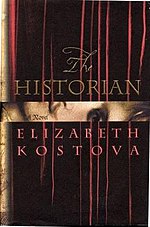
The Historian

Title: The Historian
Author: Elizabeth Kostova
Year: 2005
Genre: Fiction/Mystery/Thriller
Rating: 2

If we're sick of vampires, that's only because we've got a reason to be, after Twilight and "True Blood" and the absolute cultural obsession with the occult. But every once in awhile, there's an intellectual who focuses on the subject, because underneath all the pop culture, it is an interesting one.
Elizabeth Kostova's debut novel The Historian preceded the undead craze by a few years, and took a very intellectual, analytical approach to the legend of Dracula. Bram Stoker originally handled the 15th century Romanian myth in his 19th century novel, but Kostova reimagines the story with a gracious amount of research and historical context. The novel is wide-spanning, painting a picture of two different worlds-- tense Cold War Europe and the tenser 15th century Ottoman takeover.
Although it takes awhile to fall into the structure of this novel, it soon flows easily between your fingers, like intertwined threads. The story follows a young woman (who remains unnamed throughout the book) as she gradually discovers her father's deep research on Vlad Tepes, better known as Vlad the Impaler, better known as Dracula. Her father, Paul, haltingly tells her the flashbacks to 1954 of his unfortunate adviser at a New York university, Bartolomeo Rossi, who started him on this road before disappearing without a trace. From there, Paul meets a young Romanian woman named Helen who accompanies him in his search for the undead, legendarily cruel Dracula. Their road takes them across Eastern Europe, from Istanbul to Budapest and and back, and the truth becomes darker and more bloody with the more they discover.
The chapters of Paul's tale are interspersed with the tale of his daughter, who becomes caught up in his research on the Transylvanian vampire, and the occasional document or letter from Paul or Rossi. The novel is broken up into three parts, but there are no real cliffhangers or time jumps separating the parts, which is reminiscent more of a term paper than a novel.
Mrs. Kostova, an American, has certainly done her research. The novel is the work of ten years of her life, and her meticulous writing and composition shows in the style and gravity. Each of the places mentioned is real enough to touch; one can almost feel the sun in Istanbul, hear the voices of the singers in Bulgaria, and feel the wind off of the ominous Lake Snagov. She mentions dozens of scholarly papers and works on Dracula in as many languages, some of which are lost or fragmented. The dedication of the novel relates that Mrs. Kostova first gained interest in the character from the tales that her father told her of the Eastern European legends of the undead.
The novel could easily have been a hundred more pages. There is a lot of material here, and despite the 642-page length, it feels condensed. At the beginning, we're eased into the background, like lowering oneself slowly into hot bathwater, but toward the end, all of the important plot points happen in the space of about twenty pages. It's actually fairly disappointing. The whole novel is a great story, with so much to interest, and whole cultures that have been shut off to us by the Iron Curtain for years. Kostova does not sidle around the issue of language-- she includes snippets of Hungarian, Turkish, Bulgarian, German, French, and Romanian, making an almost cheeky point about the state of American linguistics (as the old joke goes, what do you call someone who speaks one language?). Fortunately, she smoothly provides translation that makes sense for us, and the novel never comes unglued with unexplained mysteries.
Oh, wait. The only mystery she doesn't touch is how Dracula became undead in the first place.
To a degree, it's the novelist's job to delve into mysteries and secrets that have been close-guarded, but in this case, it seems more respectful than anything. She's created a whole tale around a foggy legend, and it only seems fair that she leave one mystery to keep the original tale interesting and gripping to future generations.
The book largely sticks to its story without too much philosophizing, but she can't help but stray into the realm of deep thought at the end, when a character poses the question of good versus evil. Good is not perfectible, but evil is, so why not strive for the thing that you can make perfect? Temptation, darkness, reason, and inner conflict... it all concatenates in this one line, a tear in the neat fabric of the mystery before returning to the plotline. It shows an admirable amount of restraint-- this book alone could merit a term paper on the essence of life, death, evil, cruelty, et cetera, but Mrs. Kostova's primary goal is to tell the story. Like the great novelists, she leaves it to us to draw our own conclusions from what she's written.
After all, she is only the historian.
This fabulously dark work is available on the Kindle for $9.99, or from barnesandnoble.com for $6.28. I had to wait a long time to get it from my library because a lot of people want to read it, so I would advise buying it, because it's worth a couple of reads.

Thursday, April 12, 2012

The Court of the Air

Title: The Court of the Air
Author: Stephen Hunt
Year: 2007
Genre: Science Fiction/Thriller
Rating: 4

Let's face it: imaginary worlds are the best if they're, well, outlandish. There's a reason that Middle Earth is so much better loved than any of Isaac Asimov's worlds, and that Hitchhiker's Guide to the Galaxy boasts millions of fans while other alien books fall flat. In the world of science fiction, anything goes, and the crazier the better. The true magic of fiction is that anything unbelievable can indeed be believed.
Stephen Hunt has created a spectacular, detailed steampunk-style world in The Court of the Air, complete with unique races (I've never heard of crustacean people before) and a full, tragic history just as imaginative and convoluted as any in the real world. Jackals, Quatershift, and the Steammen Free State are gritty and vital enough to just be beyond the fingertips. Regrettably (bitterly so) this book is clumsy in every sense of the word.
The novel follows two orphans, the street-smart Molly Templar and reclusive Oliver Brooks, who are both special outcasts in the world. Oliver was abandoned to a dangerous substance called the feymist from the ages of one to five, and as a result is a registered feybreed, targeted by the government to be dragged into service. Molly, on the other hand, has no idea why she is special, and when all of her friends are mysteriously murdered or kidnapped, she runs for her life.
The book is fast-paced, with little time taken aside for thoughts and recollections, which is almost nice for a change. We meet a colorful host of characters-- Harry Stave, the rogue wolftaker (an agent of the Court of the Air); Silas Nickleby, a war criminal who is investigating a series of brutal murders for a newspaper; Commodore Black, who doesn't explain much of his history but is irrepressibly cheerful; Aliquot Coppertracks, a steamman (a sort of living machine) with an incredibly powerful mind; and the Whisperer, a dark presence with incredible power imprisoned in dreams. There are dozens of characters, each with interesting, individual features, and 582 pages don't feel like enough to get to know them very well.
I can't explain how unbelievably creative the world of Jackals is. Imagine crossing the raw creativity of Lewis Carroll with the grit and ingenuity of Philip Pullman, and then shading in more and more details until you have a maddeningly fascinating reality. The history of Jackals is filled with words lifted straight out of Aztec history (Duitzilopochtli Deeps, Chimeca, etc.) and the idea of severing the monarchs' arms to prove their lack of power to Parliament is gory and riveting. I've seen a lot of inventive government systems in fantasy, but never one with the complexity of The Court of the Air.
I might have claimed this book as one of my favorites if it hadn't been so poorly executed.
From the first page, we are absolutely bombarded with terms, jargon, slang, places, names, whatchamacallits, and anything you can imagine. Hunt may have been trying to immerse the readers in his world, but he successfully drowned us with far too many unexplained details. For instance, the very titular Court is never fully explained. Chapter after chapter goes by with allusions to it, and the only details that come out are more complexities. It's absolutely maddening.
Hunt also made a habit throughout the book of latching onto phrases and reusing them again and again. At one point, he refers to Harry as "the disreputable Stave" three or four times on a single page. By that time, we've gotten the message-- Harry is bad news. Hunt may have been trying to be humorous and give him a nickname in Oliver's mind, but there are certainly better ways to do it than that. The intriguing Whisperer is also left annoyingly vague, as are all the characters. According to Stephen Hunt's website, The Court of the Air is only the first in a series of books based in Jackals, so maybe he brings more light on the subjects in the future.
But even if he does, he needs to rectify his organizational skills first. The chapters are really poorly sorted out, mashing together the viewpoints of multiple characters with no markers for place and time at all. We jump from Molly to Oliver to Commodore Black to a random citizen to King Steam to Molly to whatever just make it stop. Some authors can do this gracefully (i.e. Ken Follett), but it's irritating and confusing in this book. Having seventy chapters is not a bad thing-- if it really bothers you, split the book into acts or sections.
To top it all off, the book ends in a fashion similar to dropping an anvil on a bird in flight. The plot has just begun to settle in and all fit together in a big map, and thwack! the end comes and makes no sense. We're given no hint as to what has happened to the rest of the characters, and there's not even a cliffhanger to imply that there will be another book. An extremely minor character who appears maybe two or three times in the entire course of the novel has the last line, and not even in a meaningful way.
The Court of the Air had so much potential. It's the most imaginative book to come into the science fiction/fantasy genre in absolute ages, but because it's so poorly written, the idea is shot down before it has a chance to really prove itself. It's a shame, because the steampunk world needs a real example of quality to set itself a standard.
Five years later, the book is available in libraries (on a side note, I picked it up purely for the cover-- the art is great). You can't buy it from the Kindle store, but you can get it at Barnes and Noble in paperback for $8.99. Amazon has several listings for cheap, but don't buy it if you can just rent it. One read is good enough for this novel.

Sunday, March 18, 2012

The Marks of Cain

Title: The Marks of Cain
Author: Tom Knox
Year: 2010
Genre: Thriller
Rating: 5

Mr. Knox, you're a thief. Give me back those four hours of my life that you sucked into this abysmal collection of words.
Although pseudonyms are largely out of date and pretentious, Tom Knox is the pen name of one Sean Thomas, who has earned some repute in the world of fiction for his thriller The Genesis Secret. Jeff Abbott, author of Panic, lauded his newest novel, The Marks of Cain, as "the new Da Vinci Code" for its taboo usage of the unexplained mysteries of the Bible and Christianity.
I don't know where Mr. Abbott gets off.
The story of  The Marks of Cain centers around two characters (which seems to be a trademark of the thriller world these days), David Martinez and Simon Quinn. Quinn unsheathes his entire life story to us in the first three pages, complete with insane brother and absentee father, conveniently attending a new Narcotics Anonymous meeting. A few more chapters in, we meet David, who is bequeathed two million dollars by his mysterious dying grandfather, available on one condition("The Ultimate Gift", anyone?)-- that he investigates the locations of several old churches on an antique map. He flies to the Basque lands in Spain and dives into a mystery much older than him, becoming involved with many dangerous characters, including a terrorist named "The Wolf."
 If you're not already bored from reading the summary, I'm either proud of you or amazed that you haven't seen any of the Indiana Jones movies. I'm not sure where Knox came up with his plot line, but it feels like an incredibly cliche mix of bad action movie and overly bloody thriller. He clearly takes pleasure in describing to us an obscure kind of torture called "knotting"-- but I won't spoil the sadistic joys of that to you in this review. Suffice it to say that I had to stop drinking my coffee.
The grisly, messy parts of this book are the only well-written parts, though. The rest is more painful than pulling teeth-- so many fragments of sentences yank us back and forth, incredibly stupid and superficial thoughts cloud the characters, and the dialogue is filled with a few thousand elipses... need I go on? Every character seems to be a pinball post to bounce more danger and blood off of, and very little psychology happens behind their glazed-over eyes. Even the two main characters, so grievously burdened with cliche baggage, are uninteresting after the first few pages.
Amy is the epitome of useless, irritating, annoying action-thriller-mystery female, and her mystery melts away a chapter after she is introduced. Knox has a horrible habit of exposing everyone's life story mere seconds after we make their acquaintance, which is an oddly ironic characteristic for someone whose books hinge on suspense. It's almost like that drunk guy at the party who latches onto you and shares with you every moment since he was fifteen without you ever asking.
Even if you are the most patient reader, this book peters out after the first few chapters. The proliferation of awkward language and phrases is only accented by Knox's attempt to colloquialize the dialogue by making the characters swear, and instead of making them human and real, it makes them sound like a low-budget writer was up at midnight before his screenplay was done.
The only quasi-interesting part of this travesty is the exposition of Basque culture. They are one of the oldest, longest-surviving natives in Europe, still speaking their own language and retaining much of their history themselves. They inhabit a very specific region of the world rather quietly, and they deserve a much better novel than the one that was inflicted upon them.
Do NOT waste your time on this book. If you wish to purchase it for some strange, unidentifiable reason, you can get it on the Kindle for $9.99, or if you have WAY  too much money, it's listed for $26.95. As I said, it's not worth reading, so if you purchase it, I wash my hands of your wallet.
Anyway, keep your eyes out for literature like this. It makes you feel like an extremely good writer.

Friday, February 11, 2011

The Terror

Title: The Terror
Author: Dan Simmons
Year: 2007
Genre: Historical fiction/thriller
Rating: 1

What a gripping, compelling piece of literature. Dan Simmons is a masterful word-weaver, and he shines his brightest in the pages of The Terror.
The Terror is, without a doubt, one of my favorite books- which is saying something for me. This is my second time through it, and I enjoyed it just as much if not more, re-reading every line with the full backdrop of the story in mind. It is a little complicated, so knowing the general outlines before going back for the details really helped in filling in the images and indeterminacies in my mind.
Terror follows the factual Lost Franklin Expedition to discover the Northwest Passage in 1845, which was lost and never recovered. Simmons creates incredibly colorful and human characters from the true historical faces of the sailors and officers. Told in alternating viewpoints as the chapters change, we hear from mostly Francis Rawdon Moira Crozier, Captain of HMS Terror, Dr. Goodsir, the surgeon's assistant aboard Erebus, Sir John Franklin himself, and John Irving, a young third lieutenant on Terror (Irving is my personal favorite). Although the first chapter occurs in 1847, the rest of the story is told in a series of flashbacks in different viewpoints. In Simmons' traditional style of not holding back a single detail, we cringe at the terrible conditions of the icy north, the death of many of the various officers and seamen, and the terrible creature that holds all of the men in bondage in the terrible wasteland of white. The story moves forward, and it seems as though there is no misfortune which does not befall the two ships. And then, as if in a dream, we see the end coming.
Simmons is a master of foreshadowing. In only the second chapter, he begins foreshadowing the conditions which would eventually befall Franklin's men in the extremes of their fight to survive. Through their trials and hardships, we see the darkest in them come out- the darkness of taking the weak way out to survive, surrendering their humanity to retain their vitality. It's heartbreaking to watch men that we became close to give up hope and either die of debilitating scurvy, poison, or give up their humanity and take the weak way out.
Despite the change of perspective, time, and location between chapters, I found that the telling was masterful and beautiful. Often when writers attempt that kind of T.S. Eliot-like shifting, I find it jarring, but not here. The changes play out like a movie's shifting in camera angle rather than a change in scenery. Crozier becomes as close to me as someone I know personally, someone who has taken a much darker angle on life. He is incredibly human and touching, his flashbacks memorable and vivid.
Simmons also does something rather unique- he blends Esquimaux (I'm going to stay with the traditional French spelling) mythology and language with the history of exploration of northern Canada and the search for the Northwest Passage, even pulling some of their monsters and gods into the physical fabric of the story. As I progressed through the later part of the story, I found myself almost learning the ancient Esquimaux language, the words resonating as I read the story and echoing through my head as familiar terms, almost as easy as their English meanings.
One of the best parts of the book is that it is so easy to follow. The plot itself, while convoluted and twisting, is understandable for two main reasons: Simmons' excellent word choice and arrangements, and the fact that he restates information often. The first is a necessary quality of any good writers; the second is, while sometimes droll and redundant, amazingly helpful in The Terror. Simmons restates the names of the men and their positions often enough to make them seem human and to help the reader easily remember who they are. He also restates what happens to the men later in the book as Crozier is taking a death count in his head- writing name, occupation, age, and cause of death, even if we knew the character fairly well.
Altogether, this a heartbreaking and enthralling piece of literature. Read it as soon as possible. I do have to warn you that some of the scenes depicting the violence done by the Thing on the Ice is not for the fainthearted or squeamish (Simmons excludes no details- I cried in several circumstances where my favored characters died), you should be able to handle it as 'showing, not telling'. The hardback copies (which I recommend you get- it's a beautiful printing) run on the expensive side- $26.00 from the Hatchette Book Group USA- and the eBook is a little pricier at $15. It is a nearly 900 page book- that tends to happen. I was really fortunate and picked this one up in a used pile for $5.00 (:D). But if your library has it, that's pretty good. I will warn you that you may be borrowing it again, though.
That's all for today. Happy reading, my pageturners!
"Winter follows summer.
Two halves.
Light and darkness complete one another.
Life and death complete one another.
You and I complete one another.
Outside, the Tuunbaq walks in night.
Where we touch,
there is light.

Everything is in balance."