Sunday, March 4, 2012

The Piano Teacher

Title: The Piano Teacher
Author: Janice K. Lee
Year: 2009
Genre: Fiction
Rating: 4

Disappointment. Although that's what this book sets out to portray, it accomplishes it in a different way that the author intended.
Set in the historically fascinating world of British Hong Kong in the 1940s and 50s, The Piano Teacher begins as a rather artsy novel that had a lot of potential. However, it fell flat about three or four chapters in, and the rest was dull and underachieving. Where Janice K. Lee has promise as a novelist, this book needed more personal editing and plot consolidation before she slapped a title and cover on it.
The novel opens on Claire Pendleton, an English lady living in Hong Kong with her somewhat platonic husband, Martin. She is employed as the eponymous piano teacher to a local family, the Chens. As the novel moves on, Claire's character is illustrated (a bit) as the girl interrupted, forced to marry someone she does not love for convenience. Her life changes when she encounters Will Truesdale, the Chen family's English driver who has a mysterious past and a strange, puzzling facade that fascinates Claire. Predictably, she is pulled into a very odd love affair, which can only end in disaster.
The parallel story of Hong Kong in the 1940s is told from Will's perspective as he remembers his relationship with the fantastic socialite Trudy Liang, a young Eurasian woman. These memories, interspersed with the story of Claire and Will, follows the tragedy of the city in the grip of the Japanese throughout World War II, the incarceration of all "enemy nationalities," and above all the dangerous facades of people. The end is confusing, though, which is upsetting for such a good idea.
Lee opens the book with the fiery passion of a novelist, creating her world and characters with clear pictures in mind. The exposition of the world of Hong Kong, amahs, and British debutantes is an intriguing one- an Oriental reproduction of the 19th century world that vanished in Europe. Claire begins as a terribly interesting character: soon after she begins teaching the daughter, she begins to steal things from Mrs. Chen, almost in a kleptomaniac way. The first part of the book is tense, waiting for Claire's thefts to be exposed, but from there it falls off into dull predictability.
Though all the characters have that subtle, human potential of being great literature, Lee falls into the trap of doing what is expected and cliche with them. The only one that delivers any sort of memorable plot point is Trudy Liang, whose end is annoyingly vague and psychologically complex. She is needy and independent all at once, leaving guilt and regret in the readers once she's gone.
Too bad she's stuck in a boring book. Will, her companion in the 1940s tale, is only interesting on the surface; once Lee begins trying to explore who he is, he becomes an annoyingly waffling person with only a dark and mysterious facade. Claire's puzzling at his vague statements and behavior makes her out to be rather unintelligent, because the things that he does are not as complicated as Lee makes them out to be.
I personally had no idea what to do with the character of Claire. It's almost as if she doesn't really have a place in the novel. It would almost have been better to eliminate the 1950s story entirely; by the end of the book, I didn't care about what happened to her at all, which seemed to be the goal of the epilogue. The story of Will and Trudy was far more interesting than Claire's moaning about Will's complex behavior and the thick social atmosphere in Hong Kong. (I nearly skimmed one of her chapters in order to get to the next 1940s bit.) If Lee had thought about the whole thing a little longer, The Piano Teacher might have come out as a much better novel with a more centered storyline.
One thing that redeems the novel a bit is the style. At first, it seems rather dull and ordinary, but as it progresses, more interesting structures come out. The thing that stood out most is the tenses of the telling: Claire's bits are told in past tense, but Will's are told in present tense, as if recalled in present tense in a memory. As we reach the end of the novel, Will's chapters are more confusing and scattered, as if repressed memories are coming out, which really lends to the effect.
It doesn't matter if there's nothing new under the sun- if you do an old idea well, then it's a joy to read. But The Piano Teacher plods out a tired story with underdeveloped editing and work, wasting its incredible potential on a very mediocre novel. It's not very long, 326 double-spaced, small pages, so it's a quick read if you have some time to kill. I got my copy at Barnes&Noble for $5.00- for some reason, I bought it, because it looked like a terribly interesting book. Don't waste your money, though. It'll probably be in your library if you need a decent read.
As always, keep reading, pageturners.

Tuesday, February 28, 2012

Fall of Giants

Title: Fall of Giants
Author: Ken Follett
Year: 2010
 Genre: Historical Fiction
Rating: 2


Ken Follett is a giant himself- with books like World Without End and The Pillars of the Earth behind him, he could write children's books for the rest of his life and still be read. Fall of Giants does not disappoint. In classic Follett style, he lays out a historical context and creates characters within it that capture our hearts.
The book begins in the glory days before World War I, on the day of George V's coronation in Westminster Abbey. That's only peripherally important to us, as the readers, though: that same day, Billy Williams goes down into the coal pit in Aberowen, Wales. Follett's depiction of a tiny, early 20th century mining town is captivating and evocative; every detail is as vividly accurate as usual, bringing every essence of the miners' desperately ordinary lives to bright color.
Fall of Giants focuses its story on eight incredibly different individuals-- Billy and Ethel Williams from Aberowen, the English nobility Maud and Fitz Fitzherbert, the German dignitary Walter von Ulrich, the Russian peasant brothers Grigori and Lev Peshkov, and the American political aide Gus Dewar. Each of them brings a different perspective to the torrent of disaster that is the oncoming World War, and Follett brings their doubts, worries, and fears to life in strikingly human situations.
The book moves forward in sections of time, which is an interesting change from the usual chapter-by-chapter setup for books. Follett titles a chapter with the date that it occurs, such as "July 1914", and under that numbers sections that either alternate between characters or time on the same character. With this setup, we don't forget about characters in the gaps between their segments, and we aren't constantly flip-flopped between vignettes of the different times and places.
However, the book has failings as well. Follett, while gripping and evocative, has some sort of visceral fascination with the taboo in time-period cultures, and gleefully describes it to awkward readers. In one scene, he describes a certain woman giving a man a surreptitious handjob in the back row of an opera. In the first chapter, he describes Billy's woe at his poor sexual development. These details are part of the reality of his characters, but there are copious amounts of them, and could be limited without being too terribly missed.
Some of the sentences in Fall of Giants seem a little choppy as well. As the book is told in third person, the necessity for simple language for simple characters is eliminated, but in some of the cases, it remains. At one point during a section of Billy's story, I was horrified to be reminded of that travesty scribbled by Stephanie Meyer in a paragraph that plodded, "Billy did this. Billy did that. Billy wasn't sure of this." It happens to the best of us, but editing can usually catch most of it.
Despite some small failings, Fall of Giants is still a wonderfully intimate, moving depiction of the true human effect of World War I. We see the desperation of friends caught between warring nations, the destruction wrought on families and cities, and the truly uncontrollable nature of human nature in politics. At the end, we see Germany moving toward the desperation that placed Hitler in power, and the chaos wrought on Russia by its own revolution. Fortunately, this is only the first in the new Century trilogy, so more of this gripping series is yet to come.
Also in classic Follett style, Fall of Giants is a fantastically long read-- around 1000 pages-- that doesn't feel all that long. I ripped through that thing in about 10 days, reading at breakfast, dinner, and coffee. This book is pretty new, so it's pretty pricey, but definitely worth your time. My library had a copy, but if yours doesn't, see if you can get it on your Kindle. It's $18.99 on the Kindle, which seems expensive, but the hardback in real life is $34.00, so suck it up and get the eBook. If you can find the paperback- which I could not- it's supposed to be $16.50, so that's a better buy if you can. However, I will probably read this book again, so I'd like to have it on hardback someday if it gets cheaper. I'll keep my eyes glued to the clearance shelf at B&N.
That's all for me today. As always, keep reading, you pageturners.

Tuesday, February 21, 2012

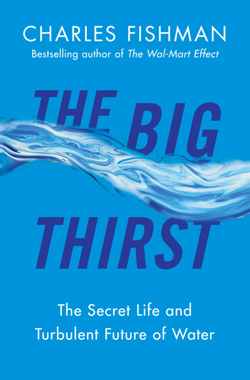
The Big Thirst

Title: The Big Thirst: The Secret Life and the Turbulent Future of Water
Author: Charles Fishman
Genre: Non-fiction
Year: 2010
Rating: 2

Water is kind of a strangely common topic to write a book about, but Charles Fishman manages to reintroduce us all to the most unique feature about the planet we call home. In journalistic style, he presents water to us in a roundabout fashion, forcing us to see in in the light of what it is: a truly magical substance that we need to respect and preserve.
Fishman, the author of the bestselling The Wal-Mart Effect and winner of the Loeb award for investigative journalism, first reported on the bottled water industry in 2006. "I'm not afraid to ask stupid questions," Fishman responds to how he became interested in the broader topic of water. "How did bottled water get here? It's a completely absurd product. Why do we need to pay for bottled water?"
That stupid question led to four years of research, travel, and carrying jugs of water on his head for three kilometers with Papua New Guineans.
Fishman takes us on an extremely logical journey through the origins of water-- by the way, that Aquafina on your desk came from intergalactic space-- to the usages in different countries, and the history of how water has been treated throughout the past century of easy access and abundance.
But as all our friends in Arizona and Las Vegas know, water is a precious commodity, and it won't be abundant forever.
Fishman's writing style is straightforward, well-informed, and to the point. Although the paragraphs and elaborations can be long, they read easily and conversationally, as if you were speaking with a very well-read friend. He presents more of the facts than an actual argument, simply showing us what he's discovered and where this journey of learning about Earth's most precious resource has led him.
This is the first non-fiction book I've reviewed, and it's been a pleasant experience for me. I was given the chance to chat with Mr. Fishman a week ago, and he explained to me the very simple reasons that he became interested in the topic of freshwater: its effect on our daily lives. At any given moment, you'll see someone with a bottle of Evian or Polish Spring in their hand, and he says that he wondered how it got there. Not just from the plant, but where in the ground it sprang from, and where water came from ultimately. "Having a sense of history, and asking why things happen, I end up talking to astronomers," he joked.
The Big Thirst is a fascinating exploration of something that we already thought we were familiar with. We all learn the water cycle in sixth grade (precipitation, gathering, evaporation, condensation, etc) and likely never think about it again until our kids ask us for help on their science homework. But what if, one day, we woke up and found ourselves wondering where the water in the ice maker came from in the beginning?
Altogether, I give this book a 2. That's probably just my affinity for fiction speaking, but it is kind of a long book, at 405 pages. You can pick up a copy at the Kindle store for $9.99, but this book is actually a super good deal at Barnes&Noble, with the hardback going for $16.25. Either way, see if you can borrow a copy from a friend, but if you can't, definitely go pick it up. It's a thought-provoking book, and you'll feel really well-informed by the end.
That's all for day, you pageturners, you. Open your mind and try some nonfiction.

Tuesday, December 13, 2011

The Devil in the White City

Title: The Devil in the White City: Murder, Magic, and Madness at the Fair That Changed America
Author: Erik Larson
Year: 2003
Genre: Historical non-fiction
Rating: 1


If you could define a masterpiece, this might be a good example.
The Devil in the White City, a national bestseller, is a stunning portrait of dark and light America in the 19th century, a picture of realism and idealism. Very often, we tell our children the best stories of America and focus on the beautiful and cheerful and positive and neglect the shameful and petty. These disillusions are not dispelled as we grow up, and we remain blithely unaware of the dark past that many of our most beautiful places have. In order to interpret our future, we have to know our past, and The Devil in the White City is an enlightening piece of our own history.
Larson tell the story of the 1893 Chicago Columbian Exposition- The World's Fair- in enrapturing, grisly detail. Beginning with the designation of the location and Chicago's determination to have it, he outlines the political winds of the time period and the reasons for why it was in the Midwest instead of the obvious choice, New York City. Larson focuses on the main architect of the fair, Daniel Burnham, who is a household name in Chicago even today, and follows his struggles, frustrations, and ultimate triumph in the legendary World's Fair.
However, Larson also tracks a nightmare in a parallel story. The tale of H.H. Holmes, a psychopathic murderer lost to history, is interspersed with the larger tale of the Exposition. In grisly, meticulously researched detail, Larson follows the quiet threads of the man who murdered at least nine people and possibly more than fifty over the course of five years. Larson paints a dark human picture, leading readers down a dark path of either madness or sick, disturbed thought.
You thought you knew history. But Larson takes his readers through their own history, rediscovering details that they thought they had forgotten and clearing away foggy parts of that time period as he goes. I don't want to spoil too much of the story, but did you know that Aunt Jemima's pancakes had their start at the Fair?
Perhaps the most astonishing part of this book is the historical accuracy. Most of us slog through history textbooks in high school and college and then never read another one until our kids ask us for help with homework, but The Devil in the White City reads like an enrapturing novel. With the skill of a historian and journalist, Larson retrieves hundreds upon hundreds of quotes from the annals of history, filling them in like dialogue. His sardonic sense of humor and irony also keep the novel funny, despite the dark overtones.
So even if you didn't think you knew history, this book is worth the week it takes to read. It's not long, and you'll rip through it. It's a little older now, so I got my copy at a consignment store for $2.00, but you can get your copy at Barnes and Noble for $16.95 or on eBooks for $9.99. And trust me, it's worth buying, because you'll read it two or three times. Then tell your friends to read it. Then recommend it to your coworkers. And so on.
Anyway, it also makes a great Christmas present. Merry Christmas, everybody!

The Journeyer

 Title: The Journeyer
Author: Gary Jennings
Year: 1984
Genre: Historical Fiction
Rating: 3

Gary Jennings is royalty in the genre of historical fiction. Aztec, Aztec Autumn, and Aztec Blood are all fantastic original pieces of historical fiction, enthralling readers in a world that now no longer exists. The Journeyer, published 4 years after Aztec, takes us back into 13th century Europe, and fulfills its name. As always, Jennings' descriptions of people, places, and events are stunning and enthralling, sometimes more attractive to the darker parts of ourselves than we care to admit.
We follow a young Marco Polo from La Serenissima, Venice, as he grows into a man and travels with his legendary father, Niccolo, and uncle, Mafio. Along the way, in classic Jennings fashion, we watch Marco become an adult through the somewhat destruction rites of passage (sex and violence) and experience the laws of pre-Renaissance Venice for ourselves as Marco is outlawed from his birth city until another Doge is crowned and he can return.
Jennings takes us from Venice to Constantinople, Baghdad to Cathay, and back again. Medieval Europe is grimy and violent, and the colorful descriptions of death will stay in my mind for a long time after the last page. Marco Polo's sometimes exaggerated adventures seem to fit in very realistically into Jennings' well-told tale.
However, if you've read Aztec, there's really nothing new here. In fact, I don't find Marco as charming character as Mixtli. I personally have always had a penchant for lost cultures, so Aztec had me from the beginning, but I feel like The Journeyer had so much potential that went unfulfilled. There are parts of it that drag, especially after the Yun-nan bit, and some parts are purely unnecessary (like Jennings' multiple descriptions of homosexual relations- one would be fine).
Don't get me wrong, it was still a fantastically written book; most of today's writers can only dream about achieving what Gary Jennings has. Superbly researched and well written, I liked The Journeyer for what it is- a wild adventure that doesn't fall into the traditional knights-in-shining-armor category of classic medieval literature. It's a step into another time and place that is not often explored- medieval China, the Middle East, and India. So often, in historical fiction from this time period, these regions are either cursory or completely ignored- Jennings explores them thoroughly and explicitly incorporates racial prejudices and wars of the time period.
Altogether, The Journeyer is yet another Jennings success. Nostril is actually my personal favorite character (and now you have to read it just to figure out the reason for his name). Don't go out and buy this book if you can avoid it, because it runs about $30.00 in hardback, but it's only $9.99 on the Kindle. It'll be at your library, and you'll want to renew it a few times, because it's a good long read.
By the way, merry Christmas! Buy a book for someone you love, because buying chocolate only lasts a week at the best and power tools only get you so far. :)

Sunday, October 30, 2011

Hornet Flight

Title: Hornet Flight
Author: Ken Follett
Year: 2002
Genre: Historical Fiction
Rating: 2

Ken Follett has done it again.
Whether you're an avid Starz fan or a voracious historical fiction reader like me, you know the compelling story of Pillars of the Earth, and many readers now know Fall of Giants. Ken Follett has proved himself a master of the genre, inventing compelling characters and throwing them into the heart of some of history's greatest moments. Hornet Flight is no exception.
The story of a young Danish boy, Harald Olufsen, intertwines with the pulse-pounding stories of the great spies of war-torn Europe. As in all of Follett's novels, you can never quite tell what twists and turns the story will take, and it leads to delightful, horrifying, compelling moments in the years that shocked the world.
Flight depicts the British/German spy game and how it really affected the fighting. In the prologue of the book, the final gambit is revealed: if the British don't find out how the Germans are detecting their planes, they'll lose the war. So from the earliest moments of the book, we are introduced to those in power, and in the next chapter, we meet those under the regime. The small country of Denmark is rarely ever talked about in history books, let alone in exciting novels; so the idea of reading about the people during that time period had me from the beginning.
Harald is a compellingly ordinary character, which is somehow attractive. He seems so traditional- the son of a preacher, a schoolboy, and a little rebellious- but after the points in the plot develop, he becomes so real that I can almost picture his blonde head walking through the crowds on the street. Plus, his peat-burning motorbike is so stinkin' cool, it's not fair.
I've always admired Follett's ability to create villains; Peter Flemming is no exception. He is incredibly complex; almost a modern Javert- a man obsessed with justice because of the lack of justice in his own life. His wife was permanently mentally damaged due to an automobile accident, and there is no recovery. As an officer of the law, we see him fall throughout the book, and justice finally prevails, but  I can't share too many of the details without spoiling the book entirely.
Arne and Hermia are my favorite, in short. :) Hermia is an absolutely fascinating character as well, with her passions unrestrained, but we cannot tell where her most powerful passion lies. It's an interesting character study.
Follett's character development is absolutely impeccable. Even in a far-removed era like Pillars, he makes Philip real enough to touch; but in a time much closer to our own, he makes every detail of his people real enough to draw breath. Fantastically researched, infallibly written, and compelling, Flight is a gritty, bittersweet tribute to the gains and losses that we all suffer in times of trial.
I managed to get away with Hornet Flight for five dollars from Barnes and Noble's sale rack, and because the books is almost ten years old now, you'll probably be able to find it for cheap on Amazon or eBooks. Either way, it's absolutely worth a read if you can get your hands on it. If not, get it from the library, but it's definitely worth a read. Don't pass it up, if you can.
That's all for me, for a bit. I have some catching up to do. Read on, my pageturners.

Monday, April 4, 2011

Aztec

Title: Aztec
Author: Gary Jennings
Year: 1980
Genre: Historical fiction
Rating: 3

Okay... here we go. Prepare for a deluge.
Aztec is a wide-spanning, incredibly detailed, indefatigably researched piece of historical literature, regarded as one of the most accurate in current existence. Gary Jennings is a master story teller- in Tlilectec Mixtli, he has created an incredibly human character who relates his life in stunning detail. And throughout his "abnormally long years", we come to know Mixtli intimately and, to borrow from Cummings, "laugh his joys and cry his griefs".
Aztec opens with a letter addressed from Bishop Zumarraga of Mexico to Emperor Don Carlos I of Spain, placing the book's year at 1529. The priests of Mexico City (inside the desecrated House of Song of ancient Tenochtitlan) press an old Mixtli to tell them completely the story of his life, which he happily does. After all, he is a "word knower"- a scribe.
Mixtli begins the story of his life at birth, and from that moment on, he leaves out nary a detail, and granted the native peoples' penchant for loose sex, it becomes awkward in many places. However, Jennings's research on the original Nahuatl tongue is impeccable- most of the terms that Mixtli uses for cultural objects are first listed in Nahuatl and then in English. Reading the language became a little wearying after awhile- I couldn't take in too much of this book in one sitting.
However, the story arcs are beautiful. Mixtli's voice is amusing and amazingly contemporary, making fun of many aspects of Mexica culture, other native peoples, and the Spanish priests' hypocritical behaviors. He often states that he was "heathen" before, but under the false words, I could detect a pride in his original faith in Tonatiu, the sun god. He is a little ashamed of many of his people's violent traditions, such as the Flowery Wars (wars fought purely for the purpose of obtaining sacrifices for the gods) or the sacrificial rites of Xipe Totec.
However, we also feel Mixtli's pain at losing those he loves. I wept with joy when he married Zyanya, Always, and had their daughter. I also shed tears when he lost her in the floods of Ahuitzotl. I was appropriately shocked in the court of Jadestone Doll (which I won't detail here). And when I found out the fate of Tzitzitlini, I wept harder than before.
Altogether, this book is a little too long. Don't get me wrong- it's beautifully written, and covers an incredible expanse of time, from the old Motecuzoma's rule until the fall of Tenochtitlan, in breathtaking detail. Everything, from the farthest south of the Mexica's rule to the history of Texcoco, is told from beginning to end. And although the information is told incredibly and there is so much of it, I began to lose interest about when the floods ended.
Also, the detailed amount of sex in this book is rather R-rated. For most indigenous cultures, sex is a common topic, but Mixtli is promiscuous, to say the least, throughout his bachelorhood; there are many sex scenes, and Jennings describes almost all of them from beginning to end. From his incestuous relationship with Tzitzilini to his loving marriage with Zyanya, Mixtli certainly sowed his wild oats. Now, I don't personally have a problem with sex in books- as it's a necessary part of the story- the number of scenes was just unnecessary (especially the one with Cozcatl). That's just a personal preference, though.
There are a number of books in the Aztec series, and although I haven't read all of them, this is a great one. Unfortunately, Mr. Jennings passed away in 1999, so there won't be any more, but this is an enduring work that he will be remembered for. I enjoyed it immensely.
I picked up my copy from the local library, but I had to renew it to finish it. I think it costs around $20.00 at B&N, but it's probably cheaper at your local Bookman's or Hastings. So, grab it from the library if you can. It's a good, lengthy read.
That's all for me today. Keep reading, my dear pageturners.