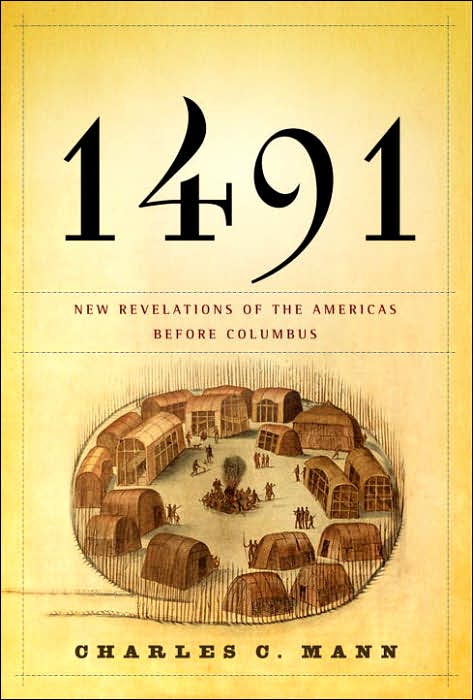
Title: 1491: New Revelations of the Americans Before Columbus
Author: Charles C. Mann
Year: 2005
Genre: Non-fiction: History
Rating: 2
I don't really make a habit of reading non-fiction, but this is one book that I had been meaning to read for about two years. It was worth it, even though sometimes reading non-fictional facts was like chewing dry bark. 1491 is excellently researched, compiled, and written, the topics all referring back to the main heading and overall idea of the book. Charles C. Mann tells a beautiful, tragic story through the facts of the history of many societies lost.
1491 has a somewhat interesting format. It starts in the present with Mann flying over the Beni, an immensely historical savanna in Bolivia. He comments on the mounds, then moves gracefully into the book itself (that was only the introduction). He first talks about the Native Americans with which we are most familiar- the Wampanoag, Tisquanto's people- and follows their history up until the time of the Pilgrims. Here, the story is engaging and fascinating as Mann weaves together creative non-fiction with the real and true facts of Tisquanto's life. He then moves to talk about the devastating and horrifying effects of disease on the Native American population. Smallpox is a terrifying thing indeed- a weapon that thinking Europeans could never have matched.
Mann shifts from the colonial New England to the great fall of the Inka (I choose to spell it like that because Mann spells it like that, the original spelling), or Tawantisuyu- the land of the Four Quarters, in Peru. He details the Inkan empire extensively, following the stories of kings and their people, of cities and their conquest. They too fell to disease and Pizarro, but they were torn by civil war long before that. But I shan't spoil the entire book for you- these are only the first two chapters.
Mann is a masterful writer, but even he cannot dislodge my inherent dislike for non-fiction. I lost interest in the book somewhere in the chapter called "Pleistocene Wars"- it was not that the facts were not interesting, only that they became a little tedious. He goes on and on for pages about the "Low Counters" and the "High Counters", which makes the book drag heavily in the middle, glutted with too much information. I think he could have gutted the middle section a little bit more, but it picks up again toward the end when he synthesizes the real story of the history with our perception of it.
I really enjoyed 1491. It took me a while to get through, but it was completely worth it, and made me realize my ancestors' mistakes indeed. The Native Americans made their mistakes, but the Europeans' were far more grave and long-reaching. True, the circumstances of the invasion of the Americas is unlikely to be repeated (Mann recounts the Indians' genetic makeup as "virgin soil" for European diseases, uniquely vulnerable), but we can still learn from their mistakes.
I have this one in paperback, and it's pretty affordable at $16.00. I couldn't find it on eBooks, but because I have in paper copy, I didn't look very hard, so I think it likely that it could be found there. I didn't buy this one from Barnes and Noble, either; I got it from a teeny little bookstore in Iowa City, Iowa, so it is likely available in your local Borders' or Bookman's.
Anyway, that's it for today. Happy reading, my dear pageturners!
“The very existence of libraries affords the best evidence that we may yet have hope for the future of man.” - T.S. Eliot
Friday, January 28, 2011
Saturday, January 15, 2011
Madman
Title: Madman
Author: Tracy Groot
Year: 2006
Genre: Christian Historical Fiction
Rating: 2
Now, before you run because of the word "Christian", I must encourage you to stop and take this all in stride. Madman is singularly better than most Christian Fiction (although not as good as The Mark of the Lion series by Francine Rivers) and tells the story of the demoniac of the Decapolis, telling the traditional Biblical text in the form of a gripping thriller.
Madman is well-researched, interestingly told, and gripping in the best literary sense. The writing style is a little choppy sometimes- Groot has an affinity for sentence fragments- but it adds to the thrill and emotion of the story. The plotlines behind the actual story are really fascinating, and it is enthralling to piece together each character's back story and relation to the other characters. Little pieces of evidence are revealed all along the way, and only at the last do you understand fully.
Following the story of a Greek servant named Tallis investigating the disappearance of an Academy of Socrates in the Greco-Roman city of Hippos, Madman begins in the tiny Palestinian village of el-Kursi, the location of the feared madman. Tallis finds that the academy is not only defunct, it disappeared nearly three years before, along with all the teachers that had been personally appointed by his beloved master in Athens, Callimachus. The plot thickens: not only is the school gone, no one in Hippos is willing to admit that it ever existed. Through a slave that he pays dearly, he finds out what happened to four of the teachers: one was murdered in a grisly fashion, another committed suicide, another is a priestess in the temple of the god Dionysus (Bacchus), and the fourth is the legendary madman of Kursi.
As the story progresses, you discover Tallis' terror and fury toward the cult of Dionysus, and through his memories, discovering the deep darkness behind the happy mask of the god of wine and debauchery. Instead of ignoring the Greco-Roman culture like so many Christian novels, Groot uses all of the Greek names for the cities of the Decapolis- Scythopolis for Beth Shean, Hippos for Annaba, Kursi for Golan Heights (although the village is still called Kursi). She uses Dionysus instead of Bacchus, his more Romanized name, as well. Staying with the view of her characters, Rome is barely ever viewed as the center of the intellectual world- Athens still holds that title, at least in Tallis' and Polonus' minds. She also acknowledges the difficulties between the Parthians and the Romans of the time, often mentioning the band of Shamash Eriba as a difficulty to travelers in the area.
Most of the book is purely fiction, a story about Tallis and his fear of madness and the Maenads (nurses of Dionysus). At the end, the story in the Biblical canon is told in breathtaking fashion, inside the mind and soul of the madman. I have never heard a story told so personally, terrifyingly, or touching as that.
Madman is honestly one of my favorite books. I fell a little bit in love with Tallis, picturing his cheerful face with the gap in his teeth, smiling and telling jokes between the disasters of the book. Getting to know his heart and mind is honestly one of the best parts of the book. It drags a little in the middle of the book, while Tallis is waiting for his Forum for Truth to meet, but it picks up speed from there until the end. Several of the characters are really hard to understand- Polonus, Bek, and Samir especially- but that tracks with the story fairly well in the end. Though not nearly as touching and tear-inducing as Beauty, I've read this book plenty of times. Groot's use of the culture of the time, the languages, the attitude toward philosophy, and the overcoming of madness are truly enthralling, and rare amongst Christian writers.
"Quandocumque impellunt, repelle- when they push, you push back. They can't take anything that you don't surrender." --Tallis
Author: Tracy Groot
Year: 2006
Genre: Christian Historical Fiction
Rating: 2
Now, before you run because of the word "Christian", I must encourage you to stop and take this all in stride. Madman is singularly better than most Christian Fiction (although not as good as The Mark of the Lion series by Francine Rivers) and tells the story of the demoniac of the Decapolis, telling the traditional Biblical text in the form of a gripping thriller.
Madman is well-researched, interestingly told, and gripping in the best literary sense. The writing style is a little choppy sometimes- Groot has an affinity for sentence fragments- but it adds to the thrill and emotion of the story. The plotlines behind the actual story are really fascinating, and it is enthralling to piece together each character's back story and relation to the other characters. Little pieces of evidence are revealed all along the way, and only at the last do you understand fully.
Following the story of a Greek servant named Tallis investigating the disappearance of an Academy of Socrates in the Greco-Roman city of Hippos, Madman begins in the tiny Palestinian village of el-Kursi, the location of the feared madman. Tallis finds that the academy is not only defunct, it disappeared nearly three years before, along with all the teachers that had been personally appointed by his beloved master in Athens, Callimachus. The plot thickens: not only is the school gone, no one in Hippos is willing to admit that it ever existed. Through a slave that he pays dearly, he finds out what happened to four of the teachers: one was murdered in a grisly fashion, another committed suicide, another is a priestess in the temple of the god Dionysus (Bacchus), and the fourth is the legendary madman of Kursi.
As the story progresses, you discover Tallis' terror and fury toward the cult of Dionysus, and through his memories, discovering the deep darkness behind the happy mask of the god of wine and debauchery. Instead of ignoring the Greco-Roman culture like so many Christian novels, Groot uses all of the Greek names for the cities of the Decapolis- Scythopolis for Beth Shean, Hippos for Annaba, Kursi for Golan Heights (although the village is still called Kursi). She uses Dionysus instead of Bacchus, his more Romanized name, as well. Staying with the view of her characters, Rome is barely ever viewed as the center of the intellectual world- Athens still holds that title, at least in Tallis' and Polonus' minds. She also acknowledges the difficulties between the Parthians and the Romans of the time, often mentioning the band of Shamash Eriba as a difficulty to travelers in the area.
Most of the book is purely fiction, a story about Tallis and his fear of madness and the Maenads (nurses of Dionysus). At the end, the story in the Biblical canon is told in breathtaking fashion, inside the mind and soul of the madman. I have never heard a story told so personally, terrifyingly, or touching as that.
Madman is honestly one of my favorite books. I fell a little bit in love with Tallis, picturing his cheerful face with the gap in his teeth, smiling and telling jokes between the disasters of the book. Getting to know his heart and mind is honestly one of the best parts of the book. It drags a little in the middle of the book, while Tallis is waiting for his Forum for Truth to meet, but it picks up speed from there until the end. Several of the characters are really hard to understand- Polonus, Bek, and Samir especially- but that tracks with the story fairly well in the end. Though not nearly as touching and tear-inducing as Beauty, I've read this book plenty of times. Groot's use of the culture of the time, the languages, the attitude toward philosophy, and the overcoming of madness are truly enthralling, and rare amongst Christian writers.
"Quandocumque impellunt, repelle- when they push, you push back. They can't take anything that you don't surrender." --Tallis
Wednesday, January 12, 2011
Till We Have Faces
Title: Till We Have Faces: A Myth Retold
Author: C.S. Lewis
Year: 1956
Genre: Fiction
Rating: 1
"How can we see face to face till we have faces?" --Orual
Without a doubt, Till We Have Faces leaves Narnia with all its bright colors and beautiful words in the dust. C.S. Lewis's deeply humane masterpiece, woven in to the fabric of the Greek legend of Cupid and Psyche, is dark and beautiful, its words twined as deep in our hearts as our very life blood. Wisdom, knowledge, pain and hardship are all as poignant here as in any book, but somehow far more personal.
The story begins with Queen Orual looking back on her life, but she does not waste much time on trivialities: she begins almost immediately, telling the story of how she and her sister, Redival, were the princesses of Glome, an heirless and now-queenless kingdom. Orual's deeply pragmatic voice pushes deep into the reader's mind, making Glome a place truly seen though her eyes, hopes, fears, and prejudices. The story follows how Istra, Psyche, becomes like a daughter to Orual, is sacrificed to the god on Grey Mountain, and finds life there. But I shan't spoil it for you.
Orual, with her often childlike perceptions of everything that happens in the story, reminds me of myself sometimes, which makes her deeply relatable (especially in her casual acknowledgement of her ugliness and perpetual virginity). The Fox, an endearing, fatherlike character, is introduced in the first chapter as a redheaded Greek slave, long taken from his family and thrown into slavery. However, he is cheerful, and he tells Orual "no man is a stranger if he remembers that the whole world is one city". He is wise, but still beautifully human and faulted, even in the somewhat confusing but fantastic ending scene.
C.S. Lewis' crowning achievement in this book, I believe, is getting me, as the reader, to know the characters as if they are standing next to me. Bardia is a very typical man, and I felt as if I have known him my whole life. Trunia is amusing, but still real in his humor and fears. Orual, however, is the truest- I know her the best; she has become an archetype for mistakes to avoid in my life, but also a heroine to me. And Psyche, of course; Psyche, in her Helen-beauty and wisdom, is the girl you have always loved, been jealous of, and wanted to know so well.
The best rivalry I have read in many books is that between Orual and Ungit. It is a deeply complex relationship, laced with fear and hate, until Orual realizes what she is; hearing the stories from the Fox, she knows to fear Ungit. But she does not know her full capacity until the dazed days of the end, in the second half of the book. The story completes itself so well in that regard that I cry every time in the last chapter.
Till We Have Faces is a fantastic piece of literature, and I commit myself to reading it at least twice a year- it never takes me more than a few sittings. The paperback copies are wonderfully cheap, but the eBook copies run a little pricey at $10.00. But if you have not read this underrated classic, get your hands on it as soon as possible.
"Did I not tell you, Maia, that one day we would meet in my house and no cloud would be between us?" --Psyche
Author: C.S. Lewis
Year: 1956
Genre: Fiction
Rating: 1
"How can we see face to face till we have faces?" --Orual
Without a doubt, Till We Have Faces leaves Narnia with all its bright colors and beautiful words in the dust. C.S. Lewis's deeply humane masterpiece, woven in to the fabric of the Greek legend of Cupid and Psyche, is dark and beautiful, its words twined as deep in our hearts as our very life blood. Wisdom, knowledge, pain and hardship are all as poignant here as in any book, but somehow far more personal.
The story begins with Queen Orual looking back on her life, but she does not waste much time on trivialities: she begins almost immediately, telling the story of how she and her sister, Redival, were the princesses of Glome, an heirless and now-queenless kingdom. Orual's deeply pragmatic voice pushes deep into the reader's mind, making Glome a place truly seen though her eyes, hopes, fears, and prejudices. The story follows how Istra, Psyche, becomes like a daughter to Orual, is sacrificed to the god on Grey Mountain, and finds life there. But I shan't spoil it for you.
Orual, with her often childlike perceptions of everything that happens in the story, reminds me of myself sometimes, which makes her deeply relatable (especially in her casual acknowledgement of her ugliness and perpetual virginity). The Fox, an endearing, fatherlike character, is introduced in the first chapter as a redheaded Greek slave, long taken from his family and thrown into slavery. However, he is cheerful, and he tells Orual "no man is a stranger if he remembers that the whole world is one city". He is wise, but still beautifully human and faulted, even in the somewhat confusing but fantastic ending scene.
C.S. Lewis' crowning achievement in this book, I believe, is getting me, as the reader, to know the characters as if they are standing next to me. Bardia is a very typical man, and I felt as if I have known him my whole life. Trunia is amusing, but still real in his humor and fears. Orual, however, is the truest- I know her the best; she has become an archetype for mistakes to avoid in my life, but also a heroine to me. And Psyche, of course; Psyche, in her Helen-beauty and wisdom, is the girl you have always loved, been jealous of, and wanted to know so well.
The best rivalry I have read in many books is that between Orual and Ungit. It is a deeply complex relationship, laced with fear and hate, until Orual realizes what she is; hearing the stories from the Fox, she knows to fear Ungit. But she does not know her full capacity until the dazed days of the end, in the second half of the book. The story completes itself so well in that regard that I cry every time in the last chapter.
Till We Have Faces is a fantastic piece of literature, and I commit myself to reading it at least twice a year- it never takes me more than a few sittings. The paperback copies are wonderfully cheap, but the eBook copies run a little pricey at $10.00. But if you have not read this underrated classic, get your hands on it as soon as possible.
"Did I not tell you, Maia, that one day we would meet in my house and no cloud would be between us?" --Psyche
Sunday, January 9, 2011
Beauty
Title: Beauty
Author: Robin McKinley
Year: 1978
Genre: Fiction
Rating: 1
Beauty is one my personal favourites. It is one of the brightest, most intelligent, and enchanting works of fiction I have ever had the pleasure of reading. I've read it so many times that I've been through two paperback copies.
Beauty is a retelling of the classic French fairy tale La Belle et la Bete, written in Robin McKinley's visionary style from the perspective of the main character, Beauty. Beauty, despite her name, is described as incredibly plain in comparison to her beautiful sisters Grace and Hope. The story tracks the collapse of their family's fortunes in the city and their subsequent retirement to the country, where the events that lead up to Beauty's moving into the castle unfold.
Beauty is an entertaining, endearing character, her ever-intellectual voice becoming the background and colour for the mysterious world of the enchanted castle of the Beast. Beauty is meticulously told- and in other books, this can be an irritating trait; but here, it's gripping and, to borrow the book's vernacular, enchanting. McKinley blends just enough of the fantastic with reality to make the tale seem like something you heard as child, a beautiful fairy tale about the girl who went to save her family and tame the Beast.
From beginning to end, Beauty tells details in just enough colour and description to make you read through the next sentence to find out more about the world that she is living in. There are a few places that, as a fourteen year-old, I didn't understand her references (she refers to the Beast as The Minotaur, Yggdrasil, and Cerberus in some places; in another, she references King Cophetua), but that takes you inside her head all the more. Beauty is the intelligent, humble heroine that all of us want to meet someday in an an enchanted castle in the wood.
Unfortunately, Beauty is not available on eBooks yet (I am writing a strongly-worded letter), but you can find it in Barnes and Noble, Hastings, Border's, or Bookman's if you look in the fiction section. And I recommend that you do so today or tomorrow- this book is completely and totally worth the read, and it won't take you long, either. I once finished it, sighed, turned back to the first page, read it again, and completely enjoyed every word. Robin McKinley's beautiful piece is very much worth the time and few dollars you have to spend on the paperback copy.
Author: Robin McKinley
Year: 1978
Genre: Fiction
Rating: 1
Beauty is one my personal favourites. It is one of the brightest, most intelligent, and enchanting works of fiction I have ever had the pleasure of reading. I've read it so many times that I've been through two paperback copies.
Beauty is a retelling of the classic French fairy tale La Belle et la Bete, written in Robin McKinley's visionary style from the perspective of the main character, Beauty. Beauty, despite her name, is described as incredibly plain in comparison to her beautiful sisters Grace and Hope. The story tracks the collapse of their family's fortunes in the city and their subsequent retirement to the country, where the events that lead up to Beauty's moving into the castle unfold.
Beauty is an entertaining, endearing character, her ever-intellectual voice becoming the background and colour for the mysterious world of the enchanted castle of the Beast. Beauty is meticulously told- and in other books, this can be an irritating trait; but here, it's gripping and, to borrow the book's vernacular, enchanting. McKinley blends just enough of the fantastic with reality to make the tale seem like something you heard as child, a beautiful fairy tale about the girl who went to save her family and tame the Beast.
From beginning to end, Beauty tells details in just enough colour and description to make you read through the next sentence to find out more about the world that she is living in. There are a few places that, as a fourteen year-old, I didn't understand her references (she refers to the Beast as The Minotaur, Yggdrasil, and Cerberus in some places; in another, she references King Cophetua), but that takes you inside her head all the more. Beauty is the intelligent, humble heroine that all of us want to meet someday in an an enchanted castle in the wood.
Unfortunately, Beauty is not available on eBooks yet (I am writing a strongly-worded letter), but you can find it in Barnes and Noble, Hastings, Border's, or Bookman's if you look in the fiction section. And I recommend that you do so today or tomorrow- this book is completely and totally worth the read, and it won't take you long, either. I once finished it, sighed, turned back to the first page, read it again, and completely enjoyed every word. Robin McKinley's beautiful piece is very much worth the time and few dollars you have to spend on the paperback copy.
Saturday, December 11, 2010
The Alchemist
Title: The Alchemist
Author: Paulo Coehlo
Year: 1988
Rating: 2 (go and buy, but don't go at 4:30 AM)
I opened The Alchemist after leaving it on my bookshelf for nearly a year (it was given to me for a Christmas gift) and finished it in two sittings. Although it was translated from Portuguese, it reads very smoothly and almost as if it was written in your own language- or the Language of the World, as it were. Paulo Coehlo's masterful telling of a Spanish boy's journey to find his purpose in life is enthralling and full of a sort of wisdom we all knew but didn't realize.
The story begins in the Spanish countryside, introducing us to Santiago, an eighteen year-old shepherd. However, that is the only time in the entire book where the boy's name is used (odd, I thought. Why did he give him a name at all?). Santiago is the sort of boy you knew growing up but never noticed; he was always staring at the sky, thinking about his life and how it affected the world as a whole. As a shepherd, Santiago learned much about himself and his concerns from his sheep, sleeping in a ruined church and selling his wool by the season to a merchant (whose daughter he fancies marrying). But his life spins into an alternate direction when he encounters a man who calls himself king.
Santiago has a dream of a treasure in a pyramid, and the king tells him that he must promise him a tenth of the sheep if he tells him about his 'Personal Legend', or purpose in life. The story begins here, with the wisdom that the king imparts to Santiago. His travels take him across an ocean, a desert, through months of working at a crystal shop, robbery, and wars. He meets many different kinds of people- those who never knew their Personal Legend, those who failed to realize them, those who do not want to realize them, and those who are working hard to achieve them. He travels, fights, learns, and falls in love along the way, all the time learning the Language and Soul of the World.
I really enjoyed seeing into Santiago's simple heart, hearing his thoughts and walking with him across hot desert sands. Although it was nothing like reading Shakespeare, the wisdom imparted on every page about alchemy and everything being one resonated into my mind. Being a Christian, it's often hard for me to read scholarly books, but Coehlo worked God into the very fabric of The Alchemist. Instead of being an anomaly, God became a part and head of the Soul of the World. I've never seen any other author do something like that so masterfully.
Coehlo even works history into the story, but I shan't spoil the entire of it for you. It dragged a little bit in the middle, when he delved deeply into explaining the Soul of the World in regard to the prophecy with the hawks in Al-Fayoum, but the story picked up rapidly, like a river, and carried me to the end. It's not a long read, but I felt as if the story completed itself beautifully.
I recommend you read this as soon as possible, but it won't disappear from shelves anytime soon. It's a classic, and it clearly deserves to be. I honestly think kids should read this in school- it's much better than anything I've read thus far in high school, and I don't understand why The House on Mango Street is fed to our freshmen when The Alchemist is left for a time in their life when they should have known all this by now.
Make our lives better- realize your part in the Soul of the World and just read through The Alchemist.
Author: Paulo Coehlo
Year: 1988
Rating: 2 (go and buy, but don't go at 4:30 AM)
I opened The Alchemist after leaving it on my bookshelf for nearly a year (it was given to me for a Christmas gift) and finished it in two sittings. Although it was translated from Portuguese, it reads very smoothly and almost as if it was written in your own language- or the Language of the World, as it were. Paulo Coehlo's masterful telling of a Spanish boy's journey to find his purpose in life is enthralling and full of a sort of wisdom we all knew but didn't realize.
The story begins in the Spanish countryside, introducing us to Santiago, an eighteen year-old shepherd. However, that is the only time in the entire book where the boy's name is used (odd, I thought. Why did he give him a name at all?). Santiago is the sort of boy you knew growing up but never noticed; he was always staring at the sky, thinking about his life and how it affected the world as a whole. As a shepherd, Santiago learned much about himself and his concerns from his sheep, sleeping in a ruined church and selling his wool by the season to a merchant (whose daughter he fancies marrying). But his life spins into an alternate direction when he encounters a man who calls himself king.
Santiago has a dream of a treasure in a pyramid, and the king tells him that he must promise him a tenth of the sheep if he tells him about his 'Personal Legend', or purpose in life. The story begins here, with the wisdom that the king imparts to Santiago. His travels take him across an ocean, a desert, through months of working at a crystal shop, robbery, and wars. He meets many different kinds of people- those who never knew their Personal Legend, those who failed to realize them, those who do not want to realize them, and those who are working hard to achieve them. He travels, fights, learns, and falls in love along the way, all the time learning the Language and Soul of the World.
I really enjoyed seeing into Santiago's simple heart, hearing his thoughts and walking with him across hot desert sands. Although it was nothing like reading Shakespeare, the wisdom imparted on every page about alchemy and everything being one resonated into my mind. Being a Christian, it's often hard for me to read scholarly books, but Coehlo worked God into the very fabric of The Alchemist. Instead of being an anomaly, God became a part and head of the Soul of the World. I've never seen any other author do something like that so masterfully.
Coehlo even works history into the story, but I shan't spoil the entire of it for you. It dragged a little bit in the middle, when he delved deeply into explaining the Soul of the World in regard to the prophecy with the hawks in Al-Fayoum, but the story picked up rapidly, like a river, and carried me to the end. It's not a long read, but I felt as if the story completed itself beautifully.
I recommend you read this as soon as possible, but it won't disappear from shelves anytime soon. It's a classic, and it clearly deserves to be. I honestly think kids should read this in school- it's much better than anything I've read thus far in high school, and I don't understand why The House on Mango Street is fed to our freshmen when The Alchemist is left for a time in their life when they should have known all this by now.
Make our lives better- realize your part in the Soul of the World and just read through The Alchemist.
Sunday, October 3, 2010
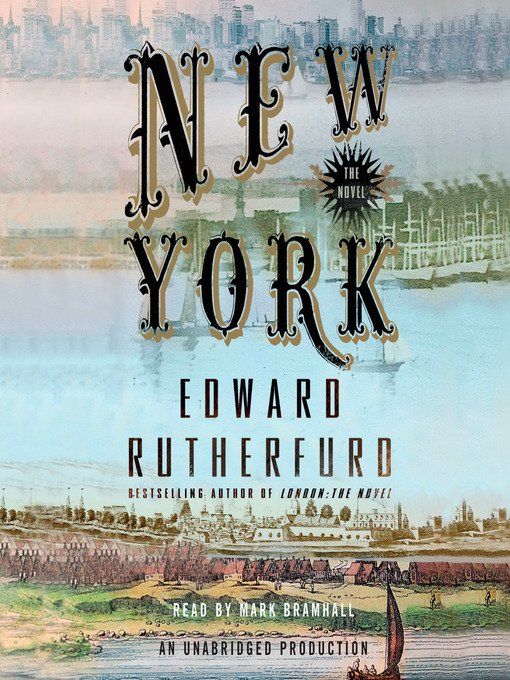
New York
Review: New York: The Novel
Author: Edward Rutherfurd
Written: September, 2009
Genre: Historical Fiction
Rating: 1
New York has such a spirit and effervescence for the beautiful city that we all know as the 'island at the center of the world' that I wanted to pack my bags and get on the first plane there. Edward Rutherfurd has an amazing talent for creating historical characters to make the truthful eras come to life in vivid color.
Historical fiction is a relatively new genre in popular fiction, but it's growing rapidly. There are a lot of new books in the ever-lengthening historical fiction aisle in my Barnes and Noble here in Prescott. Edward Rutherfurd is definitely among the governing circle of that genre, with his top sellers being such famed novels as London, The Princes of Ireland, and The Forest.
New York begins in the 17th century colony of New Amsterdam, but it really doesn't focus on the politicking of England and the Netherlands. Rather, it focuses on the people, which really gives the reader insight into what life was really like. While describing the landscape in rich words and phrases, New York still leaves something to the imagination, which gives it that extra dimension which so many books are lacking. Following the Van Dyck boat north, you can almost hear the rush of the river and the soughing of the wind through the trees of the largely still-wild Manhattan.
New York dances gracefully alongside American history without all of the heavy descriptions of the politics, and George Washington himself even makes an appearance during the Revolutionary War. I personally loved the way that Rutherfurd followed the Master family down through the ages, seeing how the years affected them and the city which changed so much beneath their feet.
Now, I've heard from many different readers that it's hard to like Rutherfurd's novels because they switch characters. I understand (I've had a hard time with some of the other ones), but New York is different. It keeps tracking all the way through, following one family throughout the ages, keeping just enough of their parents' story in it to keep you interested and reading, following each generation through their trials and hardships, either coming out triumphant or despondent in the end, searching for a happy ending the eastern land of opportunity.
I don't want to give too much of the story away, but what I must say is that the ending is both tear-jerking for those of us who witnessed it and heartwarming for those who don't remember it.
Oh, and Rutherfurd's technique of following a family heirloom is sparkling and flawless, as ever.
I borrowed it from my local library, but I wish I'd bought this book. It runs a little pricey still at a $29.00 hardback, but is totally and completely worth it. If you can get your hands on it in the next week, do so.
That's it for today. :)
Author: Edward Rutherfurd
Written: September, 2009
Genre: Historical Fiction
Rating: 1
New York has such a spirit and effervescence for the beautiful city that we all know as the 'island at the center of the world' that I wanted to pack my bags and get on the first plane there. Edward Rutherfurd has an amazing talent for creating historical characters to make the truthful eras come to life in vivid color.
Historical fiction is a relatively new genre in popular fiction, but it's growing rapidly. There are a lot of new books in the ever-lengthening historical fiction aisle in my Barnes and Noble here in Prescott. Edward Rutherfurd is definitely among the governing circle of that genre, with his top sellers being such famed novels as London, The Princes of Ireland, and The Forest.
New York begins in the 17th century colony of New Amsterdam, but it really doesn't focus on the politicking of England and the Netherlands. Rather, it focuses on the people, which really gives the reader insight into what life was really like. While describing the landscape in rich words and phrases, New York still leaves something to the imagination, which gives it that extra dimension which so many books are lacking. Following the Van Dyck boat north, you can almost hear the rush of the river and the soughing of the wind through the trees of the largely still-wild Manhattan.
New York dances gracefully alongside American history without all of the heavy descriptions of the politics, and George Washington himself even makes an appearance during the Revolutionary War. I personally loved the way that Rutherfurd followed the Master family down through the ages, seeing how the years affected them and the city which changed so much beneath their feet.
Now, I've heard from many different readers that it's hard to like Rutherfurd's novels because they switch characters. I understand (I've had a hard time with some of the other ones), but New York is different. It keeps tracking all the way through, following one family throughout the ages, keeping just enough of their parents' story in it to keep you interested and reading, following each generation through their trials and hardships, either coming out triumphant or despondent in the end, searching for a happy ending the eastern land of opportunity.
I don't want to give too much of the story away, but what I must say is that the ending is both tear-jerking for those of us who witnessed it and heartwarming for those who don't remember it.
Oh, and Rutherfurd's technique of following a family heirloom is sparkling and flawless, as ever.
I borrowed it from my local library, but I wish I'd bought this book. It runs a little pricey still at a $29.00 hardback, but is totally and completely worth it. If you can get your hands on it in the next week, do so.
That's it for today. :)
Subscribe to:
Posts (Atom)