Showing posts with label David. Show all posts

Saturday, January 26, 2013

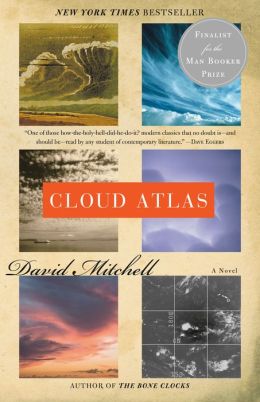
Cloud Atlas

Original image at barnesandnoble.com
Title: Cloud Atlas
Author: David Mitchell
Year: 2004
Genre: Science fiction/short stories
Rating: 1

Articles of life that we barely understand are sometimes the most beautiful. Those great mysteries that we realize can never be solved attract us over and over throughout our lives, preying on the backs of our minds, nagging, wondering. How is it that we cannot put them out of our minds? We know they have no answers, and never did, but some little part of human nature says that we cannot help ourselves. It’s better to wonder and never know than to be forever incurious.
Cloud Atlas is that balance of curiosity and answer, like echoes down a long canyon, leaving us to wonder if there really is a source at the other end. Woven artfully through difficulty and oppression, all of the characters of the book are victims of some heinous thing, but all heroes by their own spirit. Even if their stories end ingloriously, the meaning still stands, and that fact is the whole point.
            Summarizing David Mitchell’s abstract work is a bit like trying to make a Da Vinci out of cat’s cradle. So many different pieces pull against one another and seem separate, but are still knots on the same rope. We follow, more or less, a stream of consciousness on its path through six different lives, watching and guessing how they impact and change one another through the upheavals of time. From earthy, grounded Adam Ewing on the Pacific in the late 19th century to an unspecified, post-Apocalyptic Hawaii, Mitchell leads us along his twisted storyline of broken lives, and we wonder what anything means for the first 300 pages. And then, like a ball that’s made its weary way to the top of the hill, we slowly unwind to the bottom in a rush of emotions and revelations that both end our wondering and launch it into a new stratosphere.
            Mitchell is not only a literary master, but also clearly an outright genius. The organization and ingenuity it took to engineer the crisscrossing, complex, interlocked lives chronicled in Cloud Atlas would make the average novelist dizzy, let alone the invention of the unique structure. Formatted like a series of short stories, we are cut off at crucial moments and left to wonder for unnervingly long page numbers. For instance, we part ways with Adam Ewing after 39 pages and don’t meet him again until 475. If Mitchell were an average writer, we would hardly care for any of his characters by the time we see them again, but thankfully, he is not.
            Mitchell is renowned on both sides of the pond for his vivid imagery and evocative characterization, much stemming from this novel. With remarkably few lines, he attaches us so firmly to a person that never existed and never could (e.g. clone Sonmi-451, an artificially grown human that becomes sentient).
            Another feat of writing is the center segment, “Sloosha’s Crossin’ and Everythin’ After.” Written in a pidgin English style that evokes Brer Rabbit, Mitchell flexes his imaginative and technical muscles, detailing a world completely foreign to us in language difficult for us to understand. Somehow, it comes out clear and endearing, and that alone earns him a star.
            Another star comes for the sheer beauty of the ending. Many modern authors have lost the ability to move their readers by the sheer beauty of their prose, but Mitchell clearly feels deeply about the written word and the power it can bestow. He uses the last, poignant moment to reflect on what it is we are, summarizing the novel in one way and in another dispersing it.
            In essence, Cloud Atlas tells the story of what we mean to one another. Just as there is no way to accurately summarize a life, there is no way to summarize them all. We study, we learn, we pull meaning out of the past and apply it to the present, but each second creating a past that will only be changed in the future. The truth of history is what we make of it; the truth of the human experience is what we are.
            Mitchell delivers us this observation in an airy package full of printed sounds, black and white colors, and souls wrapped in words.  Something undefined fills the karma that he implies—that no matter if we live alone, feel alone, and die alone, as long as we are alive, we are never truly alone.
            Cloud Atlas is available on the Kindle for $11.99, or in paperback from Amazon for $12.98. This is not your average light weekend reading, nor is it pure entertainment—no, this book requires your attention and consideration as the pages turn. It was recently made into a film starring Tom Hanks and Halle Berry, and I have not seen it yet, but I cannot fathom how the screenplay runs. I’ll have to watch it just for pure curiosity as to how it flows.

Wednesday, March 14, 2012

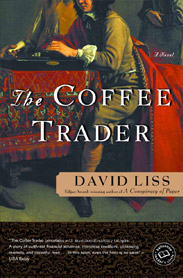
The Coffee Trader

Title: The Coffee Trader
Author: David Liss
Year: 2003
Genre: Fiction
Rating: 3


Admit it, we all drink a little too much coffee. We're all pretty well acquainted with that niggling headache around 2 o'clock if you'd made it that long without a cup, and most of us at one point or another have used it to cure a nasty hangover. Besides the TV and the microwave, the coffeemaker is a staple of the American home.
David Liss's fast-paced conspiracy novel centers around the induction of coffee into European culture as "the drink of commerce." The book reads like a long night with a little too much caffeine- always interesting, but sometimes it would be better to just go back to bed. The cast of characters is colorful and well-developed, but the whole story just tries a bit too hard.
The story opens on Amsterdam in 1659, the amazingly tolerant center of capitalism and the site of the Exchange. Our protagonist, Miguel Lienzo, is a Portuguese immigrant and a Converso-- a Secret Jew, one who outwardly professes Catholicism and keeps his faith in private. He joins in business with a crafty widow named Geertruid Damhuis in a complex plot to make an enormous fortune from imported coffee. As the book progresses, we meet Miguel's neurotic brother Daniel, and discover his wife Hannah is infatuated with Miguel. A complicated web of characters, including the annoyingly peripheral Alonzo Alferonda, try to ruin Miguel's plans as the book progresses and every situation tries to frustrate his fortune-to-be.
 Miguel Lienzo is an extremely well-developed character. We spend most of the book following him through his various debts, threats, and exchanges, cheering him on and learning more of who he is each time he interacts with someone. By the end of the book, we become so attached to him that we can hardly see what he's become, which is deliciously conflicting (and the only plot twist that affected me, honestly). Where many writers try too hard to give their characters foibles and faults, Miguel fills himself out into a full human being, and we become attached to him almost immediately, when he petulantly comments to Geertruid that coffee looks like "the devil's piss."
The Coffee Trader begins brilliantly, describing the colorful and often underrated Dutch capital in the lurching era between the Renaissance and the Enlightenment. We soon learn how wonderful a haven Amsterdam is for the Jews-- with no fear of the Inquisition, they can keep their faith to themselves but not fear constant uprooting and death. However, we also learn to be nervous of the power of the Ma'amad, their council of Portuguese Jews, and its crafty politics. Liss presents us with a world that begs to be further explored, from the wild trades on the Exchange to the grimy alleys near the canals.
Although Liss is a talented writer, he disappoints in the overall tidiness of this story. It is a conspiracy book, fast-paced and convoluted, but there are just one too many plot twists-- it becomes hard to see how the beginning unites with the end, and the characters resemble something like debris caught up in a twister. We can just keep track of all the complicated names (like Annetje, Joachim, Alferonda, or Crispjin) when Liss throws another betrayal at us, sending our opinion of that character spinning out of control. The trouble with betrayals is that we have to be attached to the character before it really affects us-- and with so many names and personalities to remember, each one becomes more expected and less upsetting.
The whole book is well-written, the language displaying Liss's easy command over the world of literature. The perspectives alternate between Miguel, Alferonda, and Hannah, giving us a full perspective on the wild world of capitalism and brutal trade. However, Alferonda disappoints for being such a central character to the work. His chapters are annoyingly self-centered, which makes the case that he is a narcissist and helps to develop his character, but does a poor job of placing him in the story. I understand Liss wanting to keep the secrets until the end of the book, but it might have been better to either leave out his "memoirs" entirely or give a little more context into the entire of the book.
Nevertheless, The Coffee Trader is a good read. At 384 pages in the hardback, it's a decent-length read, just enough to make people in Starbucks think that you're clever and deter them from interrupting you. (It becomes a far more interesting read when you have a huge mug of coffee in hand.) The historical context is well researched, and opens the historical-fiction regulars outside of the traditional box of European novels about the 17th century. It's not often that you come across a book that focuses so well on trade in a sphere outside of England or France. Here's to hoping that The Coffee Trader won't be the only one about the subject.
I got my copy of The Coffee Trader from my library, so yours should have it too. If not, you can get it on the Kindle store for $12.00, or buy it in paperback on Amazon for as low as $5.35. You can't go wrong with that price, and getting to know David Liss as an author is no mistake.