Showing posts with label Washington. Show all posts

Monday, June 24, 2013

When Captain Flint Was Still a Good Man

Title: When Captain Flint Was Still a Good Man
Author: Nick Dybek
Year: 2012
Genre: Drama/suspense
Rating: 2

Thinking of the people you know the best, you think you can estimate what they'll do, what they think, who they are by the decisions they've made in the past. They might be impatient, indecisive, peacemaking, passive, aggressive, impetuous, good or just plain mischievous. But the real questions is this: can you really ever know for sure what someone might or might not become as a reflection of their choices and their desires?
With masterful storytelling and paced gravity, Nick Dybek's When Captain Flint Was Still a Good Man peruses the effects of our choices and what they mean for who we are and what we might become. The smallest thing might change the course of someone's identity, but only if they want to change. The young voice of the narrator begins as reminiscent but fades to disillusioned as the story progresses.
Set in the rainy town of Loyalty Island in northeastern Washington State, the grey and misty air of a wet day in late November pervades the whole novel, despite the passage of time through the regular seasons. Cal Bollings, the fourteen-year-old protagonist, relates an incident surrounding the crab season in the 1980s when the heir of the Loyalty Island crab boats decides to break up his father's company, dooming the fisherman to unemployment. Richard Gaunt, the heir, is an interesting enigma to both Cal and the rest of the town: half crazy but strangely lucid, he is one of the few people that has left Loyalty Island for various destinations, but always returning because of some unnamed tie to the overcast land and dark waters. However, when fishing season comes around, Cal's father and the fishermen report back that Richard has gone overboard in the Alaskan oceans and drowned. Some weeks later, Cal finds out the truth and is forced to make a dreadful choice: defy his father and the men he has admired all his life, or do what might be right for the moment but will kill the island and all he has known.
The novel is told in flashback, which accounts for some of the grave maturity of Cal's voice, but is by no means dry. In some places, where the telling drops into vivid memories, we catch glimpses of what a fourteen-year-old might actually feel in this situation. Punctuated by poignant observations and proverbs, the writing is crisp and haunting, lending the book strength that the story might not have carried all of its own.
The characters themselves are striking. Cal's mother, for example, is a mystery to everyone on Loyalty Island, including his father, who goes off to fish in Alaska instead of trying to understand his wife. Even Cal is unsure of how he feels about her: love, anger, loyalty, bitterness and admiration all swirl around her at various points in the story. Richard Gaunt, one of the central figures of the story, is a beautifully developed character, not easily summarized or understood, even to an outside observer. Dybek is an incredibly intelligent observer of human nature, and When Captain Flint Was Still a Good Man lives and breathes with human life.
Cal's father, too, is a mixed figure, and we spend the whole story trying to determine whether he is a hero or a villain- which, of course, is the point. Perhaps we are all good and bad, and one decision can make us good just for the moment. After all, who is so bad they cannot be redeemed, and who is so good they cannot fall?
Dybek illustrates a great understanding of human nature and the suspense to tell a riveting, moving story. This novel is heavy, but not so much so that it will drown readers. Dybek is brave enough to ask questions that he doesn't answer, leaving readers to wonder what it all meant: hard for those looking for just entertainment, but for those who have the time to wonder, this story will echo.
Because it's relatively recent, When Captain Flint Was Still a Good Man is available for $10.28 in hardback from Amazon, or $9.99 on the Kindle. I was lucky enough to spot mine of the shelf of a used book shop for $2.00, so they are floating around out there, and your library might have a copy if you live in a city or a larger town. Make time for this novel, though; not a lighthearted read, but certainly valuable just for the quality of the storytelling. I would relate its tone to American Rust, which I reviewed late last year, but infinitely better done.

Wednesday, October 3, 2012

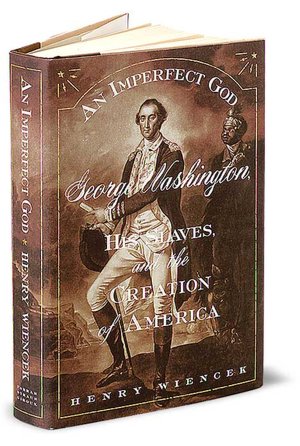
An Imperfect God

Title: An Imperfect God: George Washington, His Slaves, and the Creation of America
Author: Henry Wiencek
Year: 2003
Genre: History
Rating: 3

Think back on your elementary school history lessons. Other than the colorful (and notably bloodless) pictures of Gettysburg and the clean, proper descriptions of the Continental Congress, what do you know about our Founding Fathers as people? Most of the things we think about them are fiction, or glorified attributes. The truth of the matter is that they were tradesmen, farmers, philanderers, rebels, subversives, and, most notably, slave owners.
Most elementary school teachers somehow skip that one.
In An Imperfect God, historian Henry Wiencek stops to look closer at the life and occupation of perhaps the most mythologized man in American history: George Washington. With no royalty to idolize, Americans have generation upon generation lifted up the stories of the man with the wooden teeth (they were actually ivory and extracted teeth) who chopped down the cherry tree and had to tell the truth (a composite tale that's only partially true). In fact, the man that George Washington was has been somewhat buried in time and a whirlwind of events, and Wiencek seeks to bring it starkly to light.
The main point of the book is the irony of America: a state based on the purported ideals of freedom while maintaining slavery with a fist of iron. The Constitution "solidified the institution," Wiencek writes. Although the title and face of the book focus on Washington, the real heart of it is to convey the depth of slavery in young America and the double standard that the Founding Fathers lived by.
The book begins in the year of Washington's death, where he decides to make an addendum to his will where all of his own slaves would receive their emancipation upon his death, a shocking breach of protocol for a Virginian plantation owner at the time. By following Washington's meticulous diaries, Wiencek shows us firsthand the struggle that our first president went through within his own rigid moral barriers, trying to reconcile the ideas of the Enlightenment with a creaky, superstitious, inhuman institution like slavery. And yet, his life, his world was centered around it, and one could not pull the rafters from a building and not expect it to collapse. This was the dilemma that Washington faced, and this is the conflict that the book presents us with.
Unfortunately, it's not extremely well organized. The author is in such a rush to present us with his painstakingly researched data that he begins to gush in the very first chapter, bursting at the seams with stories and histories and connections and context. The whole book follows in this theme, sort of like a scatter plot. Washington's life is the median trend of the plot, following him from beginning to end, with bits and pieces of history, culture, and new anecdotes on slavery scattered about. The effect is somewhat confusing, but in the end it conglomerates into a big picture: division.
For the pure purpose of education, An Imperfect God is enlightening, clearing away the cobwebs of myth and idolizing with a proliferation of primary source documents. Washington kept detailed journals and books of finances, down to what he spent on gambling on nights in Williamsburg. He also kept yearly diaries with the markedly unromantic title "Where and How My Time is Spent." No one could accuse him of being flowery. However, Wiencek doesn't just leave it there, with his subject; he has scoured the annals at Mount Vernon and other depositories for letters, records, journals, and exchanges on a host of other subjects, some of which include barely literate slaves who worked at Mount Vernon. Scarcely a paragraph passes without a reference to some obscure historical character, backed up by extensive documentation.
Wiencek is a fine historian, and his work is sure to last, if only for the motivated. An Imperfect God is not written for the passive reader, only cursorily interested-- no, the dense writing and blob-like organization don't make this a golden work of the literature world. But as a historical document, it stands. Raw facts are hard to memorize; people like stories.
Maybe we ought to tell our elementary school kids the truth sometimes, even if it's hard to hear.
This book isn't available on Kindle, which is alright-- I snagged my copy from a dusty corner of the library. You can purchase it from Amazon for as low as $10.50 in the hardback, which is a lovely edition with a group of paintings in the center (including one remarkable one of Washington's cook, Hercules) that I had never seen before. Worth a read if you've got the time, worth a summary if you haven't.