Showing posts with label film. Show all posts

Saturday, January 26, 2013

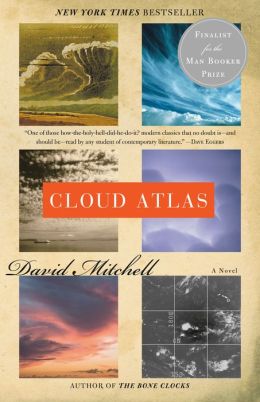
Cloud Atlas

Original image at barnesandnoble.com
Title: Cloud Atlas
Author: David Mitchell
Year: 2004
Genre: Science fiction/short stories
Rating: 1

Articles of life that we barely understand are sometimes the most beautiful. Those great mysteries that we realize can never be solved attract us over and over throughout our lives, preying on the backs of our minds, nagging, wondering. How is it that we cannot put them out of our minds? We know they have no answers, and never did, but some little part of human nature says that we cannot help ourselves. It’s better to wonder and never know than to be forever incurious.
Cloud Atlas is that balance of curiosity and answer, like echoes down a long canyon, leaving us to wonder if there really is a source at the other end. Woven artfully through difficulty and oppression, all of the characters of the book are victims of some heinous thing, but all heroes by their own spirit. Even if their stories end ingloriously, the meaning still stands, and that fact is the whole point.
            Summarizing David Mitchell’s abstract work is a bit like trying to make a Da Vinci out of cat’s cradle. So many different pieces pull against one another and seem separate, but are still knots on the same rope. We follow, more or less, a stream of consciousness on its path through six different lives, watching and guessing how they impact and change one another through the upheavals of time. From earthy, grounded Adam Ewing on the Pacific in the late 19th century to an unspecified, post-Apocalyptic Hawaii, Mitchell leads us along his twisted storyline of broken lives, and we wonder what anything means for the first 300 pages. And then, like a ball that’s made its weary way to the top of the hill, we slowly unwind to the bottom in a rush of emotions and revelations that both end our wondering and launch it into a new stratosphere.
            Mitchell is not only a literary master, but also clearly an outright genius. The organization and ingenuity it took to engineer the crisscrossing, complex, interlocked lives chronicled in Cloud Atlas would make the average novelist dizzy, let alone the invention of the unique structure. Formatted like a series of short stories, we are cut off at crucial moments and left to wonder for unnervingly long page numbers. For instance, we part ways with Adam Ewing after 39 pages and don’t meet him again until 475. If Mitchell were an average writer, we would hardly care for any of his characters by the time we see them again, but thankfully, he is not.
            Mitchell is renowned on both sides of the pond for his vivid imagery and evocative characterization, much stemming from this novel. With remarkably few lines, he attaches us so firmly to a person that never existed and never could (e.g. clone Sonmi-451, an artificially grown human that becomes sentient).
            Another feat of writing is the center segment, “Sloosha’s Crossin’ and Everythin’ After.” Written in a pidgin English style that evokes Brer Rabbit, Mitchell flexes his imaginative and technical muscles, detailing a world completely foreign to us in language difficult for us to understand. Somehow, it comes out clear and endearing, and that alone earns him a star.
            Another star comes for the sheer beauty of the ending. Many modern authors have lost the ability to move their readers by the sheer beauty of their prose, but Mitchell clearly feels deeply about the written word and the power it can bestow. He uses the last, poignant moment to reflect on what it is we are, summarizing the novel in one way and in another dispersing it.
            In essence, Cloud Atlas tells the story of what we mean to one another. Just as there is no way to accurately summarize a life, there is no way to summarize them all. We study, we learn, we pull meaning out of the past and apply it to the present, but each second creating a past that will only be changed in the future. The truth of history is what we make of it; the truth of the human experience is what we are.
            Mitchell delivers us this observation in an airy package full of printed sounds, black and white colors, and souls wrapped in words.  Something undefined fills the karma that he implies—that no matter if we live alone, feel alone, and die alone, as long as we are alive, we are never truly alone.
            Cloud Atlas is available on the Kindle for $11.99, or in paperback from Amazon for $12.98. This is not your average light weekend reading, nor is it pure entertainment—no, this book requires your attention and consideration as the pages turn. It was recently made into a film starring Tom Hanks and Halle Berry, and I have not seen it yet, but I cannot fathom how the screenplay runs. I’ll have to watch it just for pure curiosity as to how it flows.

Tuesday, December 25, 2012

The Hunger Games

Image credit to suzannecollinsbooks.com/
Title: The Hunger Games
Author: Suzanne Collins
Year: 2008
Genre: Sci-fi/thriller/teen
Rating: 2

Action! Danger! Tragedy! Oppression! Romance!
You couldn't ask for more on a movie poster. Perhaps, in fact, if any book could have skipped the written phase and gone straight to film, it would be The Hunger Games. Rapid-paced action and visceral imagery make this book a top-notch story, and even if the language leaves something to be desired, it hits its target crowd exceptionally well. After all, sometimes all we need is a good story, right?
Suzanne Collins is an experienced children's writer; she has written multiple episodes for 1990s TV shows like Little Bear, Oswald, and Clarissa Explains It All. She has also written a five-book series for children known as The Underland Chronicles, which are an interpretation of the classic Alice in Wonderland.
However, with The Hunger Games, she takes a step into the gritter world of teen fiction, leaving behind squeaky-clean genres for a heftier tale. The novel tells the story of 16 year-old Katniss Everdeen, a poor girl living in the 12th District of a post-apocalyptic North American country called Panem. She is content to lead a quiet, meager existence by illegally poaching off of government land to feed her family until her younger sister, Primrose, is called out to be a participant in the bloody gladitorial contest known as the Hunger Games. In desperation to save her sister's life, Katniss volunteers to take her place, sealing her fate to kill or be killed.
To make matters more complicated, a boy that Katniss owes her life to, Peeta Mellark, is named as the other participant, obliging her to kill someone that she feels indebted to. Thus, she explains, is the horror of the Games: in order to survive, you must give up all your dignity, which is the government's aim. As the book progresses, the relationship between Katniss and Peeta becomes much muddier and more complicated, and even she is not sure how she feels about the boy who saved her life, the boy she is obliged to kill.
Told in the first person, the book places the readers firmly inside Katniss's mind. We hear her thoughts, her gut reactions to things, and see the grossly unfair world of Panem as she sees it. Grammar fanatics will squirm and squawk as they read turns of phrase (think high school language, written down) and the truncated fragments of thoughts are jarring, but the argument stands that they do place you into the mind of a coarse teenager.
Collins has created a marvelously dark, creative world replete with extensive details and logical, ordinary, yet beautiful characters. Although some of the people we meet are rather two-dimensional (Prim and Effie are exceptionally flat, and Cato runs a close third) Katniss and Peeta are fully fleshed out, and blend together beautifully. As time progresses, we understand more of the darkness and complete victory that the Games are to the Capitol, dehumanizing their victims and their audience in one blow.
The story is a thinly veiled allegory for the evils of socialism, what with the rigid rule controls on each district's product and the omnipotence and omniscience of the government. Katniss and Peeta represent the young capitalists defying the shackles of governmental regulation, shaking off the social expectations of submission and fear. Collins has essentially created a effective propaganda piece for republicanism with a action-packed, fast-paced, driven plot filled with believable people and graphic imagery.
The target audience is most definitely teenagers and young adults. The language is easy and flows much like an average American talks, and there are few moments without some sort of action or plot-centric exchange. Collins draws in a female audience with the sweet, innocent romance between Peeta and Katniss and the male audience with the sheer horror of the Games that she describes. (Cato's death is particularly horrifying, and will shock anyone with a visual imagination.) Intuitively weaving all of her different articles together to create one enormous, lumpy tapestry, Collins introduces us to a plot that we can love and remember, cheer and grieve for, and step easily into with the tightly-woven words she has written.
Because it is told in first person, the book stays with Katniss nearly every waking moment for a few weeks, but at just over 300 pages is surprisingly short. While that style necessitates some dull moments, some of the scenes are exceptionally poignant, such as the reaping (where the participants, known as "tributes," are named) when Katniss throws herself forward to save her sister. Rife with passionate language and the impulsive nature of the action, we are gripped throughout the telling and tied tightly to the brave girl as she sacrifices herself for love of family. Because it is told in the present tense, the readers experience the events in hypothetical "real time," which places us even more inside the mind of Katniss, lending us her emotions and distractions. Perhaps it is because we nearly become her, but our heroine is one of the most complete characters in popular literature.
The film, starring Jennifer Lawrence as Katniss and Josh Hutcherson as Peeta, came out in March 2012 and drew an enormous audience for its extended run. Catching Fire, the next film, is expected in September 2013.
The Hunger Games is available for a meager $5.00 on the Kindle (it's free if you join Amazon Prime), or $10.89 in hardback. The entire trilogy, which includes Catching Fire and Mockingjay, is available for $18.99 on the Kindle or $29.50 in hardback. Because of the popularity and timeliness of these books, they are probably taken out of most libraries most of the time; if you can't borrow them, they're worth the purchase. Mine were given to me by some wonderful people as a Christmas gift, and I profusely thank them. It's taken me a really long time to jump on the bandwagon.
Merry Christmas, everyone! Hope you got or gave at least one book today. Enjoy your break and keep reading!