Sunday, October 28, 2012

The Beekeeper's Apprentice

Title: The Beekeeper's Apprentice
Author: Laurie R. King
Year: 1994
Genre: Fiction/crime/mystery
Rating: 1

The felt cap, the magnifying glass, the pipe. The sharp nose, the serious grey eyes, the angular cheekbones, the thin long legs. Quick with words, sharper with action, hardly sleeps, always works, and keeps his associates in the dark. In other words, Sherlock Holmes.
Over the century since Arthur Conan Doyle's mysteries were first published in the Strand, hundreds of adaptations of his character have appeared on stage, film, print, and music. Many of these adaptations have taken considerable liberties with the original detective so beloved to millions worldwide, resulting in interesting if non-canon stories. Doyle expressed distaste for his detective, hoping in the end that Holmes would not be his legacy, and unfortunately for him, that is the end of the story. His other works, including The Lost World, are excellent, but all pale in comparison to the astute and acidic observations of the Baker Street resident.
Few authors are ever praised for being uncreative, but Laurie R. King deserves a medal for doing just that: sticking to the original character. Far too many adaptation authors take liberties and alter the characters to their whims, betraying the original fans, but King has taken Holmes delicately into her hands and shaped him as Doyle might have, aging and retiring but by no means ordinary. The Beekeeper's Apprentice offers readers a look forward into the Holmes's later years on the Sussex Downs, patterned carefully after the original stories but with an air of progress.
The novel is narrated by a young girl named Mary Russell, who has just relocated to a family-owned farm on the downs and literally stumbles into Holmes on her walk one day. He is intrigued by her sharp, cynical mind, so very much like his own, and a casual friendship develops between them. There is no partnership between them, however, until Mary takes on a case of thievery on her own initiative, and Holmes sees that she has a capable mind "for a female." They forge a stronger friendship as the story progresses with the kidnapping of an American senator's daughter and a plot against Holmes, and they are tested both as individuals and as a pair.
Mary stands up to Watson in caliber, endearment, and appropriateness, but outshines him for intellect. Many an author's mistake is to "fangirl:" to place their character in a position where the adapted main character either becomes best friends or falls in love with them, often awkwardly. Not so in this case: Mary is a woman pulled vividly from the early 20th century, representing a shift to modern thought, and Holmes is fascinated with her both for her traditional education and intellect and modern scorn of propriety. Not only does this make her interesting for readers, it makes their relationship plausible, possible, and even likely. Despite being a Victorian gentleman, Holmes has always had a flavor of the unorthodox about him.
King has also been careful about her language. Writing the entire novel in Doyle's dense Victorian prose might be difficult for modern readers, but abandoning it entirely would be a betrayal to the dignity of the stories and take away from Mary's voice. Instead, she has struck a balance that works well, with a strong feeling of education and poetry but still captivating and understandable to her audiences.
Seeing Holmes at the age of 54, retired with beehives on the Sussex Downs, seems somewhat inglorious for the fans of his wild days as a London detective. Conducting experiments in his basement and walking to the village with honey alone hardly seems like the cocaine-addled, rapid-fire mind that we know, and at first we protest, "This can't be right! Where's the running and the hunting and 'the game's afoot'?" (by the way, that line belongs to Shakespeare anyway). However, King gently reminds us that people change, even the most rigid and machine-like of people. Mary tells us this in the beginning of the novel, that the Holmes she knew was different than the one she had read of.
After adapting to the first jolt, this older, quieter version of the detective is just as maddeningly endearing as his younger counterpart, perhaps even more so. Because this story does not focus entirely on Holmes and the crimes he solves, we see more of the man and the quick, methodical reasoning that plays a part in his life. The engine of his mind has struck a balance with his body, and Mary describes an aging Holmes that draws out a new flavor: bittersweet. For even this man, so permanent and implacable, is mortal.
The relationship between Mary and Holmes develops well as the story progresses, and if it errs a bit into over-sentimentality, it only lends to the idea that maybe Holmes is human after all. King uses a pair of intellectual equals to explore how they can spur each other to explore the gaps in themselves, progressing beyond just the salving stage of relationships and into a place where they literally shape each other, making each other better people. Surprisingly vivid and touching, we see the lonely lost orphan girl adopt the broken, stiff old man and fill him with life as he fills her with wisdom, each completing one another in small ways.
Conspicuously, Watson is largely absent, though this is only the first of many Mary Russell novels that King has written. Perhaps Watson (whom Mary refers to as "Uncle John") will make a larger appearance in the later books.
Having taken a nearly sacred figure in hand, King has woven him deftly into a story that not only stays true to the originals, but develops him even more into the man that he became after his years in London ended. Avid Holmes fans will find plenty to love, and newcomers will meet a spectacular set of characters, sure to live in the hearts of readers in all generations.
The Beekeeper's Apprentice is eighteen years old now, so it's available in most libraries, but for only $9.99 on the Kindle or $10.20 in paperback, it's affordable and worth the purchase. Rather than a sweeping story of epic proportions, King has woven a deep, moving tale with just a few pages and words, quiet and complex, to press gently into our hearts and stay.

Wednesday, October 24, 2012

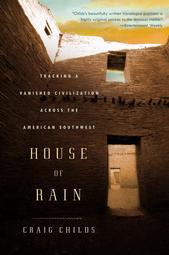
House of Rain

Title: House of Rain: Tracking a Vanished Civilization Across the American Southwest
Author: Craig Childs
Year: 2006
Genre: Non-fiction/history/archaeology
Rating: 2

Rain and the desert: polar opposites, at least to most people. Say the word desert in a crowd of people from a temperate climate, and immediately images of saguaro catci, bleached cow skulls, rattlesnakes, sand dunes, and sombreros come to mind. Dig a little deeper, and some people might think of the distant Native Americans, guiltily mumbling about how white people forced them onto godforsaken spits of land that nobody else wanted. What might surprise the average observer is that those people (the Apache, the Navajo, the Hopi, the Zuni, and many others) have lived in those lands for thousands of years and love it like their own blood. It may be harsh land, but it's their heritage.
Craig Childs's expose on the world of the Anasazi (or, more properly, the ancestral Puebloans) dispels many of the cliche tourist assumptions that Americans may have about the previous owners of our land. With a slow, respectful voice in deference to the secrets of the world around him, Childs quietly follows in the footsteps of a people who left their worlds behind them as a manner of living, tracing their history through only broken pots and tumbled walls.
House of Rain is a bifurcated novel: the main "story" follows Childs's physical pilgrimage across the migratory trails of the pre-Columbian Anasazi, and as he uncovers ruins and artifacts, he divulges his wealth of accumulated archaeological research. He begins in the New Mexican Chaco Canyon, where a great religious and commercial civilization flourished over a thousand years ago. He introduces us slowly to the terminology and basic architecture that these people used, then moves on to the next site at Fajada Butte, taking us along a journey that has long been misread, dusted over and ignored in favor of a more mysterious, though ultimately incorrect, theory.
According to popular mythology, the Anasazi were a people that lived in the Four Corners area of southwest Colorado and northeastern Arizona, constructing the impressive sites of Mesa Verde and Kayenta. On a visit to Mesa Verde, an ordinary tourist will be taken down into some of the breathtakingly complete and preserved cliff dwellings, leaning down into kivas and beholding intact wooden ladders from the 13th century. A tour guide will tell them that these people took refuge in the cliffs from an unknown enemy, possibly the Apache or the Navajo, and only occupied these dwellings for 80 to 100 years before suddenly vanishing without a trace. The guides cite the presence of full baskets of food, personal effects, and ceremonial artifacts as evidence that the people had no chance to collect themselves before disappearing.
This is not the truth, according to Childs. His research and experience have shown him time and time again that the Anasazi were a migratory people, who regularly used a pattern of abandoning structures and following the rain and drought cycle to preserve their way of life.
With extensive research and remarkable personal physical effort, the author takes us on a visceral, sensitive walk along a road that people traveled long ago, tracing the footsteps of a people not entirely gone. Along the way, he makes the point that there still are descendents of the ancestral Puebloans along this road: the Hopi still occupy their ancestral lands, the Navajo are linked to the mountains of their reservation, and people in the Paqime region of northern Mexico are familiar with the migrants' history. They are not gone, Childs concludes; they are simply dusted over with the passage of time.
His own journey drives this point home. Childs is no droll scientist sashaying into writing: his voice is clear, piercing, and in some places moving, bringing to life the dusty places that he stands. His passion for archaeology and the American Southwest pervades the novel, imbuing the words with a meaning other than simple information. That is the true beauty of this book: it is not just a dry recitation of facts. By throwing himself completely into his work, Childs has brought a possibly boring topic to life, enabling his findings to draw in even casually interested readers into a long-lost tale of a people long forgotten.
Although he does stray into sometimes long and dull passages rife with tangential information, the author never loses track of where he stands. One interesting and possibly unintentional beauty of the book is the fact that he brings his wife Regan and toddler son Jasper with him on parts of the adventure. Perhaps it was practical and coincidental, but by bringing such vivid pictures of life into these places long dead, he illustrates a point: the cycle goes on. Even if a civilization vanishes, life has not ended, and there will always be people chasing the rain, adjusting their lives to what is given.
Fascinating, comprehensive, and understandable even for a stranger to archaeology, House of Rain's 445 pages are a fantastic trip through a land that few modern Americans see: the bare deserts of the central Southwest. This book is available for $9.99 on the Kindle or $10.87 in paperback from Amazon, but because it's about five years old, it might be available in your local library. Go and take a look, because dispelling rumors is one of the most valuable things that an author can do. Sharing the truth is a great facet of history.

Thursday, October 11, 2012

The Winter Vault

Title: The Winter Vault
Author: Anne Michaels
Year: 2009
Genre: Historical fiction/romance
Rating: 4

Everyone knows that one guy that's just too articulate. You know, the guy who uses phrases like "his soul is courage," or maybe "it rolled out like a papyrus scroll in my palm." After awhile, it crosses the line from pleasantly odd to creepy to just plain annoying, no matter if he's right or wrong. Don't get me wrong, I appreciate those people-- they spice up life, give me something to think about when we're chatting across the table. But that kind of wording just doesn't really belong there, even if it is creative.
That is exactly the problem with Anne Michaels' The Winter Vault-- something about it is just off. The words all go together in beautiful order, lining up and falling into place with imagery that makes sense, but when compiled only make an enormous pile of pretty phrases. Not entirely unexpected for a poet, but still disappointing.
The novel follows the story of Avery and Jean, a Canadian newlywed couple come to the Nile valley to help with the relocation of Abu Simbel in order to build the Great Aswan Dam. Avery is an engineer and a "machine worshipper," whose mind works in a whirl of cogs and gears into a perfectly oiled machine. Jean, on the other hand, is a botanist, interested only in the growth of the exotic plants of the Egyptian river valley and the destruction that the dam is going to do to them. Tragedy unfolds and pulls the couple apart as they go back to the cold north, where Jean becomes involved with a Polish immigrant named Lucjan and Avery tries to get on with his life. Instead, they find that they're still caught up irretrievably in one another.
Unfortunately, the novel is not told nearly so cleanly. First, Michaels does away with all that "chapter" rubbish that us readers have been clinging to since the Dark Ages, replacing it with short sections that have no notation of time. This might have been fine if they didn't attempt T.S. Eliot-style time jumps, lurching back and forth between the past so suddenly that the reader is left seasick before twenty pages are past.
Avery and Jean's relationship, while soft and gentle in some places, is eyebrow-raisingly strange in others. For one, they always seem to end up talking about their parents in their spare seconds between cuddles, and is constantly interrupted by poetic epiphanies. From my experiences in the real world, poetry is the last thing that comes to my mind when I'm on a date.
The biggest, greyest, most awkward elephant in the room here is the language. Now, I'm pretty lenient about poetry in fiction-- after all, Homer and Shakespeare were both great novelists and poets-- but this book crosses the line into illegibility after awhile. Drowned in turns of phrase and tropes, the real thoughts of the characters become lost in the prose, and they become mere red blood cells for the oxygen of Michaels poetic thought. She ought to stick to poetry if she wants to make points about life without developing characters into human beings that her readers can relate to.
Not to say that the poetry is not breathtaking; Michaels clearly has talent as a writer. There are phrases and paragraphs that are deeply moving, thought provoking, and memorable, each clearly meditated and contemplatively written. Too bad they're just in the wrong place at the wrong time in the wrong book.
(On an unrelated note, ever read a novel by a Canadian? Americans with a penchant for foreign dialects will enjoy the Joyce-style quotations and the spellings of words like "tonne" and "colour.")
Some of the greatest books known to bibliophiles are those rife with beautiful phrasing, flowing with the deepest thoughts of their writers. And yet, they still create between those words the characters that have taken root so deeply in our hearts that they become inseparable from our very souls-- in other words, they are a part of us. That is the mark of truly good fiction: as Mr. Nabokov says, "the merging of the precision of poetry with the intuition of science."
The Winter Vault is available on the Kindle for $11.99, or $14.50 in hardback from Amazon. A copy was logged away in the back shelves of my local library, so unless your local branch has one, I wouldn't advise going and looking for it. The language is worth a glance, but no more than if you pick it up on the coffee table and read a page or two.

Sunday, October 7, 2012

The World Without Us

Title: The World Without Us
Author: Alan Weisman
Year: 2007
Genre: Science, environmental
Rating: 3

Ever feel guilty about being a human?
Sometimes I have spurts of self-consciousness, and I start recycling for a week, or I make an honest attempt to use as little electricity as possible. I even pick up other people's trash off the street and apologize to seagulls about polluting their lake and taking their swamp to build a huge city on. But then, life gets back to me, and I'm busy being a person again, and by the time I remember my environmentally friendly aspirations, it's many months later.
In his hypothetical experiment The World Without Us, American journalist Alan Weisman poses the question of what would happen to the Earth if we all instantly vanished. If every human either kicked the bucket or was abducted to some extraterrestrial zoo in the space of an instant, what would happen to the great cities and monuments we've built? What would become of the blue planet that we call home?
Weisman begins with our cities and suburbs. With exquisite detachment, Weisman chats about falling roofs, dirt-filled swimming pools, cracked pavement, and crumpling houses as if he is discussing the weather over a cup of coffee. Nothing in our drywall-and-plexiglass neighborhoods will last more than a decade (except for the ceramic bathroom tiles, but those will be buried by sediment before long). The step-by-step breakdown of the towns and houses we feel so safe in today is a little bit unnerving, if methodically and casually told.
Next he addresses our cities. Nature will make short work of those, Weisman says-- cracked pavement, invading trees, crumbling stone facades, collapsing subways, and so on-- and before long, islands like Manhattan will be close to the natural woodlands that they were before the Dutch ever set foot there. Of course, some things will be different, but these are just projections from one of the humans that will be long gone by the time the Empire State Building is rubble.
However, once Weisman shifts into the next part of the book (the one about the environment) the feeling of wonder ceases. The tone of casual detachment vanishes for one vaguely tinged with accusation and derision, and the guilt sets in. One must wonder if Weisman is a self-hater, for all the negative voice that he directs at mankind, even if the facts are straight.
The guilt keeps pouring on throughout the rest of the book, and by the time you reach the chapter about polymers, you're begging for good news about yourself. Maybe there's one thing that humans have done to benefit this planet, you hope desperately. And sure enough, there is a chapter about creatures that would miss us. Bad news: they're cockroaches, lice, and bacteria. The cute creatures might or might have a party when we disappear.
On top of being an enormous guilt trip, the book is really strangely organized. The beginning flows neatly, the pieces lining up into a fluid narrative of a world after humanity, the story growing like the trees that it describes. After that, however, it falls apart into a chapter-by-chapter non-cohesive blurb of information, all of which is indelibly researched and sound, but poorly set up. Disappointing for such a good beginning, the readers sigh in relief by the time they reach the end.
Altogether, though, Weisman poses an interesting question. What are we doing to protect the earth that we love? The resources may be there for our benefit, but are we being good stewards of what we have? Management is just as important as productivity. Maybe if we all think a little harder about what we use, what we buy, and especially what we throw away, the Earth would miss us a little more on the day we disappear.
The History Channel is running  an interesting series about the same topic, titled "Life After People." It's not affiliated with the book, but it just goes to show that now that the question has been raised, that nasty human attribute called curiosity has to explore it to its bitter end.
The World Without Us is available on the Kindle for $10.00, or in paperback for $10.20. After spending 26 straight weeks on the New York Times Bestseller list, this book is available in most libraries, but if not, see if a friend has it. It's not one of those books you read for fun on the weekends, but it's definitely worth it for the thought that it provokes.

Wednesday, October 3, 2012

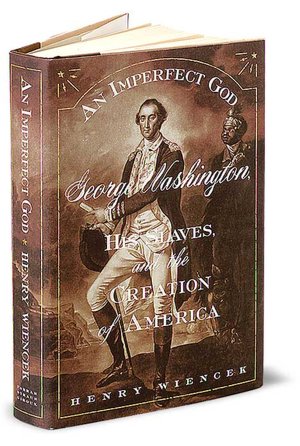
An Imperfect God

Title: An Imperfect God: George Washington, His Slaves, and the Creation of America
Author: Henry Wiencek
Year: 2003
Genre: History
Rating: 3

Think back on your elementary school history lessons. Other than the colorful (and notably bloodless) pictures of Gettysburg and the clean, proper descriptions of the Continental Congress, what do you know about our Founding Fathers as people? Most of the things we think about them are fiction, or glorified attributes. The truth of the matter is that they were tradesmen, farmers, philanderers, rebels, subversives, and, most notably, slave owners.
Most elementary school teachers somehow skip that one.
In An Imperfect God, historian Henry Wiencek stops to look closer at the life and occupation of perhaps the most mythologized man in American history: George Washington. With no royalty to idolize, Americans have generation upon generation lifted up the stories of the man with the wooden teeth (they were actually ivory and extracted teeth) who chopped down the cherry tree and had to tell the truth (a composite tale that's only partially true). In fact, the man that George Washington was has been somewhat buried in time and a whirlwind of events, and Wiencek seeks to bring it starkly to light.
The main point of the book is the irony of America: a state based on the purported ideals of freedom while maintaining slavery with a fist of iron. The Constitution "solidified the institution," Wiencek writes. Although the title and face of the book focus on Washington, the real heart of it is to convey the depth of slavery in young America and the double standard that the Founding Fathers lived by.
The book begins in the year of Washington's death, where he decides to make an addendum to his will where all of his own slaves would receive their emancipation upon his death, a shocking breach of protocol for a Virginian plantation owner at the time. By following Washington's meticulous diaries, Wiencek shows us firsthand the struggle that our first president went through within his own rigid moral barriers, trying to reconcile the ideas of the Enlightenment with a creaky, superstitious, inhuman institution like slavery. And yet, his life, his world was centered around it, and one could not pull the rafters from a building and not expect it to collapse. This was the dilemma that Washington faced, and this is the conflict that the book presents us with.
Unfortunately, it's not extremely well organized. The author is in such a rush to present us with his painstakingly researched data that he begins to gush in the very first chapter, bursting at the seams with stories and histories and connections and context. The whole book follows in this theme, sort of like a scatter plot. Washington's life is the median trend of the plot, following him from beginning to end, with bits and pieces of history, culture, and new anecdotes on slavery scattered about. The effect is somewhat confusing, but in the end it conglomerates into a big picture: division.
For the pure purpose of education, An Imperfect God is enlightening, clearing away the cobwebs of myth and idolizing with a proliferation of primary source documents. Washington kept detailed journals and books of finances, down to what he spent on gambling on nights in Williamsburg. He also kept yearly diaries with the markedly unromantic title "Where and How My Time is Spent." No one could accuse him of being flowery. However, Wiencek doesn't just leave it there, with his subject; he has scoured the annals at Mount Vernon and other depositories for letters, records, journals, and exchanges on a host of other subjects, some of which include barely literate slaves who worked at Mount Vernon. Scarcely a paragraph passes without a reference to some obscure historical character, backed up by extensive documentation.
Wiencek is a fine historian, and his work is sure to last, if only for the motivated. An Imperfect God is not written for the passive reader, only cursorily interested-- no, the dense writing and blob-like organization don't make this a golden work of the literature world. But as a historical document, it stands. Raw facts are hard to memorize; people like stories.
Maybe we ought to tell our elementary school kids the truth sometimes, even if it's hard to hear.
This book isn't available on Kindle, which is alright-- I snagged my copy from a dusty corner of the library. You can purchase it from Amazon for as low as $10.50 in the hardback, which is a lovely edition with a group of paintings in the center (including one remarkable one of Washington's cook, Hercules) that I had never seen before. Worth a read if you've got the time, worth a summary if you haven't.

Saturday, September 22, 2012

The Thousand Autumns of Jacob de Zoet

Title: The Thousand Autumns of Jacob de Zoet
Author: David Mitchell
Year: 2010
Genre: Historical fiction/conspiracy
Rating: 2

Places and times can capture our souls. A wise man once told me that we spend ten percent of our lives making new happiness and ninety percent trying to stay there rather than trying to find new ways to be happy. Have we not all felt that tug of nostalgia for a day long gone, perhaps a golden afternoon from childhood or the memory of a young love?
In David Mitchell's newest novel The Thousand Autumns of Jacob de Zoet, he explores the bittersweet realities of losing your heart to something you can never have. With the light-fingered writing that he first showcased in 2004's Cloud Atlas, Mitchell draws us in again, this time to a far more grounded story of how enchantments really do exist.
When we first meet the titular character, he has just had his nose broken by a cheating former official of the Dutch East India Company. Jacob de Zoet is a humble clerk, hoping to earn the hand of the woman he loves back in the Netherlands by serving at the Company's Japanese port, Dejima, for the next five years. Little does he know that the land will change him and his life so drastically that he will never be the same. He quickly meets a number of fascinating characters, both Dutch and Japanese, but none so mysterious and deep as the burned girl Orito Aibigawa, the only female ever allowed to study medicine. With his utmost effort, he finally forges a hesitant friendship with her, attracted by her reticence and her quiet nature.
However, things are changing in isolationist Japan. As the story moves on, the characters disperse to their various fates, unable to fight the march of time and ambition, each wronged in a way that maroons them without a ship to carry them back.
Mitchell makes use of the factual Japanese law against foreigners not just to push the story along but to make a point: if we know a land and its people inside and out, we can still be strangers. It takes more than knowledge and familiarity to be welcome in a world. That is the heartbreaking core of the novel-- Jacob can never belong. He has a name given to him by the people, respect, money, status, and can still never be one of them.
The organization of this novel is a little disconcerting for traditional readers. Mitchell reeducated us with Cloud Atlas; by comparison, The Thousand Autumns of Jacob de Zoet is a little gentler. We see parts of the story through the eyes of nearly every character at some point or another, which definitely throws the story around like dice in a cup, but lends a full feeling, like a blind man feeling the walls. Every perspective, every attitude, and every voice chips something in to make the tale the most it could be-- a time, a place, a people.
On an interesting historical side note, the end of the Dutch East India Company is an incredibly important and surprisingly overlooked moment in time. At one time, the Company was so powerful that it was basically an independent country, with its own flags and fleet of ships. Its ships traded from Batavia to Japan to Malaysia to the Netherlands and back. And yet, at the end of the 18th century, it imploded suddenly and violently, leaving an enormous economic gap in Southeast Asia, which in turn affected Europe. Mitchell does an excellent job of depicting this confusion and ambiguity in the novel, thorough for his readers but accurate to the sense at the time.
Despite the beauty of this novel, the construction is a little unbalanced. All the symbolic power is packed at the end, finishing on a terribly serious note, but many parts of the first half give a light-hearted air that belie the undertones of the story. This does appropriately endear us to the characters quickly, and we certainly know Jacob and Orito well by the end of the story, but the amount of ground that Mitchell covers in 477 pages just doesn't give us enough time to probe to the bottom of such interesting personalities.
And yet, the simplicity lends to the air of the novel. The last chapter is heart rending, breathtakingly beautiful, and quiet, just like the end of life-- as T.S. Eliot said, "this is how the world ends, not with a bang but with a whimper." Jacob de Zoet, our brave and awkward hero, cannot change his world, because he's just a man that doesn't belong, but in doing that he has changed the world for good. People pass in and out of our lives for brief moments, their presence and their absence alike leaving marks.
Two years old, The Thousand Autumns of Jacob de Zoet is available on the Kindle for $12.00 or in paperback for as low as $10.20 from Amazon. Some libraries may have a copy, but small ones won't, and this book is definitely worth the time you spend reading it and the hours you'll devote to thinking about it afterward. Quiet and beautiful, just like the land it is set in, this novel flows like a quiet stream through your heart and leaves a coolness in its wake that aches for understanding, for belonging.

Thursday, September 13, 2012

The Last Prince of Ireland

Title: The Last Prince of Ireland
Author: Morgan Llywelyn
Year: 1992
Genre: Historical fiction
Rating: 3

Anyone who's been reading this blog for awhile knows that I've got a penchant for history. My grandfather was a professor of history, my sister is a history teacher, my father was a history buff, and my favorite classes in school were always history. In the American school system, we usually focus on the "usual" docket of historical events, meaning European history and American history, with a sprinkling of ancient history thrown in. But what about those parts of the world that we've completely passed over? Those are my passion, my curiosity, my real love of history-- there are so many stories out there, each more fraught with passion and fear than the last. It is our privilege and our duty to learn and share them, to gain a fuller understanding of this wonderful world we live in.
But enough of my ranting, and on to the book of the day-- The Last Prince of Ireland, by Morgan Llywelyn (pronounced a bit like hly-WE-lin).
Based in Ireland during the end of the Elizabethan era, this book follows the journey of Donal Cam O'Sullivan and his thousand followers on their long, hungry, cold march out of the district of Munster, fleeing the wrath of his former friends and kinsmen. Although it takes place over just fifteen days (each chapter covers one day), the story seems much longer than that-- more like a slow fall into ruin and decay. Each day, the ragged survivors lose more friends, more animals, more dignity and more hope, and we can't help but wonder if it would be more of a mercy to let them just give in somewhere along the way. Donal Cam, the commander of his bedraggled and wretched army, wonders the same while struggling to lead them to life.
And yet, we see hope growing between the cracks of despair. From the earliest pages we see a lovestruck Niall spy Maire Ni Driscoll and attempt to win her heart with kindness rather than bravado, even in the depths of starvation and fear. Joan Ni Sweney and her husband, Dermod O'Sullivan, provide a wry sense of humor and determination, struggling onward and depending on one another more and more as their provisions and strength run out. And Orla Ni Donoghue, a strong woman married to Rory O'Sullivan, struggles with the past and her faith as she fights for life and fierce loyalty to her leader.
Although the novel is protracted and somewhat basic in its choice of words, the burning passion of the writer is obvious. He sees Ireland itself in these pathetic survivors, relics of a noble and strong past being exterminated by the betrayal of the modern world. This is the time when Ireland finally succumbs to the rule of the expanding British, whose influence will change and shape Irish culture for the next four hundred years. Llywelyn, while recognizing this force, clearly believes that there is a deep individuality and strength within the Irish people that cannot be extinguished by oppression.
This, too, can be extended to the human soul in general. The factual march of Donal Cam and his survivors is a tribute to that, but Llywelyn's narrative of the horrific suffering and losses of those people in their struggle for that most basic of human rights-- freedom-- is heart wrenching. As the readers, we find ourselves growing more and more attached to characters we know are considered traitors and are sentenced to death, as if that bright glimmer of light just before it goes out is the most beautiful thing that a person can ever be. And despite the fact that they are bony, dirty, and desperate, these people are beautiful, if only for the sheer strength of will that carries them forward.
The whole novel feels like a slow decline into ruin, which may be intentional, but definitely detracts from the book's readability. There is no clear climax, only a long, drawn-out journey to the end. While the story is character-based, this can only carry on to a certain extent before it become dry and-- dare I say it?-- boring. Every tale needs some sort of arc, some sort of rising action, and while this one doesn't lack for battle scenes, it just seems like disaster after disaster before long.
But in the end, The Last Prince of Ireland is still a tale that needs to be told and understood in its fullest, for the true tragedy it is-- a betrayal of trust, and a shift in patriotism. Most of the princes of the island gave up in order to save their houses, which seems pathetic and selfish, but the motives are understandable. While practically foolish, Donal Cam's protest and subsequent rebellion are noble and contain a spirit of pride; we treasure that kind of national pride and look for it in our leaders, which makes Donal Cam a truly full, admirable, nearly tangible character.
Not exactly a best seller or common, I pulled this book off the shelf by pure happenstance and enjoyed it-- it's not a long read at 364 pages. It's actually fairly difficult to find on Amazon, but if you live in a city with a good library, they should have it. You can get a copy from Amazon for $15.00, but the next lowest price was nearly $40. Go figure on obscure books.
History is vital to understanding the present, even if it is obscure history. Every story weaves together to make the present, which makes it vital to appreciate the past before we move toward the future.