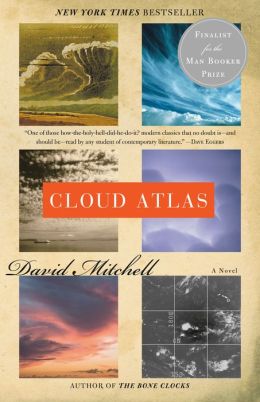
 |
| Original image at barnesandnoble.com |
Author: David Mitchell
Year: 2004
Genre: Science fiction/short stories
Rating: 1
Articles of life that we barely
understand are sometimes the most beautiful. Those great mysteries that we realize
can never be solved attract us over and over throughout our lives, preying on
the backs of our minds, nagging, wondering. How is it that we cannot put them
out of our minds? We know they have no answers, and never did, but some little
part of human nature says that we cannot help ourselves. It’s better to wonder
and never know than to be forever incurious.
Cloud
Atlas is that balance of curiosity and answer, like echoes down a long
canyon, leaving us to wonder if there really is a source at the other end.
Woven artfully through difficulty and oppression, all of the characters of the
book are victims of some heinous thing, but all heroes by their own spirit.
Even if their stories end ingloriously, the meaning still stands, and that fact
is the whole point.
Summarizing
David Mitchell’s abstract work is a bit like trying to make a Da Vinci out of
cat’s cradle. So many different pieces pull against one another and seem
separate, but are still knots on the same rope. We follow, more or less, a
stream of consciousness on its path through six different lives, watching and
guessing how they impact and change one another through the upheavals of time.
From earthy, grounded Adam Ewing on the Pacific in the late 19th
century to an unspecified, post-Apocalyptic Hawaii, Mitchell leads us along his
twisted storyline of broken lives, and we wonder what anything means for the first 300 pages. And then, like a ball
that’s made its weary way to the top of the hill, we slowly unwind to the
bottom in a rush of emotions and revelations that both end our wondering and
launch it into a new stratosphere.
Mitchell is
not only a literary master, but also clearly an outright genius. The
organization and ingenuity it took to engineer the crisscrossing, complex,
interlocked lives chronicled in Cloud
Atlas would make the average novelist dizzy, let alone the invention of the
unique structure. Formatted like a series of short stories, we are cut off at
crucial moments and left to wonder for unnervingly long page numbers. For
instance, we part ways with Adam Ewing after 39 pages and don’t meet him again
until 475. If Mitchell were an average writer, we would hardly care for any of
his characters by the time we see them again, but thankfully, he is not.
Mitchell is
renowned on both sides of the pond for his vivid imagery and evocative
characterization, much stemming from this novel. With remarkably few lines, he
attaches us so firmly to a person that never existed and never could (e.g.
clone Sonmi-451, an artificially grown human that becomes sentient).
Another
feat of writing is the center segment, “Sloosha’s Crossin’ and Everythin’
After.” Written in a pidgin English style that evokes Brer Rabbit, Mitchell
flexes his imaginative and technical muscles, detailing a world completely
foreign to us in language difficult for us to understand. Somehow, it comes out
clear and endearing, and that alone earns him a star.
Another
star comes for the sheer beauty of the ending. Many modern authors have lost
the ability to move their readers by the sheer beauty of their prose, but
Mitchell clearly feels deeply about the written word and the power it can
bestow. He uses the last, poignant moment to reflect on what it is we are,
summarizing the novel in one way and in another dispersing it.
In essence,
Cloud Atlas tells the story of what
we mean to one another. Just as there is no way to accurately summarize a life,
there is no way to summarize them all. We study, we learn, we pull meaning out
of the past and apply it to the present, but each second creating a past that
will only be changed in the future. The truth of history is what we make of it;
the truth of the human experience is what we are.
Mitchell
delivers us this observation in an airy package full of printed sounds, black
and white colors, and souls wrapped in words.
Something undefined fills the karma that he implies—that no matter if we
live alone, feel alone, and die alone, as long as we are alive, we are never
truly alone.
Cloud Atlas is available on the Kindle
for $11.99, or in paperback from Amazon for $12.98. This is not your average
light weekend reading, nor is it pure entertainment—no, this book requires your
attention and consideration as the pages turn. It was recently made into a film
starring Tom Hanks and Halle Berry, and I have not seen it yet, but I cannot
fathom how the screenplay runs. I’ll have to watch it just for pure curiosity
as to how it flows.

