Saturday, January 26, 2013

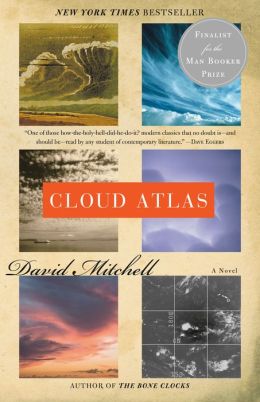
Cloud Atlas

Original image at barnesandnoble.com
Title: Cloud Atlas
Author: David Mitchell
Year: 2004
Genre: Science fiction/short stories
Rating: 1

Articles of life that we barely understand are sometimes the most beautiful. Those great mysteries that we realize can never be solved attract us over and over throughout our lives, preying on the backs of our minds, nagging, wondering. How is it that we cannot put them out of our minds? We know they have no answers, and never did, but some little part of human nature says that we cannot help ourselves. It’s better to wonder and never know than to be forever incurious.
Cloud Atlas is that balance of curiosity and answer, like echoes down a long canyon, leaving us to wonder if there really is a source at the other end. Woven artfully through difficulty and oppression, all of the characters of the book are victims of some heinous thing, but all heroes by their own spirit. Even if their stories end ingloriously, the meaning still stands, and that fact is the whole point.
            Summarizing David Mitchell’s abstract work is a bit like trying to make a Da Vinci out of cat’s cradle. So many different pieces pull against one another and seem separate, but are still knots on the same rope. We follow, more or less, a stream of consciousness on its path through six different lives, watching and guessing how they impact and change one another through the upheavals of time. From earthy, grounded Adam Ewing on the Pacific in the late 19th century to an unspecified, post-Apocalyptic Hawaii, Mitchell leads us along his twisted storyline of broken lives, and we wonder what anything means for the first 300 pages. And then, like a ball that’s made its weary way to the top of the hill, we slowly unwind to the bottom in a rush of emotions and revelations that both end our wondering and launch it into a new stratosphere.
            Mitchell is not only a literary master, but also clearly an outright genius. The organization and ingenuity it took to engineer the crisscrossing, complex, interlocked lives chronicled in Cloud Atlas would make the average novelist dizzy, let alone the invention of the unique structure. Formatted like a series of short stories, we are cut off at crucial moments and left to wonder for unnervingly long page numbers. For instance, we part ways with Adam Ewing after 39 pages and don’t meet him again until 475. If Mitchell were an average writer, we would hardly care for any of his characters by the time we see them again, but thankfully, he is not.
            Mitchell is renowned on both sides of the pond for his vivid imagery and evocative characterization, much stemming from this novel. With remarkably few lines, he attaches us so firmly to a person that never existed and never could (e.g. clone Sonmi-451, an artificially grown human that becomes sentient).
            Another feat of writing is the center segment, “Sloosha’s Crossin’ and Everythin’ After.” Written in a pidgin English style that evokes Brer Rabbit, Mitchell flexes his imaginative and technical muscles, detailing a world completely foreign to us in language difficult for us to understand. Somehow, it comes out clear and endearing, and that alone earns him a star.
            Another star comes for the sheer beauty of the ending. Many modern authors have lost the ability to move their readers by the sheer beauty of their prose, but Mitchell clearly feels deeply about the written word and the power it can bestow. He uses the last, poignant moment to reflect on what it is we are, summarizing the novel in one way and in another dispersing it.
            In essence, Cloud Atlas tells the story of what we mean to one another. Just as there is no way to accurately summarize a life, there is no way to summarize them all. We study, we learn, we pull meaning out of the past and apply it to the present, but each second creating a past that will only be changed in the future. The truth of history is what we make of it; the truth of the human experience is what we are.
            Mitchell delivers us this observation in an airy package full of printed sounds, black and white colors, and souls wrapped in words.  Something undefined fills the karma that he implies—that no matter if we live alone, feel alone, and die alone, as long as we are alive, we are never truly alone.
            Cloud Atlas is available on the Kindle for $11.99, or in paperback from Amazon for $12.98. This is not your average light weekend reading, nor is it pure entertainment—no, this book requires your attention and consideration as the pages turn. It was recently made into a film starring Tom Hanks and Halle Berry, and I have not seen it yet, but I cannot fathom how the screenplay runs. I’ll have to watch it just for pure curiosity as to how it flows.

Wednesday, January 16, 2013

The Dark Lord of Derkholm

Original image at Wikipedia.org
Title: The Dark Lord of Derkholm
Author: Diana Wynne Jones
Year: 1998
Genre: Fantasy
Rating: 1

Everyone has one of those silly books that they're incredibly attached to. Something about it just stirs your heart, and even if the language is simple and the concepts basic, you laugh every time and read it again and again. For many people, these books are those like the Harry Potter series; for others, it's The Enchanted Wood.
The Dark Lord of Derkholm is mine. And it's not because I read it when I was very young; in fact, I picked it up off a neglected bottom shelf at my small town library when I was 15 because it happened to be next to Howl's Moving Castle, which I was reading in preparation for the animated film. Something about it snagged my attention, and I proceeded to read it twice before I had to return it. I ordered my own weatherbeaten paperback and have read it at least twice a year since.
Diana Wynne Jones, who has a knack for bringing a sense of humor to the genre of fantasy, has created a world with charm, wonder, and intrigue. Derk, a homely wizard who creates unique animals (e.g. daylight owls, pigs that fly, and intelligent griffins) finds himself pegged to play the role of the Dark Lord for the Pilgrim Parties, tours that annually come through Derk's world and make a proper mess of everything. Derk and his people are contractually bound to play along, pretending that their fairly well-developed world is a medieval waste living in fear of the Sauron-like Dark Lord, and the Pilgrim Parties each think that their role in their tour is to kill him and liberate the world. However, as Derk scrambles to put his life aside to perform the role, other wizards work behind the scenes to end the Pilgrim Parties forever.
We meet dozens of hilarious, colorful characters, such as Derk's family, which is composed of his wife, son, and daughter, and five griffins he has mixed with human cells "to make them people," as one of them explains. Each one behaves just like a peevish human teenager, and Derk's relationship with each of them is heartfelt. By the end of the story, we've nearly forgotten that they're griffins. Jones also presents ordinary domestic stresses to the story, weaving them neatly in with the magic of the world, creating a believable family with believable problems.
Oftentimes, fantasy writers are so caught up with creating their worlds and developing the science, characters, and plot, they lose their voices as storytellers and become mere documentarians. Jones skilfully paints her world with so many joyful details, kingdoms, and stories that we are dazzled from the beginning; add her dry, subtle sense of humor, and you have a masterpiece. She masterfully satirizes the fantasy genre while adding an unforgettable piece to it.
Derk is, of course, the man around which the entire novel whirls, but Jones easily transports us to and fro across the world to catch up the most important pieces of the story without losing us along the way. Communicating stress in a novel can be a dangerous thing (you don't want your readers to become too stressed themselves to keep reading) but Jones does it playfully, yet strongly enough to induce her audience to pitying our favorite wizard. Derk is just a harassed, unfortunate man, and yet a symbol of strength and steadfastness; just what a father should be. And yet, everything goes wrong.
Jones's main point in the story is to remind us how very little we are in control once we give ourselves away. Sometimes, giving up control can be a good thing, like submitting to those we love; however, sometimes it can be so easy to just give in to those who want control, and for the sake of those we love, we cannot stop watching for what is best for our world. The end does not justify the means; collateral damage is necessary, but people's feelings must always be considered.
Maybe this novel doesn't change the earth, but it worms its way into your heart, never to be forgotten. With lighthearted love for that world, readers of every age can enjoy The Dark Lord of Derkholm and its manifold virtues. At any rate, it's worlds better than your average R.A. Salvatore novel. All of Diana Wynne Jones's novels satirize fantasy, but this one does it best.
The novel has no conclusive ending, but in the mood of the story, we don't miss it. Life goes on. Its sequel, The Year of the Griffin, was published in 2010; I have yet to read it, but be sure I'll get around to it.
Because this novel is quite old now, it's available in most book stores, or on the Kindle for $6.64. Or, if you want a printed copy, it's available at Barnes and Noble in paperback for $7.99, which I recommend. Pick up one from your library if you can, but if not, it's worth the purchase. It's pretty bloodless and devoid of serious swearing, so kids can enjoy it. That is, once their parents are done with it.

Monday, January 7, 2013

Mockingjay

Original image at suzannecollinsbooks.com/
Title: Mockingjay
Author: Suzanne Collins
Year: 2010
Genre: Teen/thriller/sci-fi
Rating: 2

The end of a series is supposed to settle the readers' minds, even if it's not a happy ending. We want to see our heroes reach a resting place to nurse their wounds and work their way toward happiness after the battle is over.
But for a hyperactive, ADD plot like Mockingjay's, concluding is synonymous with death. Had Suzanne Collins not committed to a trilogy, she would have probably drawn out Katniss's story for another two books or so, and if it would have helped to pace this novel better, she would have been right to do so. As it stands, Mockingjay reads like twenty climaxes smashed together to make a jarring, heaving, ponderous plot laced with gratuitous gore and little meaning. The only thing that keeps us going is an attachment to the central characters.
At the beginning, we find Hunger Games victor Katniss Everdeen broken, bruised, and confused after her dramatic rescue from the arena and removal to the mythical District Thirteen, which resembles some kind of industrial distopia. Katniss chafes at the rigorous rules of her new home and at the expectations placed upon her to become the Mockingjay, the symbol of the rebellion now seizing Panem. For the past two years, Katniss's presence on national TV has been sparking these seeds of discontent, and now the rebels see her as an icon of hope, of defiance. All she wants to do is go back to District Twelve with Gale Hawthorne and her family, but her home has burned to the ground, her friends either dead or refugees, and Peeta Mellark in captivity in the Capitol.
Katniss, besides being faced with the decision to be the face of the revolution or not, is also faced with that omnipresent question of romance: her best friend Gale, or her fellow victor Peeta. As the violence spins more and more out of her control and she begins to question her own dedication to the cause, the world exerts more pressure on her and on her fellow soldiers, driving their war to the bitter end.
The most interesting thing that Collins does with the idea of revolution is the PR face. Katniss is by no means the great general that the rebels need to command them; she is merely the symbol that they all recognize to keep fighting, and the hard-hearted president of District Thirteen is set on using her as propaganda to propagate her war. The executives of the movement tape clip after clip of Katniss and her team to indoctrinate the people, constantly considering her behavior and how it will affect mass opinion of the war. Katniss knows this and feels ill-used, which is the most complicated emotion in all the books that Collins puts forth: are the deaths of all the people she encourages Katniss's fault?
When it comes to sheer surface entertainment, the Hunger Games series is unrivaled. Loaded with suspense and danger, Mockingjay keeps readers on the edges of their seats and guessing until the end, the plot careening down a wildly twisting path until the conclusion. And it is twisting: any sense of restraint that Collins felt about her violence is suddenly stripped away in her third installment. The first two books were graphic, but there was always a subtle hint of reluctance to kill characters that we had grown attached to. Not so here. Just like her characters, Collins seems to have driven herself to the edge and held her ground strongly enough to kill off rebels that she had written extensively about. This lends the story a feeling of reality-- revolutions are horrifyingly bloody, and many beloved people die every time. It would have been laughable had all of Katniss's allies made it through unharmed.
Oh, do the parallels of the evils of socialism continue. District Thirteen is an eerie shell of Soviet Russia, with toe-trampling rules and over-the-top punishments for tiny crimes. Freedoms are restricted to the bare minimum, and the people don't seem to mind. Only Katniss and Gale, the brave champions of freedoms, are willing to defy the rules of the overbearing society, braving the anger of the ruling powers for the general good.
However, that's the only real parallel. The surface entertainment is about all the value available in Mockingjay; Collins awkwardly skirts around any pithy topics, even if she has set up a perfect situation for them to be explored. One theme that appears over and over again is the question of what it truly means to kill another person. She repeatedly mentions this struggle in Katniss's thoughts throughout all three books, and yet after roughly 1100 pages, we still don't know what it really means. Death after death goes by, and the only one that really comes close to touching that question is Rue's death in the arena in the first book.
(On a side note, does Collins really think she's being clever with her Latin? Maybe for a monolingual society she is, but seriously, I saw the Rome parallel before I even read the book. She didn't need her whole Panem et Circenses bit. Plus, Avox is a really pathetic attempt. When the characters think 'hijack' is an archaic word, how on Earth do they know enough Latin to name various things?)
The most disappointing part of Mockingjay is the ending. With all this colorful, thrilling writing under her belt, one would think that Collins could piece together a conclusion worthy of the characters that she has spent so much time developing, but we're left with a twenty-five page slop that is like staring at grey wallpaper with grey patterns on it. Sure, she's trying to portray a fog of grief, but the writing should induce tears of sympathy, not boredom. Even the epilogue is arbitrary and pointless. The bare facts of how the story ends are sort of bittersweet and touching, but change in pace drops us like a stone into the cold water of the book being over. Something tells me that her publisher was pushing her toward a deadline and she had to crank out an ending.
Altogether, the Hunger Games tells a beautiful, terrible story, filled with characters we can believe in images we won't forget. Perhaps the meaning is meant to come from us as we read. Collins has provided us with a beautiful wilderness of story; it's up to us to make it mean something.
 Mockingjay is available on the Kindle for $5.99, or in hardback from Amazon for $9.86. Because the Hunger Games is such a book of our times, it's worth a read, but don't go in expecting deep thoughts. Consider the series a light weekend thing, but definitely don't read it to your kids. It's a little graphic even for adults.

Monday, December 31, 2012

Catching Fire

Original image at suzannecollinsbooks.com/
Title: Catching Fire
Author: Suzanne Collins
Year: 2009
Genre: Teen/thriller/popular
Rating: 2

The second installment of a trilogy is almost always the best of the three. Take for example The Two Towers, which captures the soul of the whole story, or The Empire Strikes Back of Star Wars. Because the central story doesn't have to introduce strangers into a brand new world or say goodbye, it nearly writes itself. The tension strings the two together, and the book can act like the climax of the whole.
Catching Fire, the second novel of the acclaimed Hunger Games series, acts like the first. After the choppy, rushed introduction of the first book, the second flows much more naturally and freely.
Suzanne Collins brings us back into her futuristic country of Panem, where Katniss Everdeen and Peeta Mellark have returned to their home district and prepare for their forced tour of the districts. Their relationship is forced and awkward now that the games are over and they must go back to their original, simpler lives. However, the world has changed since Katniss's explosive presence on the Hunger Games. The twelve districts are on the brink of revolution, and the remarkably revolting President Snow approaches Katniss to enlist her to defuse the rebellions steadily growing in the country.
But Katniss has other problems. And as her personal life spins out of control, so does the feeling in the country.
Collins has clearly realized that in the face of the immense popularity of The Hunger Games, she needs to refine her writing for a larger audience. The syntax of this novel is much cleaner and more mature, and the characters think in much more logical, mature manner. Peeta, who was borderline childish for large sections of the first novel, is suddenly an adult and full of much more relatable pain. Gale, who was pointless and flat, suddenly folds out like origami into something far more complicated and able to stand on his own. He remains a little cliche in places, but his interactions with the citizens of District 12 glow far more than those with Katniss.
Better yet is the unpredictability of the novel. While The Hunger Games is both somewhat predictable and even a touch corny at times, Catching Fire pitches a continuation of the story in a familiar direction with the touches of Suzanne's overall goal for the story. Katniss, Haymitch, and Peeta are pitched into a sort of dysfunctional family relationships because of their one horrid commonality-- they were forced to kill their peers for the entertainment of those around them.
And yet, despite the improvement of the entire novel, there is a hollowness, as if Collins has written the body of the story but sucked the marrow out of the bones. It has a skeleton, but the bones are empty and there's no blood in its body. She tried to make up for it with the gratuitous amount of violence, but this does not stop us from feeling a certain emptiness for a true meaning in the story. One of the themes that screams to be explored is also the most obvious: what does it mean to kill another person? What has to change inside of us to be able to face someone just like us and kill them to save our own life?
Sadly, Collins skirts these great questions for the entertainment value. Not that it is lacking-- the story is fast-paced, gripping, and tear-jerking in places. Great new characters are introduced, and the relationship between Katniss and Peeta changes into a form both more complicated and more simple. Katniss does all she can just to survive, even when that means hurting the people she thinks she might love.
The title is a double entendre and refers to the first Games, which takes about half the book to figure out. However, the scene in which she fulfills it is strikingly unforgettable; even if she is no Dickens, she has the visuals of a master.
Altogether, though, Suzanne Collins has done that thing that authors dream of: writing a sequel that improves on the original. Available for $5.99 on the Kindle or $9.87 for the hardback on Amazon, Catching Fire is worth the read for anyone, but read the original first, because otherwise confusion is inevitable.
The film is due out in September 2013, with a much larger cast (including Philip Seymour Hoffman as Plutarch Heavensbee). Look for the long line of screaming teenage girls outside the movie theatres.

Tuesday, December 25, 2012

The Hunger Games

Image credit to suzannecollinsbooks.com/
Title: The Hunger Games
Author: Suzanne Collins
Year: 2008
Genre: Sci-fi/thriller/teen
Rating: 2

Action! Danger! Tragedy! Oppression! Romance!
You couldn't ask for more on a movie poster. Perhaps, in fact, if any book could have skipped the written phase and gone straight to film, it would be The Hunger Games. Rapid-paced action and visceral imagery make this book a top-notch story, and even if the language leaves something to be desired, it hits its target crowd exceptionally well. After all, sometimes all we need is a good story, right?
Suzanne Collins is an experienced children's writer; she has written multiple episodes for 1990s TV shows like Little Bear, Oswald, and Clarissa Explains It All. She has also written a five-book series for children known as The Underland Chronicles, which are an interpretation of the classic Alice in Wonderland.
However, with The Hunger Games, she takes a step into the gritter world of teen fiction, leaving behind squeaky-clean genres for a heftier tale. The novel tells the story of 16 year-old Katniss Everdeen, a poor girl living in the 12th District of a post-apocalyptic North American country called Panem. She is content to lead a quiet, meager existence by illegally poaching off of government land to feed her family until her younger sister, Primrose, is called out to be a participant in the bloody gladitorial contest known as the Hunger Games. In desperation to save her sister's life, Katniss volunteers to take her place, sealing her fate to kill or be killed.
To make matters more complicated, a boy that Katniss owes her life to, Peeta Mellark, is named as the other participant, obliging her to kill someone that she feels indebted to. Thus, she explains, is the horror of the Games: in order to survive, you must give up all your dignity, which is the government's aim. As the book progresses, the relationship between Katniss and Peeta becomes much muddier and more complicated, and even she is not sure how she feels about the boy who saved her life, the boy she is obliged to kill.
Told in the first person, the book places the readers firmly inside Katniss's mind. We hear her thoughts, her gut reactions to things, and see the grossly unfair world of Panem as she sees it. Grammar fanatics will squirm and squawk as they read turns of phrase (think high school language, written down) and the truncated fragments of thoughts are jarring, but the argument stands that they do place you into the mind of a coarse teenager.
Collins has created a marvelously dark, creative world replete with extensive details and logical, ordinary, yet beautiful characters. Although some of the people we meet are rather two-dimensional (Prim and Effie are exceptionally flat, and Cato runs a close third) Katniss and Peeta are fully fleshed out, and blend together beautifully. As time progresses, we understand more of the darkness and complete victory that the Games are to the Capitol, dehumanizing their victims and their audience in one blow.
The story is a thinly veiled allegory for the evils of socialism, what with the rigid rule controls on each district's product and the omnipotence and omniscience of the government. Katniss and Peeta represent the young capitalists defying the shackles of governmental regulation, shaking off the social expectations of submission and fear. Collins has essentially created a effective propaganda piece for republicanism with a action-packed, fast-paced, driven plot filled with believable people and graphic imagery.
The target audience is most definitely teenagers and young adults. The language is easy and flows much like an average American talks, and there are few moments without some sort of action or plot-centric exchange. Collins draws in a female audience with the sweet, innocent romance between Peeta and Katniss and the male audience with the sheer horror of the Games that she describes. (Cato's death is particularly horrifying, and will shock anyone with a visual imagination.) Intuitively weaving all of her different articles together to create one enormous, lumpy tapestry, Collins introduces us to a plot that we can love and remember, cheer and grieve for, and step easily into with the tightly-woven words she has written.
Because it is told in first person, the book stays with Katniss nearly every waking moment for a few weeks, but at just over 300 pages is surprisingly short. While that style necessitates some dull moments, some of the scenes are exceptionally poignant, such as the reaping (where the participants, known as "tributes," are named) when Katniss throws herself forward to save her sister. Rife with passionate language and the impulsive nature of the action, we are gripped throughout the telling and tied tightly to the brave girl as she sacrifices herself for love of family. Because it is told in the present tense, the readers experience the events in hypothetical "real time," which places us even more inside the mind of Katniss, lending us her emotions and distractions. Perhaps it is because we nearly become her, but our heroine is one of the most complete characters in popular literature.
The film, starring Jennifer Lawrence as Katniss and Josh Hutcherson as Peeta, came out in March 2012 and drew an enormous audience for its extended run. Catching Fire, the next film, is expected in September 2013.
The Hunger Games is available for a meager $5.00 on the Kindle (it's free if you join Amazon Prime), or $10.89 in hardback. The entire trilogy, which includes Catching Fire and Mockingjay, is available for $18.99 on the Kindle or $29.50 in hardback. Because of the popularity and timeliness of these books, they are probably taken out of most libraries most of the time; if you can't borrow them, they're worth the purchase. Mine were given to me by some wonderful people as a Christmas gift, and I profusely thank them. It's taken me a really long time to jump on the bandwagon.
Merry Christmas, everyone! Hope you got or gave at least one book today. Enjoy your break and keep reading!

Friday, December 14, 2012

A Reenchanted World

Original image at jameswilliamgibson.com
Title: A Reenchanted World: The Quest for a New Kinship With Nature
Author: James William Gibson
Year: 2009
Genre: Non-fiction/environmental/sociology
Rating: 3

Tree-huggers have a negative connotation in today's culture. Somehow, they've acquired this stereotype of long-haired, smelly, poor, bleeding-heart liberals, and we look down on them as a handicap to progress. They strap themselves to bulldozers for the sake of a few trees, and that's ridiculous, right? Why defend a few trees?
It's more than the trees. It's a kinship with nature itself, according to James William Gibson's book A Reenchanted World. With detailed journalism and observations on sociology, Gibson explores the modern yearning for a connection with nature amidst the expanding suburban world of chain-link fences and asphalt. While he does address the whole world, he mostly focuses on America, which deserves all the discussion it gets.
The book begins with the story of John Quigley, who received national attention for his two-month-long tree-sit in California in 2002. The local developers wanted to tear down the tree in order to expand a road into a subdivision, and the local environmentalists howled in protest. Quigley climbed into the tree and refused to move, much to the chagrin of the developers, and was supported by other environmentalists in the LA area. "Old Glory," as he named the tree, remained standing.
This fierce love for nature is not new to the world, but it's new to us, according to Gibson. For nearly 200 years, Americans have been recklessly and aggressively taking hold of the New World, blazing fields and drilling oil rigs in the name of progress, and the victims have been endangered species, our natural environment, and the climate. Odd, considering that the Native Americans are some of the most naturally-connected people on the planet, and it is from this that Gibson draws his beginning.
Native Americans believe in the spirituality of nature, and the environmental movement in the 1960s and 70s stemmed mostly from a revival in tribal traditions amongst Native American chieftains. As we know, it spread quickly through the youth because of the anti-war sentiments at the time, taking the world in great strides with movements like "flower power" and Greenpeace. Yet, despite all the positive effects that a more natural environment has been proven to have, these hippies have been blacklisted by modern society as radical, liberal, and dangerous.
Gibson takes this movement in hand and explains the desire for a connection with nature in both scientific and spiritual terms. The very title refers to attaching a holiness to the natural world, which seems ridiculous to us. But if you look at it, we do anyway. Gibson's primary example is our reverence for whales. People come from around the world to the great oceans to take a cruise liner out into the middle of the sea just to see whales surface for a moment, and it changes them. This doesn't just apply to biologists or whale experts; ordinary people have been reduced to tears by simply watching a whale surface out of the water for a moment, blow water at them, and disappear majestically once more. Any whale stranded on a beach makes national news as hundreds of people rush to its rescue, and there was recently a film entitled Big Miracle based on the true story of the drastic attempts to rescue a whale family marooned in the ice. Shamoo, the performing whale at SeaWorld, is more famous than many humans.
Gibson's point is not that we are coming back to nature worship, or that people will soon revert to worshiping ants or grass. No, instead, he outlines the reasons that we are still attached deeply to our world, and that environmentalism is merely an expression of the love and responsibility that we must bear for our planet.
This book was remarkably similar in topic to The World Without Us, which I reviewed earlier this year. However, Gibson doesn't have Weisman's writing charisma, and A Reenchanted World reads like a scientific article. The facts and points are well laid-out, the theme is relevant, and the ideas that he shares are true and thought-provoking, but it still feels dry. Scattered with words like "dispensationalism" and "counterculture," Gibson might have reached a wider audience by simplifying his ideas into layman's terms.
Addressing environmentalism's place in politics is necessary for any ecology book, but because of the stiff relations between the two, the discussion can become awkward. Gibson devotes two chapters for politics and religion, and while they make excellent points, they both feel a bit like rants against the right wing and conservatism. Although the men he refers to are radicals and usually known as such, he does not address the moderate right wing, nor the average American view of environmentalism, which leaves a big gap in our ideology. It is easy to pick out the red threads in the weave, but all the ones that blend together make the big picture and are equally important.
Altogether, this book makes an important contribution to the picture of today's environmentalism: it's not just a sense of misplaced duty, but a pure connection to the world that motivates us to save it. Rife with excellent examples and pithy quotes, Gibson has provided us with a guidebook for why we love nature and how to responsibly go about conserving it as long as we can. There are more details about the book on his website.
The book is only two years old, so it's available for $9.99 from the Kindle store or $10.80 in hardback from Amazon. The library might have a copy, so check there first, but do read this. Even if you're not an environmentalist, it can't hurt to understand what drives them, and it might help to make you understand our world and its people a little better.

Monday, December 10, 2012

We, the Drowned

Original image from stevementz.com.
Title: We, the Drowned
Author: Carsten Jensen
Year: 2010 (English)
Genre: Historical, exploration
Rating: 1

What do we base our identities on? Does the shape of the whole define the shape of each individual, or the other way round? Perhaps both.
W.B. Yeats once wrote, 
              The finished man among his enemies? 
                    How in the name of heaven can he escape
        that defiling and disfigured shape
 the mirror of malicious eyes 
          casts upon his his eyes until at last 
                 he thinks that shape must be his shape?
                            And how in the name of heaven can he escape
            if honor find him in a wintry blast? 
--A Dialogue of Self and Soul
  Carsten Jensen's seafaring novel We, the Drowned not only explores the ending days of sailing ships and the Danish world, but also delves into the heart of those questions that purse us every time that something ends. Where do we go from here? What am I without it? 
Told from the perspective of no particular character, only the we of the town, the novel tells the story of a Danish seafaring town called Marstal off the northeastern coast of Denmark. For generations, men and their sons and their grandsons have gone to school until confirmation, then taken to the decks of ships to sail around the world, only returning once every two years or so. Those left behind, the mothers and children and parents, wonder if they will ever see their sons again, but have to learn to live around it-- Marstal is a seafaring town. The men take pride in it, and don't care if they drown. To them, that's just collateral damage in their line of work.
The book tells the story of Marstal from 1848 until the end of World War II, sharing the lives and adventures of several people along the way, but never from their perspective. It is always the townspeople sharing the story from the outside, as if they were reading diary entries or sharing the tales over beer in a pub. We begin with Laurids Madsen, the heart of Marstal seafaring, a man who trusted nothing save his own skills and his sea boots. He disappears into the South Pacific, and fifteen years later, his abandoned son Albert goes looking for him to give his family some closure. We trace Albert's life from beginning to end, and we meet Knud Erik, a boy who was denied the sea by his mother, and wanted the adventure with his whole heart. Dozens of other names float by, like acquaintances we only knew a little, living their lives and passing away as time goes by.
The first chapter is a bid muddled, as you are walking in on a complex world that you know very little of, but everything soon falls into place. The crew is the "we" in this case, and they tell the stories of the legendary Laurids Madsen, like a hero that they all knew, who did nothing more than survive. That is the legacy of Marstal-- those who survive are the heroes.
The greatest majority of the book, though, involves Albert. After becoming a hero for sailing the South Pacific and returning with tales of cannibals and shrunken heads, Albert watches his friends die and his town grow old, and he can do nothing to stop it. He watches his own life drift idly by after he comes ashore, constantly longing for the danger of the sea, and conflicted by his own desire. After all, who is he without the sea? He is a sailor, and if he no longer sails, he's drifting.
Knud Erik, too, is an vividly living character, full of latent desire, suppression, and longing, pursued by his own dreams. He was shaped from a young age to love the sea and sailing, and once he reaches it, it's so different than his expectations that he's not sure what to do. His whole life has been about sailing, and when his desires change as he ages, he falls stagnant, trapped by his achievement.
Jensen is brilliant. Even though We, the Drowned has been translated from the Danish, it reads smoothly and beautifully in English, even the idioms and quotes falling into place. He clearly has a passion for this town and its history, and as he grew up there, he understands the dreams of the people and the things lost. Marstal comes to life in its biography, fraught with danger and very real characters.
The novel is gritty, dark, and gruesome where it needs to be, but no more so than necessary to be real. Many times adventure novels become romanticized, and while this book has its fictional elements, the core of it is so deeply human and real that even the words of the characters come to life. Every Marstaller walks the streets, warm with the blood of their ancestors that we knew, full of the dreams that they know will never come true.
The core is all about identity. We all know that nothing lasts forever, even if we hope it will, and life is all about learning to say goodbye and change ourselves. Marstal faces the extinction of its way of life, and even though the men are the greatest sailors in the world, they cannot stop the end of the sailing ship as they had known it for centuries. Laurids' identity is in his thirst for adventure, and it ruins him; Albert's identity is in his skill and experience as a sailor, and once he retires, he is forced to change himself. Knud Erik's identity is in his dreams and ambitions as a sailor and defiance of his mother. There is a drawing point where each man must face failure or change, and some do, but some fade away.
The second chapter is the most strikingly poignant. We are placed amongst the schoolboys of Marstal, tortured by Isager, the abusive schoolteacher. He teaches them to accept pointless abuse, because that is what they will get aboard ships their whole lives, and the readers recoil against it. And rightly so-- it is horrific, but real. In the middle of the chapter, the boys have a quiet moment, and they say poignantly,  "We committed appalling acts and only realized the horror of what we'd done when we stood gathered around the evidence of our atrocity. Violence was like a drug that we couldn't relinquish. He planted a thirst for blood in us. One that could never be quenched."
In addition to the brilliant main characters, every side character is unique and colorful. Jensen has painted a full picture of a town, leaving no one out and nothing corrected. For example, Lorentz, a contemporary of Albert, is constantly seeking acceptance and only learns to accept himself by years of rejection. Another striking character that is nearly impossible to sort out is Herman, a darkly suspicious man who does what he will, but he is still a Marstaller and therefore "one of us."
At 678 pages, We, the Drowned is a hefty novel, but it wastes no time on unnecessary moments. Capturing the very real parts of life is the challenge to the novelist, but Jensen has done it so poignantly that his work will survive amidst names like Moby Dick, The Old Man and the Sea, and The Odyssey.
Available for just $9.32 from the Kindle store, We, the Drowned is one of the best books I've ever read. I have a deep fondness in my bones for seafaring novels (stemming from a childhood copy of Carry On, Mr. Bowditch) but this one goes even deeper. Because of its raw emotion and beauty, this novel will live forever in the hearts of those who quest for adventure and identity. We all want to know who we are, and we belong to each other just as much as everyone belongs to us.